
Table of Contents
- 1. Start with one clearly identified color standard
- 2. Confirm the actual fabric and finishing route
- 3. Review the lab dip under controlled conditions
- 4. Give comments that the dyeing team can use
- 5. A lab dip is not a guarantee of the bulk shade
- 6. Compare bulk production with the approved reference
- 7. Define what happens when bulk is outside the target
- 8. Separate shade approval from colorfastness approval
- 9. A practical approval record
- 10. Final takeaway
A lab dip may match the target color beautifully and the finished bulk fabric may still look different. That does not always mean the dyeing was careless. The lab sample and the production lot are made at different scales, and activewear fabrics add further variables: stretch, knit density, heat setting, brushing, surface sheen and even the color worn underneath.
Good color control therefore depends on more than approving a small swatch. The buyer and supplier need one traceable standard, agreed viewing conditions and a clear route from laboratory development to bulk shipment.
Start with one clearly identified color standard
“Match this blue” is not a workable production instruction unless everyone is looking at the same reference.
The starting standard may be:
- a physical fabric cutting;
- a recognized color-system reference;
- an approved garment or trim;
- a previously approved lab dip.
Record the reference name or code, fabric article, color name, date and revision. If a physical swatch is used, protect it from sunlight, moisture, dust and repeated handling. An old cutting that has faded or become soiled should not remain the master standard.
The buyer should also state what must match. A color chip and a knitted fabric do not reflect light in the same way. If the commercial requirement is to coordinate a top, legging and rib trim, the decision may be a visual harmony standard rather than an impossible demand that different materials appear identical from every angle.
Confirm the actual fabric and finishing route
A lab dip should be developed on the intended substrate wherever possible. The same dye recipe can appear different on polyester, nylon and blended fabrics. Yarn type, optical brightness, knit construction and elastane content may also change the result.
For activewear, confirm:
- fabric article and fiber composition;
- greige source or relevant lot information;
- face and reverse;
- intended dyeing route;
- heat setting and other finishing;
- brushing, sueding or softening, where applicable;
- whether the shade is reviewed relaxed or at a defined extension.
This matters because finishing can change surface reflection and perceived depth. A brushed fabric may look softer and less saturated than a smooth fabric dyed to a similar instrumental reading. A dark elastic knit may also become visibly lighter when stretched.
Review the lab dip under controlled conditions
Suppliers often submit several lab-dip options so the buyer can select the closest direction. Review each submission against the same master standard rather than comparing the options only with one another.
A useful review includes:
- placing the standard and sample in the same orientation;
- identifying the fabric face and pile direction;
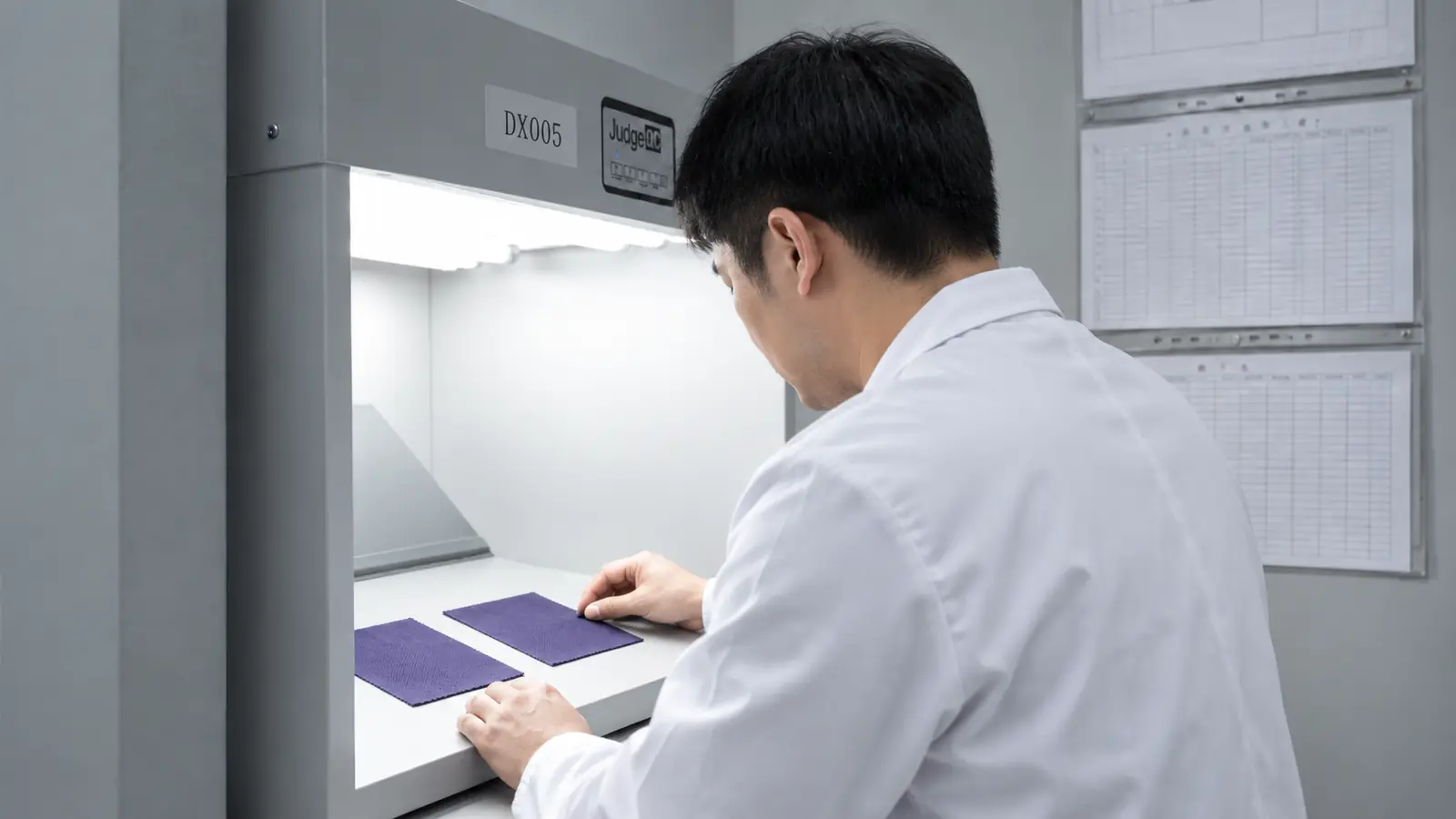
- viewing them in an agreed light cabinet or controlled area;
- checking the agreed light sources for metamerism;
- comparing hue, depth and brightness;
- recording comments against the sample reference.
Avoid making the final decision beside a window, under mixed office lighting or from phone photographs. Cameras, screens and automatic white balance can change color substantially.
Instrumental readings can support the decision, but they do not replace visual assessment. ISO 105-J01 sets out general principles for measuring textile surface color, while AATCC EP9 addresses visual assessment of textile color difference. The appropriate procedure, illuminants, measurement settings and acceptance limits should be agreed for the program rather than copied from an unrelated product.
Give comments that the dyeing team can use
Comments such as “not right” or “make it better” create another round without giving the laboratory a clear direction.
Use short, comparative language:
- slightly darker or lighter;
- redder or greener;
- bluer or yellower;
- brighter or duller;
- acceptable under one light source but not another.
Approve one clearly labeled option. If the approval includes a minor correction for bulk, state it precisely and keep both the approved dip and the written comment. Avoid combining parts of several options into a vague instruction.
A lab dip is not a guarantee of the bulk shade
Laboratory dyeing uses a small sample and controlled equipment. Bulk production introduces a larger liquor volume, production machinery, fabric loading, circulation, temperature control and finishing conditions. Small differences can affect the finished shade.
The approved lab dip should therefore serve as the production target, not as proof that every roll is already approved.
Before bulk dyeing, freeze the relevant variables as far as practical:
- approved color standard and lab-dip reference;
- fabric article and revision;
- dyeing and finishing route;
- target width and weight range;
- surface treatment;
- agreed viewing and measurement conditions.
If the fabric construction or finishing route changes after approval, review the color again. Using an approval from another article simply because the fiber percentages are similar is risky.
Compare bulk production with the approved reference
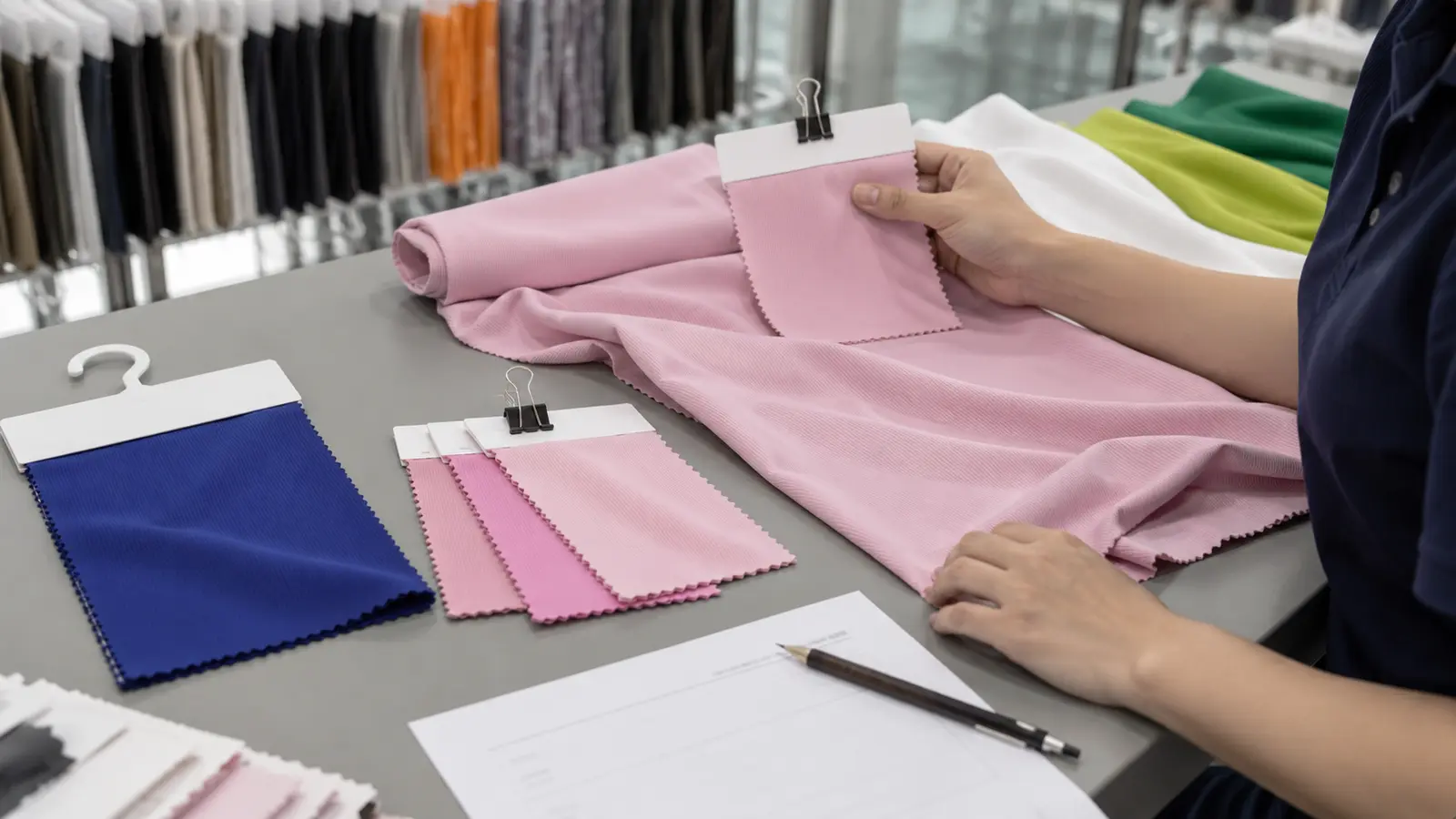
Bulk shade approval should use a finished production cutting representative of the lot. Compare it with the approved standard under the same viewing conditions used for the lab dip.
For activewear fabric, review more than a small flat square:
- face and reverse appearance;
- color in relaxed and relevant stretched conditions;
- shade across the usable width;
- beginning, middle and end of the batch where required;
- roll-to-roll consistency;
- brushed or directional surfaces in the same orientation;
- coordination with trims, linings or companion fabrics.
The approval record should identify the production lot and the sample retained. A labeled bulk cutting is more useful for future repeat orders than an email saying only “bulk approved.”
Define what happens when bulk is outside the target
Not every visible difference has the same commercial effect. A slight shift may be acceptable for a standalone garment but unsuitable when multiple panels, trims or repeat deliveries must coordinate.
Before production, agree how borderline lots will be handled. Options may include:
- approval as submitted;
- conditional approval for a specific order;
- segregation by shade band;
- reprocessing where technically appropriate;
- rejection and remake.
Do not rely on an unspecified “standard tolerance.” Color-difference formulas, commercial limits and visual expectations vary by brand, material, shade and end use. A numerical result should be interpreted using the agreed method and viewing conditions, alongside the actual appearance of the fabric.
Separate shade approval from colorfastness approval
A fabric can match the approved shade and still perform poorly during wear or laundering. Shade approval asks whether the produced color matches the target. Colorfastness testing asks how well that color resists washing, perspiration, rubbing, light or other exposure.
Deep shades, high-contrast garments and next-to-skin activewear may need particular attention to staining and crocking. These requirements should be specified before development, then verified using the agreed methods and acceptance criteria. See our guide to activewear fabric colorfastness for the separate testing process.
A practical approval record
For every approved color, retain:
- master color standard;
- fabric article and construction;
- approved lab-dip reference;
- dyeing and finishing version;
- viewing conditions and light sources;
- visual and instrumental comments, where used;
- bulk lot identification;
- representative approved bulk cutting;
- approver and approval date.
This record reduces argument, speeds repeat orders and makes it easier to investigate a later shade difference. It also gives the garment factory a clear reference when several materials must be coordinated.
Final takeaway
Reliable activewear color control is a chain of decisions. The target must be identified, the lab dip must represent the intended fabric, the approval must be made under controlled conditions, and the finished bulk lot must be checked against the same reference.
The goal is not to eliminate every physical source of variation. It is to make variation visible, traceable and manageable before fabric reaches cutting.
For color development or bulk shade review, share the fabric article, target reference, intended finish, quantity and required approval procedure with the Cofinay technical team through our contact page.
Written by Amber, Cofinay Technical Team.
About Cofinay
With over 16 years of expertise, Cofinay is a premier manufacturer of high-end activewear fabrics, certified by global ecological standards. We specialize in engineering premium performance knits for yoga, tennis, equestrian, and golf. Backed by our self-operated vertical weaving and dyeing infrastructure, we provide complete end-to-end services to empower global activewear brands to scale.