
Table of Contents
- 1. What a pre-shipment inspection should answer
- 2. Agree the inspection rules before production
- 3. What the Four-Point System measures
- 3.1. Visual defects receive penalty points
- 3.2. Compare scores on the same area basis
- 3.3. A score cannot answer every quality question
- 4. Check the roll beyond its defect score
- 4.1. Identity and quantity
- 4.2. Finished and usable width
- 4.3. Shade and surface consistency
- 4.4. Hand feel and finished construction
- 4.5. Required performance results
- 5. A roll approval checklist for buyers
- 6. Decide what happens to nonconforming rolls
- 7. Confirm the release package before dispatch
- 8. Sources
What a pre-shipment inspection should answer
The fabric has been knitted, dyed and finished. Before the rolls leave the mill, the buyer needs to know whether they match the order—and whether the cutting room can use them as planned.
A report marked “passed” is useful only when the parties have agreed what was inspected, how defects were graded and what else must be checked. A roll may have few visible defects but the wrong shade or insufficient usable width. Another may meet the average defect limit yet contain a repeated flaw that makes cutting difficult.
For activewear fabric, shipment approval should connect three records: the approved material reference, the inspection results and the identity of the rolls being dispatched.
Agree the inspection rules before production
Do not leave acceptance criteria until the goods are ready to ship. Include the following in the order or quality agreement:
- the inspection method, edition and point-assignment option;
- the inspection coverage and any buyer or third-party sampling plan;
- limits for individual rolls and the shipment, where applicable;
- how holes, continuous faults and recurring defects will be treated;
- finished width, usable width, weight and length requirements;
- shade references, review conditions and permitted grouping;
- required physical tests and shipment documentation;
- who can release, hold or approve a concession.
ASTM D5430 describes visual fabric inspection and grading. Its published guidance notes that results can differ between point-assignment options, so purchaser and supplier should use the same option when comparing results.[1]
“Four-point inspected” is therefore a method description, not a complete purchase specification. The score limit and the consequences of exceeding it still need to be agreed.
What the Four-Point System measures
Visual defects receive penalty points
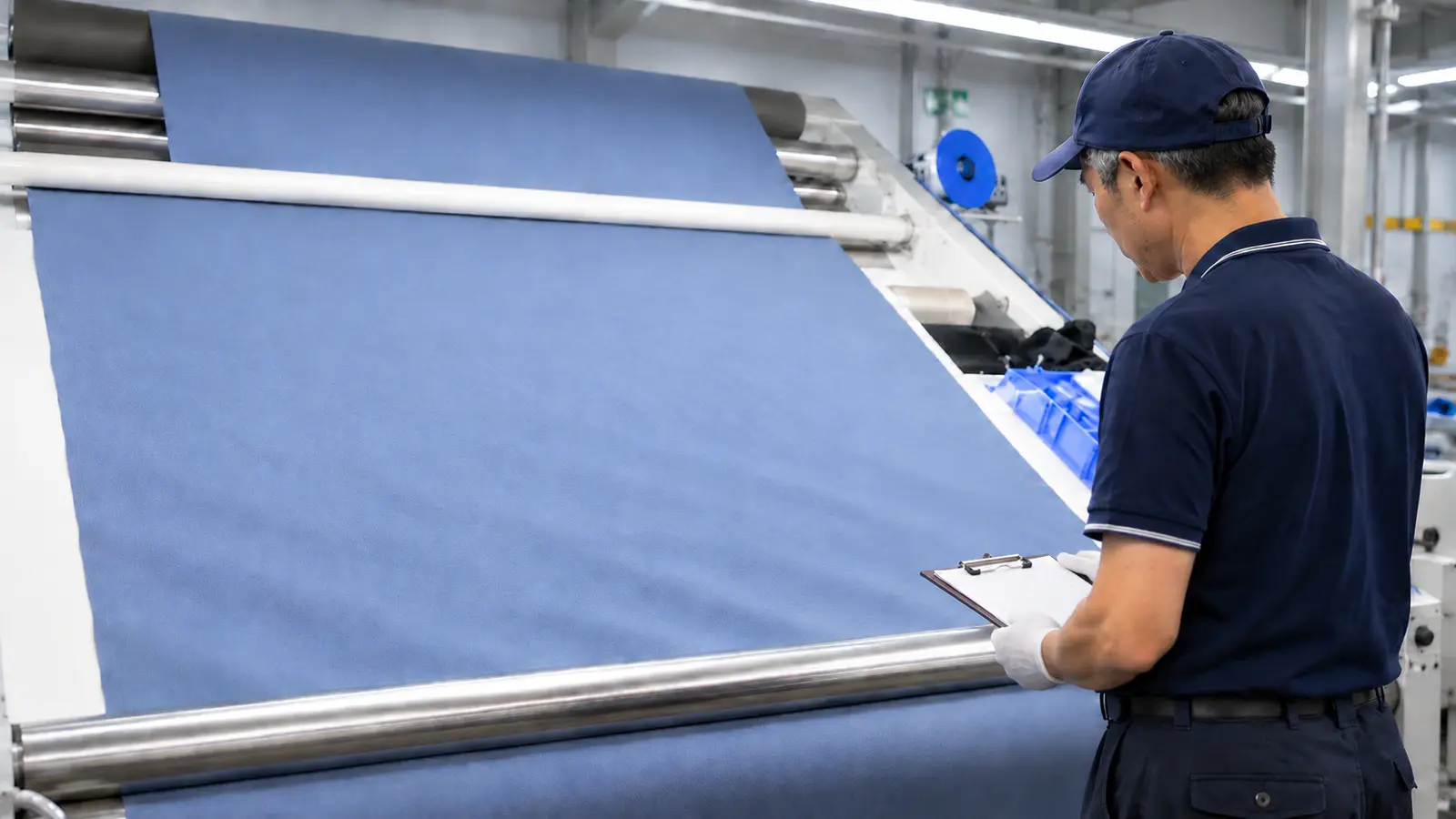
In four-point grading, visible defects are assigned penalty points according to the selected procedure. The inspector records the defects while reviewing the fabric, then calculates the score on the agreed area basis.
For activewear knits, the review may identify holes, yarn faults, dropped stitches, stains, lines, creases or other visible irregularities. Classification and scoring must follow the chosen rules rather than an improvised judgement.
Keep defect location as well as score. A cutting team needs to know where a fault occurs, not simply how many points the roll accumulated.
Compare scores on the same area basis
Raw point totals do not provide a fair comparison between rolls of different lengths or widths. Where the agreed reporting basis is points per 100 square metres, the calculation is:
Points per 100 m² = total penalty points × 100 ÷ inspected area in m².
The area is calculated from the inspected length and the width defined in the agreed procedure. Do not quietly substitute usable width for total width, or mix metric and imperial reporting bases.
For example, if the agreed inspected area is 150 m² and the roll receives 24 points, its score is 16 points per 100 m². This is a calculation example, not a Cofinay test result or a recommended acceptance limit.
A score cannot answer every quality question
Visual grading does not establish stretch recovery, shrinkage, colourfastness or moisture performance. Those properties require their own agreed assessments.
A shipment average can also conceal a poor individual roll. Review roll-level results and recurring defects before relying on the overall score. Where a fault could affect many garment panels, agree a specific decision even if the numerical total appears acceptable.
Check the roll beyond its defect score
Identity and quantity
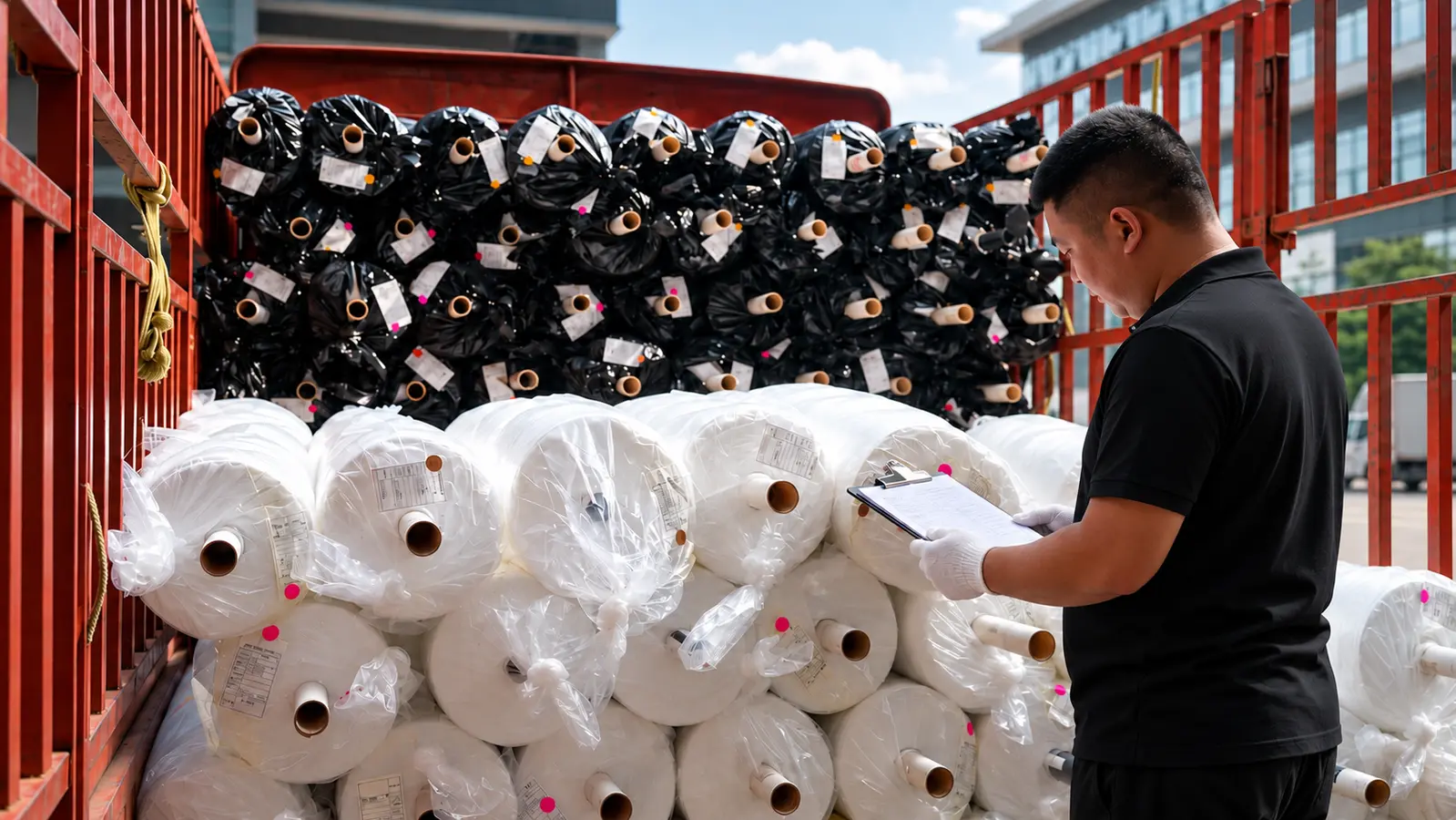
Each roll should connect to the correct article, colour, production lot and inspection record. Check the roll list against the packing list, including the declared length or weight and the unit used.
Do not treat kilograms and metres as interchangeable quantities. Conversion depends on actual fabric weight and width, and the order should define how quantity is measured and accepted.
Finished and usable width
The cutting room works with usable width. Confirm how edge areas are excluded and whether the usable width remains within the agreed tolerance along the roll.
A narrow section may affect marker efficiency even when the average width looks satisfactory. Record variation and the relevant locations instead of reporting only one convenient measurement.
Shade and surface consistency
Compare the finished fabric with the approved reference under the agreed viewing conditions. Where required, review variation along the roll, across the width and between rolls.
For brushed or directional surfaces, align the face and viewing direction. Different orientation can change appearance and complicate garment matching.
If rolls are grouped by shade, identify the groups in the roll list and obtain the buyer’s agreement. Grouping is not automatic permission to ship outside the approved shade range.
Hand feel and finished construction
Compare the supplied finish with the sealed reference. Check the required GSM and other agreed construction properties using the specified procedures.
A softer hand is not necessarily an acceptable substitution. If the finish changed during production, review whether the change affects recovery, dimensions, surface durability or the intended garment.
Required performance results
Check that reports refer to the relevant article, colour, finish or lot, as required by the test plan. A development report from another fabric should not serve as evidence for the shipment.
The necessary scope depends on the product. Fitted leggings may require particular attention to recovery, dimensional stability and coverage; a brushed studio fabric may also need surface-durability review. Keep these requirements separate from visual defect grading.
A roll approval checklist for buyers
Check | Evidence to review |
|---|---|
Correct material | Article, colour and lot linked to the approved reference |
Visual grading | Inspection coverage, selected rules, roll score and defect locations |
Dimensions | Recorded length and agreed finished or usable width |
Weight | GSM results under the agreed procedure and tolerance |
Shade | Reference comparison and any authorised shade grouping |
Surface and touch | Finish consistent with the approved physical sample |
Performance | Relevant reports for the agreed release requirements |
Quantity and packing | Roll list matches shipment quantities and labels |
Release status | Accepted, held, reworked or concession-approved rolls identified |
Decide what happens to nonconforming rolls
Keep held rolls separate from released goods. Record the issue, affected roll identities, proposed action and the person responsible for the decision.
Depending on the problem, the next step may be reinspection, reworking, replacement or a documented buyer concession. Reworking should be followed by the relevant checks; correcting shade or finish can affect other properties.
If a buyer accepts a concession, state its scope. An agreement to use one roll for a specific purpose should not become a blanket approval for the whole shipment or future orders.
Do not rely on a verbal “the cutting room can work around it.” The buyer needs enough information to judge the effect on yield, appearance and production planning.
Confirm the release package before dispatch
The final package should let the receiving team match physical rolls to the inspection decision. It normally includes the agreed roll list, packing list, inspection records and relevant test documents. Include order-specific traceability or certification documents where required, confirming their availability and timing separately.
Retain the approved reference and identified production samples according to the project agreement. If a question arises after delivery, both sides then have a basis for comparison.
Cofinay by Xiongqi Textile Technology Co., Ltd. describes inspection of finished rolls on illuminated frames using the Four-Point System, alongside laboratory checks, on its manufacturing page.[2] Buyers should confirm the applicable limits, records and release requirements for their own order rather than relying on a general quality statement.
Contact Cofinay to agree your fabric inspection and shipment requirements.
Sources
- [1] ASTM D5430: Standard Test Methods for Visually Inspecting and Grading Fabrics.
- [2] Cofinay manufacturing and quality assurance.
Written by Amber, Cofinay Technical Team.
About Cofinay
With over 16 years of expertise, Cofinay is a premier manufacturer of high-end activewear fabrics, certified by global ecological standards. We specialize in engineering premium performance knits for yoga, tennis, equestrian, and golf. Backed by our self-operated vertical weaving and dyeing infrastructure, we provide complete end-to-end services to empower global activewear brands to scale.