
Table of Contents
- 1. Start by confirming that the fabrics are comparable
- 2. Compare finished GSM—not only the quoted composition
- 3. Use usable width to calculate real material yield
- 4. Check how the MOQ is calculated
- 5. Separate development cost from bulk fabric cost
- 6. Confirm what testing is included
- 7. Compare the same commercial and delivery terms
- 8. Calculate total sourcing cost
- 9. Use a quotation comparison sheet
- 10. Compare evidence, not only promises
Two quotations may appear to describe the same activewear fabric while representing different products, approval scopes and commercial risks.
One supplier may quote a lower price per kilogram but offer a heavier fabric, narrower usable width or higher color MOQ. Another quotation may include laboratory testing, custom color development and final inspection, while the cheaper offer covers only unfinished production.
The useful question is not simply:
Which fabric has the lowest price?
It is:
Which quotation delivers the required finished fabric, in the required quantity and condition, at the most reliable total cost?
Start by confirming that the fabrics are comparable
A quotation is meaningful only when each supplier is pricing the same requirement.
Before comparing prices, align the following points:
- Fabric article or construction reference;
- Fibre composition;
- Finished GSM;
- Usable finished width;
- Knit structure;
- Surface and hand-feel requirement;
- Stretch and recovery expectations;
- Color and color-matching reference;
- Functional or surface finish;
- Required testing;
- Order quantity and number of colors;
- Packing and delivery terms.
Descriptions such as “nylon-spandex fabric,” “buttery soft” or “four-way stretch” are not complete specifications. Two fabrics with the same composition can differ in density, yarn size, usable width, recovery, coverage and finishing.
A quotation should therefore be connected to an identifiable physical swatch or clearly defined development reference.
Compare finished GSM—not only the quoted composition
GSM describes the weight of one square metre of fabric. It affects material yield and can influence coverage, drape, drying behaviour and garment weight, but it is not a quality score.
A lower-priced 230 GSM fabric should not be treated as a direct substitute for a 200 GSM fabric simply because both are listed as nylon-spandex.
Ask whether the quoted GSM refers to:
- Greige fabric or finished fabric;
- A target value or an acceptable production range;
- Conditioned laboratory measurement or an estimated figure;
- The exact color and finish being quoted.
Brushing, sanding, heat setting and other finishing processes can affect the finished weight and width. The commercial comparison should use the specification that will actually be delivered.
Use usable width to calculate real material yield
Fabric price is commonly quoted per kilogram, but garments are cut from linear metres. Usable width therefore has a direct effect on cutting yield.
The relevant figure is the width available after excluding selvedges or areas that cannot be used for cutting—not merely the machine width or total roll width.
An approximate conversion is:
Fabric weight per linear metre = GSM × usable width in metres ÷ 1,000
Fabric cost per linear metre = price per kilogram × weight per linear metre
For example:
Quotation | Price/kg | Finished GSM | Usable width | Approx. cost/metre |
|---|---|---|---|---|
Fabric A | $9.00 | 210 | 1.50 m | $2.84 |
Fabric B | $8.50 | 230 | 1.60 m | $3.13 |
Fabric B has the lower kilogram price but the higher approximate cost per linear metre.
This calculation is only an initial comparison. Actual garment cost also depends on marker efficiency, fabric direction, shrinkage allowance, defects, panel dimensions and the garment factory’s cutting plan.
Check how the MOQ is calculated
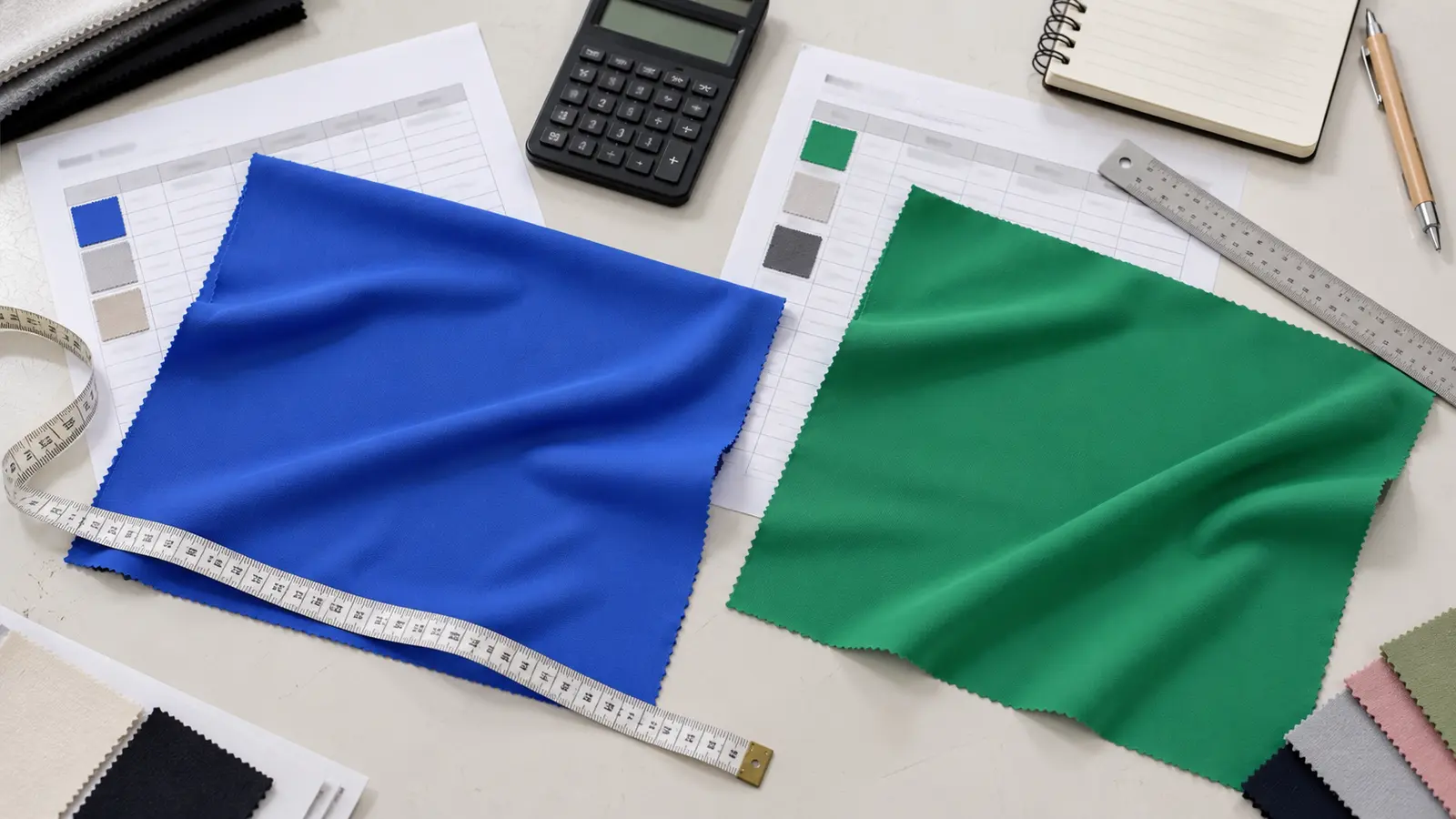
MOQ may apply per fabric article, per color, per dye lot or across the complete order. These are not equivalent.
A quotation should clarify:
- Whether the MOQ is stated in kilograms or metres;
- Whether every color must meet the minimum separately;
- Whether suitable greige fabric is already available;
- Whether specialty yarns or finishes create another minimum;
- Whether small-order surcharges apply;
- What quantity tolerance may occur during production.
A 300 kg order in one color is operationally different from 300 kg divided among six colors. Each color may require separate lab dips, dyeing, setup, inspection and records.
At Cofinay, standard custom dyeing commonly begins at 100 kg per color. For qualifying fabric qualities permanently stocked in greige form, trial orders may be considered from 50 kg per color. These are starting points rather than universal terms; the final MOQ depends on the fabric, color, finish, testing and production route.
Buyers should also compare how excess or short production quantities will be handled and invoiced.
Separate development cost from bulk fabric cost
A low bulk price may exclude work required before production can begin.
Ask whether the quotation includes or separately charges for:
- Swatches or hanger samples;
- Courier fees;
- Lab dips;
- Sample yardage;
- Custom knitting trials;
- Special yarn sourcing;
- Color matching;
- Functional or surface finishes;
- Laboratory testing;
- Certification or transaction documents;
- Revisions after the first submission.
These charges are not automatically unreasonable. The important point is that they are visible and connected to a defined approval stage.
A more expensive development route may reduce bulk risk if it confirms color, sewing behaviour, coverage, recovery and garment fit before full production.
Confirm what testing is included
“Tested fabric” is too general for quotation comparison.
The supplier should identify:
- Which properties will be tested;
- Which test methods will be used;
- Whether testing is conducted internally or by a third party;
- Which sample, color and finish the report covers;
- Whether testing occurs during development or on the bulk lot;
- Whether retesting after a material or finish change is included;
- Who pays for additional buyer-specific testing.
Depending on the garment, relevant checks may include finished GSM and width, dimensional stability, stretch and recovery, pilling, abrasion, colorfastness, bursting strength, coverage or moisture-related performance.
Not every project needs every test. A sports bra, pale yoga legging and lightweight running top carry different risks. Testing should follow the intended garment and any claims made to the market.
A report from another article, color or production lot should not be treated as proof for the quoted fabric without confirming its relevance.
Compare the same commercial and delivery terms
Prices cannot be compared fairly when they use different delivery terms.
Record the following for each quotation:
- Currency;
- Quotation validity;
- EXW, FOB, CIF or other Incoterm;
- Payment terms;
- Packing method;
- Estimated roll length and weight;
- Production lead time;
- Whether buyer approval time is excluded;
- Freight, insurance, duties and destination charges;
- Policy for claims, replacement or non-conforming material.
A quotation may appear cheaper because freight, export handling, testing or packaging is excluded. Another may carry a higher unit price but provide more complete documentation and fewer unplanned charges.
Lead time should also begin from a defined point. “Ten days” may mean ten days after deposit, lab-dip approval, greige allocation or final specification confirmation. These dates can be very different.
Calculate total sourcing cost
The total cost of a fabric order may include:
**Bulk fabric cost
- development and sample charges
- testing and documentation
- packing and freight
- duties and local handling
- expected cutting loss
- unusable or rejected material
- cost of delays, corrections or repeat production**
Some risks cannot be converted into an exact number before production, but they should still influence the decision.
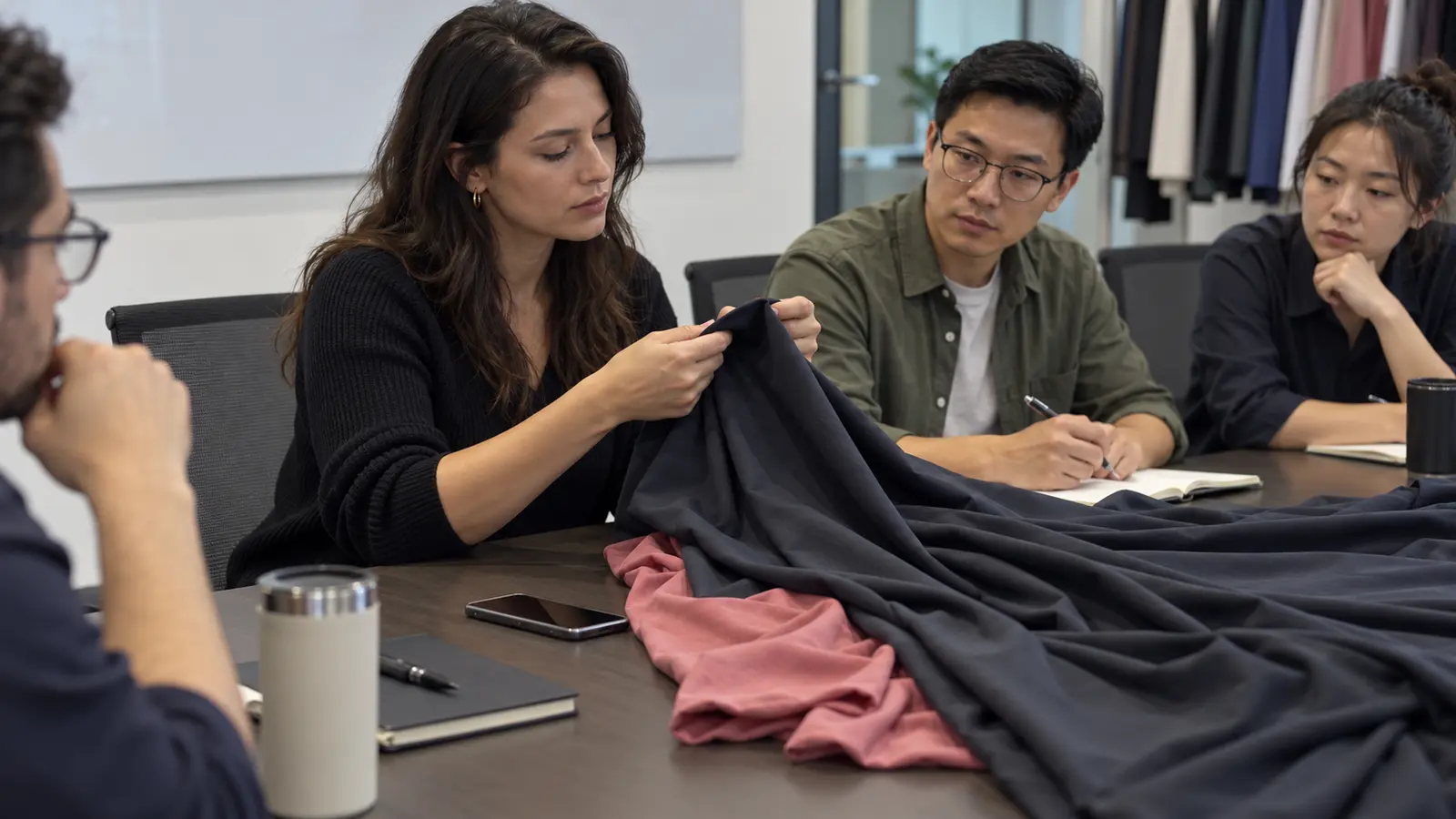
A small price saving may disappear if the delivered width is narrower than quoted, the shade requires correction, test documents are missing or the fabric cannot be repeated consistently.
Use a quotation comparison sheet
A practical comparison sheet can contain the following columns:
Comparison item | Supplier A | Supplier B | Supplier C |
|---|---|---|---|
Article and approved swatch |
|
|
|
Composition |
|
|
|
Finished GSM and tolerance |
|
|
|
Usable finished width |
|
|
|
Price and currency |
|
|
|
Approx. cost per metre |
|
|
|
MOQ per article/color |
|
|
|
Color and finish basis |
|
|
|
Included testing |
|
|
|
Development charges |
|
|
|
Lead-time starting point |
|
|
|
Trade and payment terms |
|
|
|
Certification documents |
|
|
|
Packing and freight |
|
|
|
Quantity tolerance |
|
|
|
Claim or replacement terms |
|
|
|
Do not force every difference into one score. First remove quotations that cannot meet the essential garment requirement. Then compare commercial value among the technically suitable options.
Compare evidence, not only promises
A reliable quotation should connect the offered price to:
- A labeled physical swatch;
- A finished specification;
- A defined color and finish;
- A relevant test plan;
- An identifiable MOQ and production route;
- Clear approval stages;
- Written commercial terms.
The lowest quoted figure is useful only when it purchases the fabric the brand actually needs.
Cofinay by Xiongqi Textile Technology Co., Ltd. supports buyers with physical fabric comparison, custom color development, specification review, relevant testing and bulk quality control. To receive a more accurate quotation, share the intended garment, target fabric or reference sample, finished GSM and width, color count, estimated quantity, required tests and delivery destination.
Explore the Cofinay activewear fabric collection or contact the Cofinay technical team to discuss a project-specific quotation.
Written by Amber, Cofinay Technical Team.
About Cofinay
With over 16 years of expertise, Cofinay is a premier manufacturer of high-end activewear fabrics, certified by global ecological standards. We specialize in engineering premium performance knits for yoga, tennis, equestrian, and golf. Backed by our self-operated vertical weaving and dyeing infrastructure, we provide complete end-to-end services to empower global activewear brands to scale.