
Table of Contents
- 1. Confirm What the Supplier Actually Controls
- 2. Test Whether the Supplier Can Reproduce an Approved Sample
- 3. Review the Quality System, Not Only the Test Report
- 4. Match Testing to the Garment Risk
- 5. Verify Certificates by Scope
- 6. Evaluate Communication and Change Control
- 7. Use a Small Trial to Check the Working Relationship
- 8. Watch for Practical Warning Signs
- 9. Build a Supplier Scorecard Around the Project
- 10. Choose the Supplier That Can Explain the Process
An attractive swatch can start a conversation, but it cannot prove that a supplier can reproduce the same fabric in bulk. Activewear materials combine stretch yarns, precise knitting, dyeing, heat setting and surface finishing. A change at any stage can affect shade, width, weight, recovery, hand feel or garment fit.
Supplier evaluation should therefore answer a broader question: can this company control the fabric from the approved reference to repeat production, and can it show evidence when something changes?
This guide provides a practical framework for screening an activewear fabric supplier before committing to substantial sampling or bulk orders.
Confirm What the Supplier Actually Controls
“Manufacturer,” “mill” and “factory direct” are used loosely in textile sourcing. The important issue is not the label. It is which production stages the supplier operates, which are handled by long-term partners, and who is responsible when a problem crosses process boundaries.
Ask for a simple process map covering:
- Yarn sourcing and incoming inspection;
- Knitting or greige allocation;
- Dyeing and color matching;
- Heat setting and functional or surface finishing;
- Laboratory testing;
- Final roll inspection, packing and shipment.
If some stages are subcontracted, that is not automatically a problem. The supplier should still be able to identify the facility, maintain lot traceability, communicate the agreed specification and manage corrective action. What creates risk is an unclear chain in which no one owns the final result.
For activewear, pay particular attention to knitting, dyeing and heat setting. These stages strongly influence extension, recovery, usable width, finished GSM, shrinkage and surface appearance.

Test Whether the Supplier Can Reproduce an Approved Sample
Sample quality and production reliability are different capabilities. A supplier may find one suitable swatch without having a disciplined route for repeating it.
Before bulk approval, establish a reference chain:
- Original brief or physical reference;
- Selected development swatch;
- Confirmed construction and finished specification;
- Approved lab dip or color standard;
- Sample yardage used for the garment trial;
- Tested and signed approval sample;
- Bulk shipment reference retained by both parties.
Each reference should have an article number, color, lot or sample date, and approval status. Comments such as “make it softer” or “same as last time” are too open to interpretation unless they point to a physical sample and a controlled specification.
Repeatability also matters for replenishment. Ask how the supplier manages dye-lot variation, retained samples and shade approval when a color is reordered months later. An exact visual match cannot always be assumed across separate production lots, so the acceptance method should be agreed before the repeat order begins.
Review the Quality System, Not Only the Test Report
A test report records a result for a particular sample. A quality system explains how the supplier keeps production within the agreed range.
Useful evidence includes:
- Incoming yarn or greige inspection records;
- Approved specifications with tolerances;
- Dye-lot and finishing-batch identification;
- In-process width, weight or shade checks;
- Laboratory test records linked to the relevant lot;
- Final four-point inspection reports;
- Roll numbers, packing lists and retained shipment samples;
- A procedure for handling non-conforming material.
Do not ask for every possible document on the first enquiry. Select evidence according to the order risk. A standard color in a proven fabric may require a lighter review than a new brushed construction, a pale matching set or a recycled program requiring shipment-level traceability.
The strongest answer is not “we always pass.” It is a clear explanation of what is checked, when it is checked, which standard or agreed method is used, and what happens when the result is outside tolerance.
Match Testing to the Garment Risk
A long laboratory menu does not make a supplier more suitable. Testing should reflect the garment, market and expected use.
For close-fitting activewear, buyers commonly need to consider:
- Fabric weight, usable width and dimensional stability;
- Extension, recovery and growth after repeated movement;
- Coverage in both relaxed and stretched states;
- Pilling or abrasion for high-contact areas;
- Colorfastness to washing, perspiration and rubbing;
- Surface or hand-feel stability after laundering;
- Drying or moisture-management performance where it is a real product claim.
The test method, conditioning, color, finish and sample stage should be recorded. Results from one construction or color should not be casually applied to another. Garment trials remain necessary because seams, panels, lining, pattern reduction and fit can change the wearer’s experience even when the fabric report is acceptable.
Verify Certificates by Scope
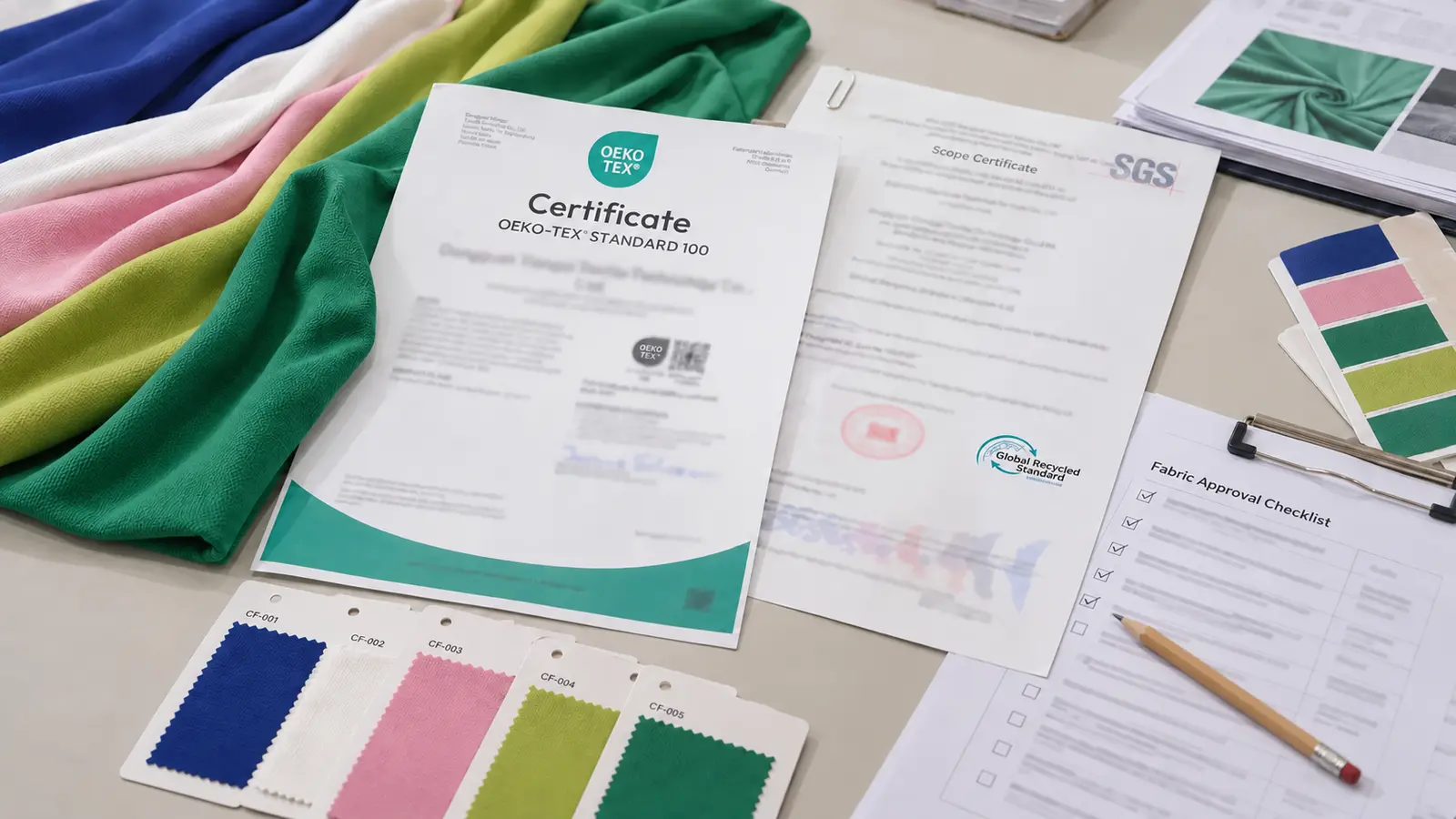
Certificates are useful only when they apply to the relevant company, facility, process and order.
Check:
- The legal company and facility named on the document;
- The issuing or certification body;
- The standard and current validity period;
- The certified product or process scope;
- Whether additional transaction or shipment documents are required.
For example, OEKO-TEX® STANDARD 100 addresses tested textile safety within the certificate’s stated scope. GRS covers certified recycled content and chain-of-custody requirements, but a general scope certificate is not the same as an order-specific Transaction Certificate. Buyers should confirm which evidence will accompany the shipment before placing a recycled-material order.
ISO management-system certificates can indicate that formal procedures exist, but they do not replace fabric-specific approval and testing. Request legible documents and verify them through the issuer or certification body where appropriate.
Evaluate Communication and Change Control
Many sourcing problems begin as communication problems. A technically capable supplier still creates risk if comments are lost, approvals are unclear or changes reach production without confirmation.
During sampling, observe whether the supplier:
- Distinguishes confirmed requirements from preferences;
- Flags conflicts between hand feel, weight, opacity, support and cost;
- Identifies which sample is being discussed;
- Records revisions rather than relying on chat history;
- Explains how a change affects price, MOQ or lead time;
- Requests written approval before replacing yarn, construction, finish or color standard;
- Gives realistic dates and reports delays early.
One practical test is to send a short garment brief and ask the supplier to return its understanding. A useful reply should identify the intended application, open technical questions, recommended next sample and information needed for a reliable quotation. A quick price without specification alignment may be less useful than a slower, more precise response.
Use a Small Trial to Check the Working Relationship
Factory photos, video calls and documents help with screening, but a controlled trial reveals how the supplier actually works.
Start with an existing or regularly produced fabric where possible. Order sample yardage or a manageable first color, then evaluate:
- Whether the delivered material matches the stated article and specification;
- Whether shade, hand feel and width are consistent across the sample;
- Whether roll and batch information is complete;
- Whether documents arrive with the material;
- How quickly questions or discrepancies are investigated;
- Whether the supplier’s explanation matches the physical evidence.
Do not create an artificially simple trial if the real program involves pale colors, brushing, recycled claims or demanding coverage. The trial should include at least one meaningful risk from the intended collection.
Watch for Practical Warning Signs
Common warning signs include:
- Reluctance to identify where key processes take place;
- Quotations missing finished GSM, width, finish or color basis;
- One certificate presented as proof for every product and order;
- Test reports that cannot be linked to the offered fabric;
- Frequent article-number changes without an explanation;
- Bulk production proposed before color, specification or sample approval;
- Performance promises without a stated method or sample condition;
- Unapproved substitutions described as “equivalent”;
- Dates that ignore lab dips, testing, corrections or buyer approval time.
One warning sign may be a documentation gap that can be corrected. Several together usually indicate weak process control.
Build a Supplier Scorecard Around the Project
Avoid choosing a supplier through one overall impression. A simple weighted scorecard makes the decision easier to explain internally.
Evaluation area | Evidence to review |
|---|---|
Product suitability | Relevant swatches, construction options, garment-risk understanding |
Manufacturing control | Process map, facility evidence, subcontracting disclosure |
Repeatability | Approved references, retained samples, lot and revision control |
Quality assurance | Inspection records, relevant tests, non-conformance process |
Compliance | Valid certificates, correct scope, order-level documentation plan |
Commercial fit | MOQ, price basis, lead time, payment and trade terms |
Communication | Clear ownership, written follow-up, realistic change management |
Weight the categories according to the product. Compliance and traceability may carry more weight for a recycled collection, while stretch recovery, shade consistency and surface durability may dominate a premium leggings program.
Choose the Supplier That Can Explain the Process
The best activewear fabric supplier is not necessarily the one with the largest sample wall or the lowest initial quotation. It is the supplier that can connect the buyer’s garment requirement to a controlled material, a traceable approval route and a repeatable production process.
Cofinay combines knitting, dyeing and finishing coordination with fabric development, laboratory evaluation and final roll inspection for activewear programs. Buyers can review physical swatches, applicable certification documents and the required testing scope before bulk production. Final specifications, commercial terms and documentation should always be confirmed for the individual order.
When evaluating any supplier, ask for evidence in proportion to the risk, run a meaningful trial and keep approvals tied to identifiable samples. That discipline is more dependable than relying on a factory claim, certificate logo or attractive first swatch alone.
Written by Amber, Cofinay Technical Team.
About Cofinay
With over 16 years of expertise, Cofinay is a premier manufacturer of high-end activewear fabrics, certified by global ecological standards. We specialize in engineering premium performance knits for yoga, tennis, equestrian, and golf. Backed by our self-operated vertical weaving and dyeing infrastructure, we provide complete end-to-end services to empower global activewear brands to scale.