
Table of Contents
- 1. What does “breathable fabric” actually mean?
- 2. What controls air permeability?
- 3. What controls water-vapour transmission?
- 4. Air permeability and WVTR are not interchangeable
- 5. Which test methods should buyers request?
- 6. Match breathability to the application
- 7. A practical sourcing brief
- 8. The takeaway
“Breathable” is one of the most common descriptions used for activewear fabric, but it is also one of the least precise.
Some buyers use breathability to mean that air can pass through the fabric. Others mean that heat and moisture vapour can escape from the space between the skin and the garment. These behaviours are connected to comfort, but they are not the same property and should not be approved with the same test.
For a useful fabric specification, the first step is to decide whether the garment needs air permeability, water-vapour transmission, or a controlled balance of both.
What does “breathable fabric” actually mean?
In everyday product language, breathability usually describes how effectively a garment reduces the build-up of heat and humidity. In technical sourcing, that broad idea needs to be separated into measurable properties.
Air permeability measures the passage of air through a fabric under a defined pressure difference. It is strongly influenced by the size, number and continuity of openings within the structure.
Water-vapour transmission measures the relative passage of moisture in vapour form through a textile. It is relevant when perspiration has already evaporated or when warm, humid air is trapped inside the garment.
A fabric can perform well in one area and modestly in the other. A visibly open mesh usually allows more airflow than a compact interlock. A close construction may still transmit moisture vapour, even when the wearer cannot feel air moving directly through it.
Neither result proves moisture-wicking or quick-dry performance. Wicking concerns liquid transport, while drying concerns the removal of retained water. These are covered separately in Cofinay’s guide to moisture-wicking and quick-dry activewear fabrics.
What controls air permeability?
Airflow is governed primarily by fabric structure rather than the fibre name printed on a specification sheet.
Important variables include:
- Knit construction: mesh, pique and engineered ventilation structures usually create more open pathways than compact jersey or interlock.
- Loop density: tighter loops and higher cover reduce the space available for air movement.
- Yarn size and filament arrangement: these affect how closely the yarns pack together.
- GSM and thickness: heavier or thicker constructions often restrict airflow, although structure can be more influential than weight alone.
- Brushing and surface fibres: raised fibres may partially obstruct openings while adding softness and warmth.
- Finishing and heat setting: dimensional changes can alter pore size and fabric density.
- Stretch during wear: extending an elastic knit can open the structure and change its permeability.
This is why an unstretched laboratory result should not be treated as a complete prediction of garment performance. A close-fitting cycling jersey, supportive sports bra and relaxed training top place the fabric under different levels of extension.
What controls water-vapour transmission?
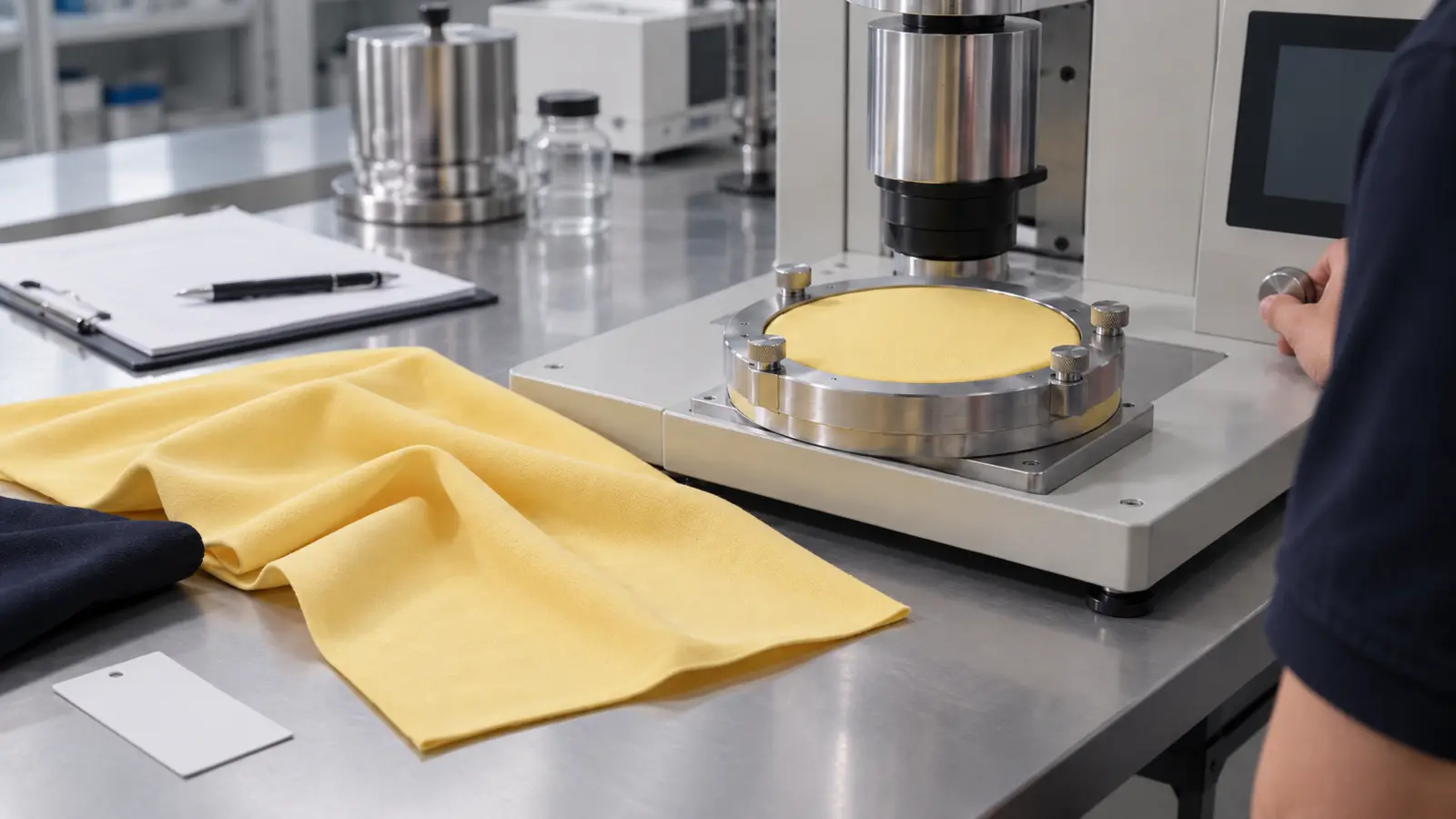
Water-vapour transfer depends on the humidity difference between the two sides of the fabric, the material’s resistance to vapour movement and the test environment.
Fabric thickness, density, surface finish and absorbed moisture can all affect the result. Laminated or coated structures require particular attention: a membrane may limit direct airflow but still be designed to allow moisture vapour to pass through. This is common in weather-protective garments where unrestricted air movement would conflict with wind resistance.
The surrounding conditions also matter. Temperature, relative humidity and air movement influence the vapour pressure driving moisture through the specimen. Results should therefore be compared only when the same method and conditions are used.
For activewear buyers, WVTR should not be reduced to a single universal “good” number. The suitable requirement depends on the garment, climate, layering system and whether the material is a single knit, brushed layer, coating or laminate.
Air permeability and WVTR are not interchangeable
Property | What passes through the fabric? | Most affected by | Typical relevance |
|---|---|---|---|
Air permeability | Air | Openings, knit density, pressure difference and stretch | Running tops, mesh panels, training wear and ventilation zones |
Water-vapour transmission | Moisture in vapour form | Humidity gradient, thickness, material resistance and finishing | Base layers, close-fitting activewear, outdoor layers and laminates |
High airflow can support cooling, but it can also reduce wind protection, coverage or thermal insulation. High vapour transmission can help manage internal humidity, but it does not show how liquid sweat spreads or how quickly a saturated fabric dries.
The correct specification is a balance. Asking for the highest possible result in every category may create a fabric that no longer meets the required opacity, support, abrasion resistance or hand feel.
Which test methods should buyers request?
Common methods include:
- ASTM D737 or ISO 9237 for air permeability of textile fabrics;
- AATCC TM204 for the relative rate of water-vapour transmission through textiles.
The report should identify the test method, units, specimen condition and relevant test settings. Air-permeability results obtained with different test areas or pressure differentials should not be compared as if they were produced under identical conditions. WVTR results are also method- and climate-dependent.
Before testing, confirm:
- the intended face and orientation of the material;
- whether the sample is relaxed or tested under extension;
- the approved colour and finishing route;
- whether testing occurs before or after laundering;
- the benchmark fabric or acceptance range;
- whether the final garment contains lining, print, bonding or multiple layers.
A fabric report can compare controlled samples. It cannot fully reproduce the microclimate created by garment fit, seam placement, body movement and changing environmental conditions.
Match breathability to the application
Application | Main comfort question | Development considerations |
|---|---|---|
Running and training tops | Can excess heat and humid air escape during high output? | Lightweight construction, airflow, wet cling, coverage and drying |
Yoga and Pilates | Does the fabric remain comfortable without losing opacity or support? | Moderate airflow, soft hand, stretch recovery and squat coverage |
Cycling | Can close-fitting zones release heat without creating excessive drag or exposure? | Zonal ventilation, extension, chafing and drying |
Sports bras | Can heat escape while the structure maintains support? | Dense support zones, mesh placement, lining and skin comfort |
Light outdoor layers | Can vapour escape while wind and light weather protection are maintained? | Airflow resistance, WVTR, layering and surface finishing |
A practical sourcing brief
Instead of requesting a “highly breathable fabric,” give the supplier a brief that includes:
- garment type, fit and activity intensity;
- target climate and layering position;
- required GSM, width, stretch, recovery and coverage;
- whether airflow or vapour transfer is the priority;
- relevant test method and agreed benchmark;
- selected colour, print, brushing, coating or lamination;
- required result after the agreed care cycles;
- any trade-off involving warmth, wind resistance or support.
Where possible, submit an existing garment or fabric that performs well. Testing a benchmark and new development under the same conditions gives both teams a more useful comparison than applying a generic number without product context.
The takeaway
Breathability is not one claim. Air permeability measures air moving through the structure; water-vapour transmission evaluates moisture vapour passing through the textile. Wicking, drying and garment ventilation add further parts to the comfort system.
For buyers, the best approach is to identify the dominant wear condition, choose the corresponding test and approve the result alongside stretch, coverage, hand feel and garment trials.
Cofinay develops high-gauge circular-knit and warp-knit activewear fabrics for yoga, Pilates, cycling, running, fitness and light outdoor applications. Buyers can explore the Cofinay fabric collection or contact the technical team with a garment brief and benchmark sample.
Written by Amber, Cofinay Technical Team.
About Cofinay
With over 16 years of expertise, Cofinay is a premier manufacturer of high-end activewear fabrics, certified by global ecological standards. We specialize in engineering premium performance knits for yoga, tennis, equestrian, and golf. Backed by our self-operated vertical weaving and dyeing infrastructure, we provide complete end-to-end services to empower global activewear brands to scale.