
Table of Contents
- 1. Why the recycled-material conversation is changing
- 2. A material claim is not the same as traceability
- 3. What verifiable chain of custody looks like
- 4. GRS and RCS: useful standards, not interchangeable shorthand
- 4.1. A standards transition begins at the end of 2026
- 5. 2026 is also changing the risk around environmental language
- 6. Better claims start with a better evidence structure
- 6.1. Match each statement to the evidence it needs
- 7. Recycled content cannot replace performance validation
- 8. A practical recycled-fabric procurement workflow
- 8.1. 1. Define the claim before choosing the material
- 8.2. 2. Put the recycled percentage into the specification
- 8.3. 3. Verify the supplier's current certification scope
- 8.4. 4. Confirm which supply-chain stages must remain certified
- 8.5. 5. Build lot identity into production records
- 8.6. 6. Check transaction-document feasibility before placing the order
- 8.7. 7. Approve performance on the actual fabric
- 8.8. 8. Release marketing language only after evidence review
- 9. Questions buyers should ask before approving recycled polyester or nylon
- 10. How Cofinay approaches recycled activewear development
- 11. The 2026 takeaway
- 12. Sources and further reading
For several years, a recycled-material story could begin and end with a fiber name. A product page might say recycled polyester, recycled nylon or simply made from recycled materials. In 2026, that language is increasingly treated as the beginning of a due-diligence process rather than its conclusion.
The questions from buyers are becoming more specific:
- What percentage of the product is recycled?
- Is the input pre-consumer or post-consumer?
- What was the original feedstock?
- Which facilities handled the material?
- Is each relevant stage covered by a valid certification scope?
- Can the supplier connect the shipped lot to an order-level transaction record?
- Does the wording used in marketing match the evidence available?
This change is not only about compliance. It reflects a more mature sourcing market. Recycled polyester and recycled nylon remain important tools for reducing dependence on virgin fossil-based inputs, but a credible material strategy now requires better records, more precise claims and the same performance discipline expected from any other activewear fabric.
Why the recycled-material conversation is changing
Recycled synthetics are growing in volume, but the wider fiber market is growing too. According to Textile Exchange's Materials Market Report 2025, global fiber production reached approximately 132 million tonnes in 2024. Polyester represented 59% of that volume, and 88% of polyester was still fossil-based.
The same report estimated that recycled polyester production increased from around 8.9 million tonnes in 2023 to 9.3 million tonnes in 2024. Its share of the polyester market nevertheless declined from 12.5% to 12%, because virgin polyester grew faster. It also found that 98% of recycled polyester was still made from plastic bottles, while less than 1% of the total global fiber market came from pre- and post-consumer recycled textiles.
Those numbers reveal two different realities. Recycled polyester is already commercially significant, but textile-to-textile circularity remains limited. A bottle-to-fiber route can reduce demand for virgin polyester, yet it should not automatically be described as closed-loop textile recycling.
Recycled nylon is a smaller and less uniform market. Feedstock may include industrial production waste, discarded fishing nets, carpets or textile waste, depending on the supplier and recycling route. The words recycled nylon do not identify which of these sources was used. They also do not tell a buyer whether the material was mechanically or chemically recycled, or whether the source was independently verified.
In practical sourcing, the fiber name is only one field in a much larger evidence set.
A material claim is not the same as traceability
Three levels of information are often combined in a single sentence, even though they answer different questions.
Level | What it establishes | What it does not establish |
|---|---|---|
Material specification | The declared fiber composition and recycled-content percentage | The origin and chain of custody of a particular shipment |
Facility certification | A site is approved to handle products within a defined certification scope | That every product or order sold by the site is certified |
Transaction evidence | A specific certified material flow is connected to a sale or shipment | Finished-product performance or a broad life-cycle benefit |
A laboratory can help confirm polymer type or composition, but fiber identification alone cannot reconstruct the material's commercial history. Conversely, a certificate cannot prove that a fabric has the stretch recovery, colorfastness, pilling resistance or dimensional stability required for its intended garment.
Credible sourcing therefore needs two parallel evidence paths:
- Chain-of-custody evidence for the recycled-content claim.
- Technical test evidence for the fabric's performance and quality.
Neither should be used as a substitute for the other.
What verifiable chain of custody looks like
Textile Exchange describes chain of custody as the system used to document and verify the path certified material takes through the supply chain. Under its current system, relevant organizations maintain certification, and commercial documents support the movement of material between stages. Its chain-of-custody guidance is designed to ensure that certified input and output claims remain connected as materials are processed and traded.
For an activewear fabric, the evidence trail may cover:
- Recycled feedstock classification — including whether the material is pre-consumer or post-consumer.
- Polymer and yarn production — connecting the recycled input to the yarn specification.
- Knitting or weaving — recording yarn lots, production quantities and fabric batch identities.
- Dyeing and finishing — maintaining product identity through wet processing and finishing.
- Sale and shipment — matching the certified product description and quantity to commercial and shipping records.
Two documents are especially easy to confuse:
- A Scope Certificate shows that an organization is certified for specified activities and product categories during a stated period.
- A Transaction Certificate, or the corresponding approved transaction record, relates to specific certified products moving through a particular commercial transaction.
Textile Exchange explains that scope certificates establish whether a company is qualified to produce or handle certified products, while transaction certificates verify specific certified products. Its standards FAQ also notes that transaction records rely on supporting documents such as purchase orders and shipping documents to evidence physical material flow. See Textile Exchange's explanation of how chain of custody is maintained and its Standards FAQs.
For buyers, the practical lesson is simple: a supplier's facility certificate is an important first check, but it is not order-level proof on its own.
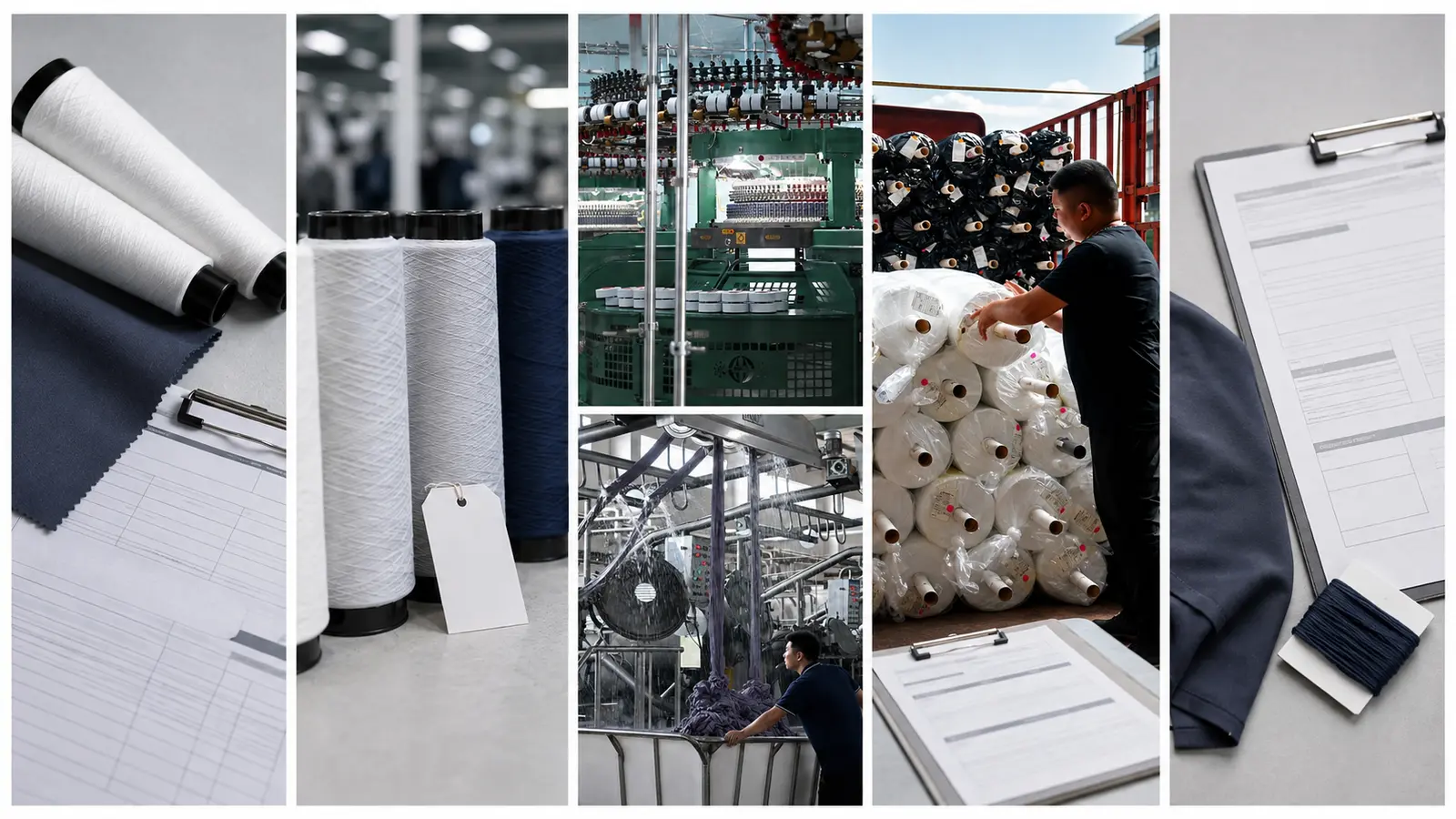
A conceptual traceability workflow illustrating material input, yarn batches, knitting and dyeing, shipment records and order documentation. Actual documentation varies by order.
GRS and RCS: useful standards, not interchangeable shorthand
The Global Recycled Standard (GRS) and Recycled Claim Standard (RCS) provide third-party frameworks for recycled materials and chain of custody. Textile Exchange states that both standards verify recycled content and support informed buying decisions. GRS also includes additional social, environmental and chemical-processing requirements.
There are important thresholds behind the familiar logos. Textile Exchange explains that GRS can function as a business-to-business certification tool for products containing at least 20% recycled content, while consumer-facing GRS labeling requires at least 50% recycled content. Claims and logo use remain subject to the applicable policy and certification status; buyers should not assume that a certified supplier can automatically apply a consumer label to every finished product. The current requirements and distinctions are summarized on Textile Exchange's RCS and GRS overview.
Certification should therefore be treated as a defined assurance system, not as a general synonym for sustainable. It verifies specified attributes within its scope. It does not, by itself, prove that one product has a lower total environmental impact than every alternative.
A standards transition begins at the end of 2026
Textile Exchange published the final Materials Matter Standard in December 2025. The organization states that the standard becomes effective on December 31, 2026, becomes mandatory for relevant Tier 4 audits from December 31, 2027, and requires all claims and labels to transition by June 30, 2029. Its existing Content Claim Standard will continue to support chain of custody and product claims.
This does not mean that GRS and RCS documentation suddenly becomes invalid during 2026. It means that brands, recyclers, primary processors and certified suppliers should understand which part of the system applies to them and prepare for the staged transition. The official timeline is available on Textile Exchange's Materials Matter Standard and standards transition pages.
2026 is also changing the risk around environmental language
In Europe, Directive (EU) 2024/825 strengthens consumer protection against misleading environmental claims and unreliable sustainability labels. EU Member States were required to adopt implementing measures by March 27, 2026, with the rules applying from September 27, 2026. The directive addresses generic environmental claims and sustainability labels that are not supported by an appropriate certification scheme or public authority. Market-specific implementation should still be reviewed with qualified legal or compliance advisers. The dates and legal text are available through EUR-Lex.
The Ecodesign for Sustainable Products Regulation, Regulation (EU) 2024/1781, also establishes the framework for Digital Product Passports. It is important not to overstate the present obligation: product-specific delegated rules will determine what data particular textile products must carry and when. In 2026, the direction is clear, but a general claim that every textile product already requires a complete DPP would be premature.
In the United States, the Federal Trade Commission's current Green Guides emphasize that environmental claims should be truthful, substantiated and qualified when necessary. Its recycled-content guidance advises marketers to state the proportion when a product is only partly made from recycled material—for example, “made with 30% recycled material”—rather than implying 100% recycled content.
Across markets, precise language is becoming safer than broad language.
Better claims start with a better evidence structure
A claim-ready product record should be assembled during development, not reconstructed after the marketing campaign has been approved. At minimum, buyers should consider recording:
- Internal fabric or product code
- Full fiber composition
- Recycled-content percentage
- Polymer type: polyester, nylon 6, nylon 6.6 or another specified material
- Pre-consumer or post-consumer classification
- Declared feedstock source, where a source-specific claim will be made
- Recycling route, if relevant and verified
- Yarn supplier and yarn lot
- Greige-fabric and dye-lot references
- Certified facility names and current scope certificates
- Purchase order, invoice, packing list and shipment references
- Applicable transaction certificate or approved transaction record
- Claim wording approved for business-to-business and consumer use
- Separate technical test reports for performance requirements
This information does not need to appear publicly in full. It needs to exist in a structured form that allows an authorized team to trace a statement back to evidence.
Match each statement to the evidence it needs
Proposed statement | Evidence to request before use |
|---|---|
“Contains recycled polyester” | Composition, recycled percentage and order-specific chain-of-custody evidence |
“Made with post-consumer recycled polyester” | Evidence that identifies the input as post-consumer, not only recycled |
“Made from recycled bottles” | Source documentation showing bottle-derived PET feedstock |
“Contains recycled nylon” | Polymer and recycled-content records tied to the shipped material |
“Made from discarded fishing nets” | Source-specific collection and chain-of-custody documentation |
“GRS certified” | Valid certification scope, eligible product and claim/label authorization |
“Textile-to-textile recycled” | Evidence that the feedstock came from textile waste rather than bottles or industrial plastic |
“Circular” | A defined circular system and supporting evidence covering more than recycled input alone |
Claims such as ocean plastic, ocean-bound plastic, closed loop, low impact or circular require evidence beyond a generic recycled-content certificate. If the source cannot be demonstrated, the wording should be narrowed.
Recycled content cannot replace performance validation
Activewear places demanding requirements on yarn and fabric. Recycled input may affect dye behavior, shade consistency, tensile properties, surface appearance or processing stability depending on feedstock quality, recycling method and yarn engineering. These effects are not automatically negative, but they must be evaluated on the actual construction being purchased.
A sourcing brief should define performance separately from recycled content. Depending on the application, relevant checks may include:
- Stretch and recovery
- Dimensional stability after laundering
- Colorfastness to washing, perspiration and rubbing
- Pilling and abrasion resistance
- Bursting or tensile strength
- Moisture management and drying behavior
- Fabric weight, width and usable yield
- Shade consistency between dye lots
A certificate supports the material claim. A test report supports the performance claim. A buyer needs both when both appear in the product story.

Illustrative review of physical fabric batches, specifications and supporting traceability documents; documentation varies by order.
A practical recycled-fabric procurement workflow
1. Define the claim before choosing the material
Decide whether the intended statement is simply contains recycled material, a percentage claim, a certification claim or a source-specific story. Each option creates a different evidence burden.
2. Put the recycled percentage into the specification
Do not rely on a collection name or a verbal description. Record the target composition and acceptable tolerance in the product specification, alongside weight, width, stretch, handfeel, color and finishing requirements.
3. Verify the supplier's current certification scope
Confirm the legal entity, facility, product category, process and validity period. A similarly named company, an expired certificate or a certificate held by another supply-chain stage should not be treated as equivalent.
4. Confirm which supply-chain stages must remain certified
Ask who supplies the yarn, who knits the fabric, who dyes and finishes it, and who invoices the final shipment. Identify any subcontracted process before production begins.
5. Build lot identity into production records
Yarn lots, knitting batches, dye lots, finished rolls and shipping quantities should remain reconcilable. Traceability becomes much harder when this information is collected only after delivery.
6. Check transaction-document feasibility before placing the order
Confirm whether the exact construction, recycled percentage, facility route, MOQ and shipment can qualify for the required transaction evidence. Also agree who will request it, when it can be issued and which company name must appear on the commercial documents.
7. Approve performance on the actual fabric
Test the sample or trial lot that reflects the proposed yarn, construction, dyeing and finishing route. Avoid transferring results from a visually similar fabric without confirming equivalence.
8. Release marketing language only after evidence review
The claim on a hangtag, product page or campaign should match the final shipped material—not an early development sample or a supplier's general capability statement.
Questions buyers should ask before approving recycled polyester or nylon
- What is the exact recycled-content percentage in the finished fabric?
- Is the recycled input pre-consumer, post-consumer or a defined blend?
- What is the original feedstock, and is that source independently documented?
- Is the fiber recycled polyester, nylon 6, nylon 6.6 or another polymer?
- Which standard covers the material and which facilities are within scope?
- Can the supplier show a current scope certificate for the relevant legal entity and process?
- Can order-level transaction evidence be issued for this construction and shipment?
- How are yarn lots, dye lots and finished rolls linked?
- Are any production stages subcontracted?
- Which consumer-facing claims and logos are permitted for the final product?
- What technical tests will be conducted on the actual bulk fabric?
- What happens if the final composition, quantity or certified route changes during production?
These questions are useful even when a brand does not plan to place a certification logo on the garment. They reveal whether the supply chain can support the product statement consistently.
How Cofinay approaches recycled activewear development
Cofinay develops recycled polyester and recycled nylon activewear fabrics according to the required composition, weight, stretch, handfeel, construction, color and finishing brief. Where an order is placed through an eligible GRS-certified route, the relevant material and shipment records are maintained so that an official Transaction Certificate can be requested through the certifying body after shipment.
The documentation route should be confirmed at the start of development because eligibility depends on the final material, recycled percentage, production path, commercial records and intended claim. Certification does not replace fabric testing, so recycled constructions are evaluated against the same application-specific performance requirements used for other activewear fabrics.
For a new program, buyers can send Cofinay a target specification, physical reference, intended garment use and required claim wording. The technical team can then align the material route and development plan before bulk production. Contact Cofinay to discuss a recycled polyester or recycled nylon project.
The 2026 takeaway
The recycled-material market is moving from broad category labels toward documented evidence. A credible claim now depends on how clearly a company can connect the words used in public with the material, facility, batch, shipment and documents behind them.
Recycled polyester and recycled nylon still offer broad possibilities for performance textiles. But the strongest sourcing programs will not treat recycled as a complete product description. They will specify the percentage, verify the source, preserve chain of custody, test the finished fabric and communicate only what the evidence can support.
That is the difference between a material claim and verifiable traceability.
Sources and further reading
- Textile Exchange — Materials Market Report 2025
- Textile Exchange — Recycled Claim Standard and Global Recycled Standard
- Textile Exchange — Chain of Custody
- Textile Exchange — Materials Matter Standard
- Textile Exchange — Standards Transition
- EUR-Lex — Directive (EU) 2024/825
- EUR-Lex — Regulation (EU) 2024/1781
- U.S. Federal Trade Commission — Green Guides
- Cofinay — Sustainability
Regulatory and certification requirements may change and can vary by market, product, claim and supply-chain role. This article is intended as general sourcing information, not legal advice. Verify current requirements with the relevant standard owner, certification body or qualified adviser before publishing claims.
About Cofinay
With over 16 years of expertise, Cofinay is a premier manufacturer of high-end activewear fabrics, certified by global ecological standards. We specialize in engineering premium performance knits for yoga, tennis, equestrian, and golf. Backed by our self-operated vertical weaving and dyeing infrastructure, we provide complete end-to-end services to empower global activewear brands to scale.