
Table of Contents
- 1. The market has learned the language of performance
- 2. A feature becomes baseline when its absence is more visible than its presence
- 3. The new baseline is a system, not a list of finishes
- 4. Four baseline expectations—and the questions behind them
- 5. Why familiar claims are losing differentiating power
- 6. Where differentiation moves when performance is expected
- 7. Durability is moving closer to the centre of performance
- 8. What this means for activewear sourcing briefs
- 9. Fewer claims, stronger proof
- 10. Where Cofinay fits into the development process
- 11. Performance is the starting point, not the finished story
- 12. Research note and source boundaries
- 13. Sources and further reading
Not long ago, a product page could make activewear sound advanced with a short list: four-way stretch, moisture wicking, quick drying and breathable.
Those words have not become irrelevant. They have become familiar.
As technical language spreads across sportswear, athleisure and even everyday clothing, consumers increasingly encounter the same claims at multiple price points. Stretch is assumed in leggings. A training top is expected to manage sweat better than an ordinary T-shirt. Fabric should recover after movement, remain comfortable against the skin and tolerate regular washing. When these basics work, they are barely noticed. When one fails, the failure can define the entire product.
That is the shift behind performance becoming the baseline. Functional properties are moving from optional differentiation toward minimum entry requirements. The market question is no longer simply, “Does this garment perform?” It is becoming, “Does it perform reliably for this user, in this activity, over the life of the product—and what makes that experience meaningfully better?”
For activewear brands, this raises the standard for product development. More features are not necessarily the answer. Clearer priorities, stronger validation and better integration between fabric, garment construction and real use are.
The market has learned the language of performance
The activewear customer is no longer hearing functional terminology for the first time. Moisture management, odor resistance, stretch, easy care and shape retention now appear throughout the category. That repeated exposure changes how a claim is received.
Cotton Incorporated’s 2024 activewear coverage, drawing on its Global Activewear Survey, reported that consumers were looking for features including easy care (84%), shrink resistance (80%) and odor resistance (79%) when purchasing activewear. These figures come from Cotton Incorporated’s consumer research and should be interpreted within that study’s methodology rather than applied to every market. Even with that boundary, the ranking is revealing: shoppers are not concerned only with what a garment does during one workout. They also care about what happens in the laundry and whether the product remains usable. Source: Cotton Incorporated Lifestyle Monitor, Here’s What Consumers Want in Their New Year/New You Activewear, January 2024.
The wider sporting-goods market reinforces the point. McKinsey and the World Federation of the Sporting Goods Industry reported in 2025 that active consumers increasingly treat fitness as part of their identity. In their December 2024 survey, 51% of active consumers agreed that fitness and sport were a core part of their routine; the figure was 58% among millennial and Gen Z active consumers. The same report found that 39% of active consumers—and 50% of millennial and Gen Z active consumers—said their routines involved several sports. Source: McKinsey & Company and WFSGI, Sporting Goods 2025—The New Balancing Act, March 2025.
This does not prove that every consumer demands the same technical specification. It suggests the opposite: as activity becomes more regular and varied, people have more opportunities to notice whether a garment works. A fabric that feels acceptable during a fitting may behave differently during repeated squats, a long run, a heated class or several hours of travel.
Experience is teaching customers what to expect. The baseline rises with it.
A feature becomes baseline when its absence is more visible than its presence
Baseline performance is easy to misunderstand. It does not mean every garment needs maximum stretch, maximum compression or the fastest possible drying time. It means the product must meet the normal functional expectations of its intended use without creating avoidable distraction.
For leggings, that may include coverage during movement and recovery that limits bagging at the knee. For a running top, sweat should not leave the fabric heavy or abrasive. For a studio layer, softness may matter more than aggressive moisture transport. For light outdoor use, weather protection must be balanced against heat and moisture escape.
The common thread is reliability.
When performance is reliable, the wearer can focus on the activity. When it is not, the product demands attention: the waistband rolls, the fabric turns transparent, seams chafe, sweat remains trapped or the garment changes shape after washing.
This is why the most important performance properties often behave like infrastructure. Customers may not celebrate them every time they work, but they remember when they fail.
The new baseline is a system, not a list of finishes
Marketing often presents performance as a series of independent labels. In practice, fabric behavior comes from an interaction among fibre choice, yarn, knit structure, density, weight, dyeing and finishing, garment pattern, seams and fit.
Stretch offers a useful example. A fabric can show high extension in one direction yet provide poor recovery after repeated movement. Increasing elastane does not automatically create a better garment: the result may feel too firm, run warmer, complicate dyeing or exceed the support level required by the activity. A fabric with moderate stretch and well-controlled recovery may perform better for an all-day pant than a more forceful compression fabric.
Moisture management is equally dependent on context. AATCC’s moisture-management training distinguishes among absorbency, vertical and horizontal wicking, liquid-moisture management, drying time, drying rate, water-vapor transmission and air permeability. These are related questions, but they are not interchangeable. A broad “moisture-wicking” label does not explain which behavior was measured, under what method or whether the result remains appropriate once the fabric becomes a finished garment. Source: AATCC, Moisture Management Testing Workshop.
Even protection can create trade-offs. AATCC notes that, in water-repellent outdoor clothing, comfort depends on balancing resistance to incoming water with the ability of heat and perspiration to escape. Improving one side without checking the other can undermine the wearer’s experience. Source: AATCC, The Resurgence of Water Repellency Testing.
The practical lesson is simple: performance should be engineered as a system around use, not assembled as the longest available feature list.
Four baseline expectations—and the questions behind them
Baseline expectation | What it means in use | What development must resolve |
|---|---|---|
Movement without constant adjustment | The garment stretches, supports and returns without rolling, shifting or bagging | Directional extension, recovery and an activity-appropriate level of support |
Moisture comfort | Sweat does not create excessive wet cling, weight or trapped heat | The right balance of wicking, drying, airflow and skin contact for the intensity and climate |
Credible coverage in motion | The wearer feels secure through bending, squatting and extension | Colour, density, weight, stretch and garment fit assessed together |
Performance that survives ownership | Surface, colour, shape and function remain appropriate after use and care | Risk-based evaluation of pilling, abrasion, dimensional change, colourfastness and recovery |
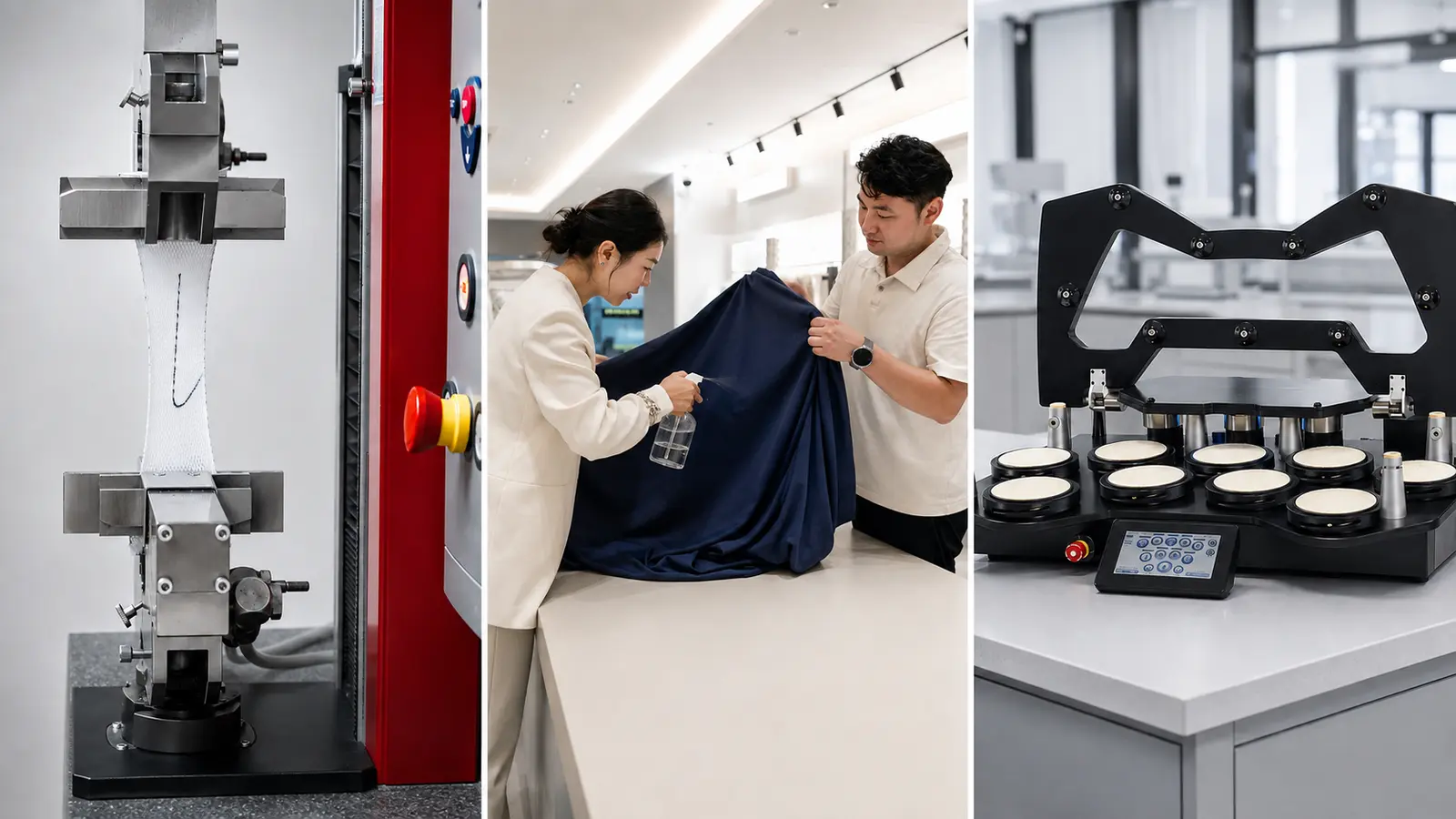
These expectations cannot be confirmed from a flat sample alone. A fabric that looks opaque on the table may become less secure when stretched across the body. A material with high extension may recover poorly. A soft brushed surface may retain more warmth or need closer pilling review. Prototype evaluation and agreed care cycles are therefore part of the performance question, not separate concerns.
Why familiar claims are losing differentiating power
When most competitors use similar language, adding the same claim produces less distinction. “Breathable” can describe dramatically different constructions. “Four-way stretch” says little about recovery, support or durability. “Quick dry” is difficult to evaluate without a method, conditions and benchmark. “Premium” is not a material property at all.
This creates two risks. The first is commoditisation: if every product promises the same benefits, technical language gives buyers little reason to look beyond colour, styling and price. The second is an expectation gap: a vague claim may imply a level or type of performance the product was never designed to deliver.
Brands can reduce both risks by becoming more specific. Instead of treating “performance” as one universal category, they can define the movement, environment and wearer problem the product is built around. The distinction moves from claiming that a feature exists to explaining why its particular balance is useful.
Where differentiation moves when performance is expected
The strongest specification is not the one with every possible feature. It is the one that resolves the priority conflicts of a clear use case.
- From maximum performance to the right performance. A high-sweat running garment may accept a more technical handfeel for lower wet cling and faster drying. A Pilates set may prioritise softness, controlled stretch and a quiet surface. A studio-to-street piece may trade extreme compression for comfort over several hours.
- From first touch to lasting sensory quality. Softness matters, but not if the surface changes rapidly with washing. A more defensible balance may be softness without uncontrolled pilling, smoothness without excessive shine, or support without a rigid feel.
- From one result to performance after care. The validation plan should follow the risk. Deep colours may require closer colourfastness review; brushed surfaces may need pilling and abrasion testing; high-stretch bottoms may place more emphasis on recovery, dimensional stability and opacity.
- From fabric data to garment confidence. Pattern, seams, panels, fit and layering can change the result. Fabric selection, prototype fitting and end-use review should operate as one loop.
Specificity is harder to copy than a generic feature list because it connects material decisions to a defined wearer and a visible product outcome.
Durability is moving closer to the centre of performance
Durability was sometimes treated as a separate quality-control topic, less marketable than stretch or sweat management. That separation is becoming harder to defend.
McKinsey’s 2025 sporting-goods report describes persistent inflation, cautious spending and pressure on brands to improve growth and productivity. It does not measure fabric-durability preferences directly, but it provides relevant commercial context: products must justify their place in a more selective purchase decision. Source: McKinsey & Company and WFSGI, Sporting Goods 2025—The New Balancing Act.
European policy direction strengthens the same logic from another angle. The European Commission’s Strategy for Sustainable and Circular Textiles sets a 2030 vision in which textile products placed on the EU market are durable, repairable and recyclable, and in which consumers benefit longer from higher-quality products. This is a policy objective, not a statement that one durability rule already applies to every activewear item. It nevertheless signals where product expectations and regulation are heading. Source: European Commission, EU Strategy for Sustainable and Circular Textiles.
For brands, durability now supports value, repeat trust and a more credible sustainability position. A garment kept in use because it retains colour, shape, surface and function makes a stronger practical case than one supported only by broad environmental language.
What this means for activewear sourcing briefs
A sourcing brief built around “soft, breathable, four-way stretch” leaves too much room for interpretation. It describes an aspiration, not a measurable product.
A more useful brief connects consumer experience to development and verification:
Intended experience | Development question | Evidence to request |
|---|---|---|
Secure movement without restriction | What stretch, recovery and support balance suits the activity? | Agreed extension/recovery method plus garment movement review |
Comfortable moisture handling | Is the priority wicking, drying, vapor transfer, airflow or a combination? | Test method and result relevant to the chosen claim |
Coverage during movement | How do colour, density, stretch and fit interact? | Fabric assessment plus prototype opacity check under movement |
Stable appearance after use | Which surface risks are most likely: pilling, abrasion, snagging or shine? | Risk-based physical testing before and, where required, after care |
Reliable repeat purchase | Can colour, handfeel, weight and performance be reproduced by lot? | Approved standard, lab records and agreed batch-control tolerances |
Longer useful life | Which properties must remain after repeated care? | Laundering protocol linked to dimensional, colour and performance checks |
The brand does not need every technical answer at the beginning, but it must define the hierarchy. Which failure is unacceptable? Where is a trade-off possible? What determines whether the garment remains in regular use? Those questions give the development team something actionable to engineer.
Fewer claims, stronger proof
As performance becomes baseline, restraint can make communication more credible.
A product does not need every technical term plausibly associated with its fabric. It needs the properties that matter to the intended user, supported by appropriate evidence. That may mean naming the test method in buyer documentation, defining the conditions and avoiding numerical claims that are not controlled across production.
The same discipline should apply to sustainability language. Recycled content, certification and lower-impact processes can be relevant, but they do not replace product durability or prove every environmental benefit. Material claims, performance claims and environmental claims each require their own documentation.
Clear boundaries do not weaken a product story. They help the buyer understand what has actually been developed and what still needs to be confirmed for the final garment.
Where Cofinay fits into the development process
Cofinay’s role is not to attach the longest possible feature list to a standard fabric. It is to help translate a brand’s use case into a workable material brief, then align knitting, dyeing, finishing and quality control around the agreed priorities.
Depending on the project, that may involve adjusting composition, yarn, knit structure, density, weight, handfeel, colour or finish, followed by testing selected for the intended claim and risk. Cost targets, order quantity, certification needs, sampling route and lead time should be confirmed against the actual customization details rather than assumed from a general product category.
This matters because the baseline is not identical for every garment. A buyer who requires stronger recovery, stricter colourfastness, a softer surface or tighter cost control is defining a different engineering problem. The development route should reflect that difference.
Performance is the starting point, not the finished story
The activewear market is not moving beyond performance. It is becoming less impressed by performance language that does not lead to a dependable wearing experience.
Stretch, moisture comfort, coverage and durability remain essential. But their presence alone does not guarantee distinction, especially when similar claims appear throughout the market. The next level of value comes from choosing the right performance balance, verifying it under relevant conditions and making sure it remains credible after movement, care and time.
For brands, this is an opportunity to become more precise. Define the user and the activity. Identify the failure that matters most. Build the material and garment around that priority. Test what is claimed. Communicate the result without asking one feature to promise more than it can prove.
When performance becomes the baseline, differentiation does not disappear. It moves deeper—into relevance, reliability and the quality of execution.
To discuss a custom activewear fabric brief, contact the Cofinay technical team.
Research note and source boundaries
This article combines several kinds of public evidence:
- Consumer research: Cotton Incorporated’s activewear feature preferences. The reported percentages belong to the cited survey context and should not be generalized to every country or consumer segment.
- Sporting-goods industry research: McKinsey and WFSGI data on active consumers and the commercial environment. These findings cover the survey populations described in the report; they are not fabric-performance test results.
- Technical standards context: AATCC material on moisture-management and water-repellency testing. It is used to show why broad claims require specific methods, not to prescribe one universal test protocol.
- Policy direction: The European Commission’s textile strategy. Its 2030 vision is presented as policy direction rather than as a finished requirement that applies identically to every product today.
No market-size, CAGR or sales forecast figures are used. No Cofinay product composition, GSM, width or performance value is asserted in this article. All external source material is paraphrased, and all final product claims should be checked against the approved sample, applicable test method, target market and buyer specification.
Sources and further reading
- Cotton Incorporated Lifestyle Monitor — Here’s What Consumers Want in Their New Year/New You Activewear
- McKinsey & Company and WFSGI — Sporting Goods 2025: The New Balancing Act
- AATCC — Moisture Management Testing Workshop
- AATCC — The Resurgence of Water Repellency Testing
- European Commission — EU Strategy for Sustainable and Circular Textiles
About Cofinay
With over 16 years of expertise, Cofinay is a premier manufacturer of high-end activewear fabrics, certified by global ecological standards. We specialize in engineering premium performance knits for yoga, tennis, equestrian, and golf. Backed by our self-operated vertical weaving and dyeing infrastructure, we provide complete end-to-end services to empower global activewear brands to scale.