
Table of Contents
- 1. The market signal: comfort has become a fashion value
- 2. From athleisure to an everyday uniform
- 3. The new styling language: active base, personal layers
- 3.1. A close-fitting base with a relaxed outer layer
- 3.2. Sport elements mixed with familiar wardrobe pieces
- 3.3. Tonal color instead of obvious “gym” coding
- 3.4. One outfit, several degrees of formality
- 4. Confidence is replacing the idea that clothing must “correct” the body
- 5. Why the shift resonates with younger consumers
- 6. What the US and European signals have in common—and where they differ
- 7. What this trend means for fabric development
- 8. The buyer brief should describe a life, not just a category
- 9. Where Cofinay fits into the conversation
- 10. The future of activewear is not limited to the studio
- 11. Research note and source boundaries
- 12. Sources and further reading
For years, fashion treated comfort as a compromise. The polished outfit was assumed to require structure, restraint or a degree of inconvenience; stretch belonged to the gym, soft layers belonged at home, and leggings were rarely presented as a serious wardrobe choice.
That separation is weakening.
Across the United States and Europe, consumers are not simply wearing more sports-inspired clothing. They are building wardrobes around a different hierarchy of needs. Comfort, fit and freedom of movement increasingly sit alongside appearance rather than beneath it. A fitted active set can be worn with an oversized wool coat. Leggings can be balanced by a hoodie, a tailored jacket or a trench. A baseball cap, sunglasses, clean sneakers or a leather bag can shift the same foundation from workout wear to a credible city look.
The larger change is not that fashion has stopped mattering. It is that many consumers—especially younger adults—are less willing to look fashionable at the expense of feeling like themselves. Clothing is being asked to support a full day, a changing schedule and a more individual idea of confidence.
This is the real meaning of from studio to street: activewear is no longer confined to the place where exercise happens.
The market signal: comfort has become a fashion value
The strongest evidence is not a runway image. It is the way consumers describe their own priorities.
In the United States, 79% of consumers said they choose comfort over style when buying clothes, according to YouGov’s 2024 US fashion report. At the same time, only 29% described themselves as keeping up with current fashion trends. This does not mean that appearance is irrelevant; it suggests that fashion value is being judged through wearability as well as visual impact. Source: YouGov, America’s Top Fashion Brands of 2024, published December 2024.
The generational picture is more nuanced than the phrase “young consumers prefer comfort” might imply. YouGov found that US Gen Z respondents were more likely than millennials to consider themselves fashionable and to follow current trends. Yet both generations ranked price, value, quality and fit among their leading purchase considerations. Millennials also placed relatively more emphasis on garment functionality and fabric or material choice. Source: YouGov, How American Gen Z & Millennials Approach Fashion Differently, November 2024.
That combination matters. Younger consumers can be highly style-aware without wanting clothes that feel restrictive or impractical. Comfort is not replacing fashion consciousness; it is becoming one of the conditions under which fashion earns a place in the wardrobe.
British data points in a similar direction. In YouGov Profiles data published in January 2025, 32% of women in Great Britain said they did not follow trends and preferred to feel comfortable in their clothing. Another 44% said they bought items they liked the look of in shops. Read together, these figures show that visual appeal and comfort coexist rather than cancel each other out. Source: YouGov, How Men and Women Shop for Clothes in Britain, January 2025.
The useful conclusion for the activewear market is therefore not “style is over.” It is this: a product that looks good but feels difficult now faces a higher barrier to repeat wear.
From athleisure to an everyday uniform
Athleisure originally described the crossover between athletic and leisure clothing. The current shift is broader. Active garments are becoming dependable wardrobe foundations: pieces that can absorb different styling choices, temperatures and parts of the day.
A pair of leggings may begin with a morning class, continue through a commute and remain on for errands or an informal meeting. A fitted tank can sit under a zip hoodie, an open shirt or a blazer. A lightweight performance top can be paired with relaxed trousers rather than matching tights. Track pants can be styled with a knit, coat or structured bag.
European material sourcing commentary already reflects this extended use. PERFORMANCE DAYS, the Munich-based functional fabric platform, describes performance tights and pants as garments for activities such as running, yoga and cycling that are also worn throughout the day as part of a relaxed lifestyle. Source: PERFORMANCE DAYS, Fabrics for Performance Tights & Pants.
Fashion editorial offers a separate, non-survey signal. Recent styling coverage from US and British Vogue has placed leggings and other sports-derived pieces with oversized leather jackets, wool coats, trenches, blazers, knitwear, baseball caps and more formal footwear. These examples should not be treated as population statistics, but they demonstrate how mainstream fashion media is reframing stretch garments as styling components rather than gym-only products. Sources: Vogue, Athleisure Outfits That Balance Style and Sport; British Vogue, How to Make Leggings Look Cool in 2026.
The distinction is important. The market is not simply selling complete “athleisure looks.” It is enabling consumers to create their own combinations.
The new styling language: active base, personal layers
The most convincing studio-to-street outfits rarely depend on excessive detail. Their strength comes from proportion, texture and contrast.
A close-fitting base with a relaxed outer layer
Leggings, bike shorts, a sports bra or a fitted tank create a clean foundation. An oversized hoodie, coat, blazer or open shirt changes the social reading of the outfit. The contrast between a streamlined base and a looser top layer makes the result feel intentional rather than unfinished.
This formula also supports practical use. The base remains suitable for movement, while the outer layer provides warmth, coverage, pockets or a more urban silhouette.
Sport elements mixed with familiar wardrobe pieces
A cap, tote, sunglasses or sneakers can retain the athletic reference. A trench, wool coat, leather jacket, knit or structured bag can move the same outfit toward work, travel or social use. Consumers do not need every item to come from a performance collection; the appeal lies in the mix.
Tonal color instead of obvious “gym” coding
Black remains useful, but studio-to-street styling is not limited to black leggings. Chocolate, navy, burgundy, soft grey, olive, cream and muted pink can make active separates feel easier to integrate with an existing wardrobe. Tonal dressing also allows fabric texture and silhouette to carry the look without prominent graphics.
One outfit, several degrees of formality
Changing a single layer can shift the same active base. A hoodie makes it casual; a long coat adds polish; a blazer creates sharper structure; a cap restores a streetwear note. This adaptability is one reason the trend aligns with clothing freedom: the wearer decides how much sport, fashion or ease the outfit should express.
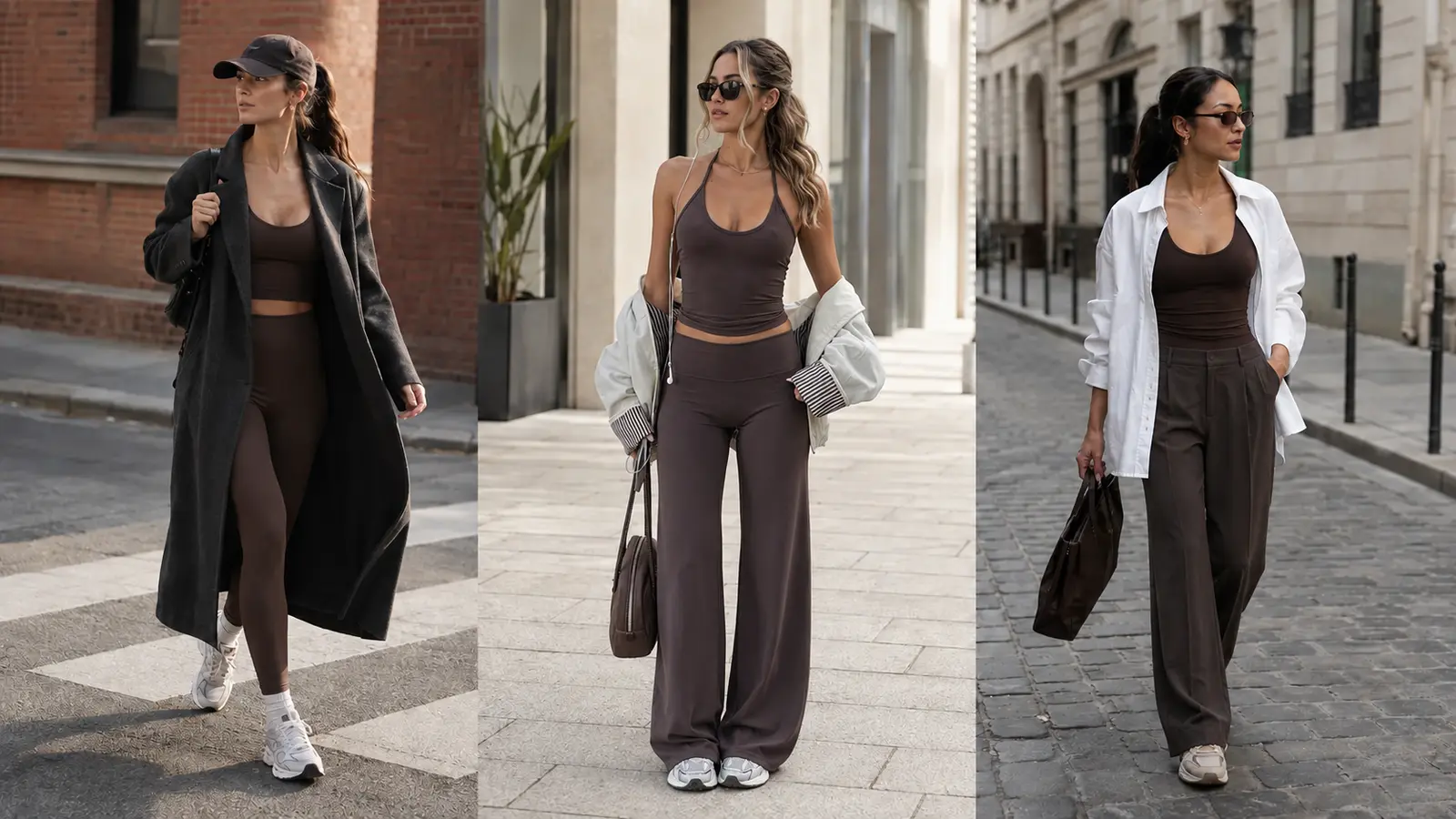
Three studio-to-street styling directions combining activewear with everyday urban layers.
Confidence is replacing the idea that clothing must “correct” the body
One of the most meaningful parts of this trend is the way women’s bodies are presented.
Traditional fashion communication often treated the body as something to disguise, lengthen, slim or correct. Performance clothing introduced a different visual language: strength, posture, movement and physical capability. As activewear moves into everyday styling, that language is moving with it.
The result can be a more natural form of femininity. A strong shoulder, defined leg or athletic waist does not need to be hidden to make an outfit sophisticated. Nor does confidence require revealing as much of the body as possible. A fitted set beneath an oversized coat can feel self-assured precisely because the wearer controls the balance between exposure, coverage and proportion.
This is an editorial interpretation of the broader trend, not a claim measured by the consumer surveys cited above. But it helps explain why studio-to-street imagery resonates: it shows women occupying ordinary public space in clothes that allow movement, rather than dressing solely to meet an external ideal.
Wear freedom, in this context, is practical as well as expressive. It means being able to sit, walk, travel, work, train and meet friends without the outfit becoming a source of discomfort. It also means having permission to style the same garment differently instead of obeying one fixed idea of when activewear is “appropriate.”
Why the shift resonates with younger consumers
Several pressures converge in younger wardrobes.
First, the boundaries between activities are less stable. Hybrid work, shared workspaces, flexible fitness schedules, travel and social plans can all happen within one day. Clothing that serves only a narrow occasion is harder to justify—especially when price and value remain important purchase factors.
Second, wellness is increasingly woven into everyday identity. McKinsey’s 2025 wellness research found that Gen Z and millennials purchase across a wider range of wellness products and services than older consumers, describing a broader cultural shift in the way wellness is understood. This is not apparel-specific evidence, but it provides useful context: movement, recovery and self-care are no longer treated only as scheduled activities. Source: McKinsey & Company, The Future of Wellness Trends Survey 2025.
Third, social media has made styling more modular. Consumers see a legging worn with a blazer, a sports bra beneath a shirt or track pants beside a polished coat, then reinterpret the formula using pieces they already own. The value is less about buying a prescribed head-to-toe uniform and more about recombination.
Finally, comfort supports confidence. A garment that pinches, slips, becomes transparent or loses shape demands constant attention from the wearer. A garment that moves reliably allows attention to return to the day itself. That emotional benefit is difficult to reduce to one performance claim, but it strongly influences whether a product becomes a repeat-wear favorite.
What the US and European signals have in common—and where they differ
It would be inaccurate to speak of the United States or Europe as a single aesthetic. New York, Los Angeles, London, Paris, Copenhagen and Berlin do not dress alike, and the surveys cited here do not represent every European country.
Even so, several shared directions are visible:
- Comfort is treated as a legitimate purchase value, not merely a private preference.
- Sports-derived pieces are entering mixed wardrobes, rather than remaining inside complete gym looks.
- Fit, quality and versatility matter alongside trend relevance, particularly for consumers who expect more use from each purchase.
- Outerwear and accessories do much of the styling work, allowing a functional base to shift between contexts.
- A quieter visual language is gaining importance, including matte surfaces, tonal color and restrained branding.
There are also differences in emphasis. US casualwear culture often makes the athletic reference more direct: caps, hoodies, sneakers, matching sets and visible sports cues can remain central to the look. In British and continental European fashion styling, the active piece is often placed in tension with tailoring, knitwear, leather or a strong coat. The outfit may look less like “gym wear outside” and more like a fashion wardrobe that happens to include stretch garments.
This comparison is a market interpretation drawn from the consumer data, functional-textile commentary and fashion-editorial examples cited in this article. It should be used as a design direction, not as a universal rule for every city or audience.
What this trend means for fabric development
Once activewear is expected to remain on the body beyond a workout, its material brief becomes more demanding. Performance still matters, but it must coexist with long-wear comfort and a surface that coordinates with non-sport garments.
Consumer expectation | Garment expression | Fabric implication |
|---|---|---|
Comfortable for several parts of the day | A fitted garment that does not become distracting | Soft handfeel, balanced stretch, controlled compression and recovery |
Easy to style with coats, hoodies or tailoring | A clean, quiet foundation | Matte or restrained luster, even surface and stable color |
Confidence during movement and in public | Coverage without excessive bulk | Structure, density and stretch selected together; opacity checked in garment form |
Useful beyond one occasion | Repeat wear and frequent laundering | Pilling, abrasion, dimensional stability and colorfastness appropriate to actual use |
Freedom to move between indoor and outdoor settings | Comfort across changing temperature and activity | Breathability, moisture comfort and weight matched to the intended wearing pattern |
These expectations involve trade-offs. A highly brushed surface may feel soft but require closer pilling evaluation. More weight may improve coverage while adding warmth and slowing drying. Strong compression may support training but feel excessive after several hours. A very smooth surface may look refined yet show abrasion or pressure marks more easily.
There is no single studio-to-street specification. The correct balance depends on what the garment is expected to do first, how long it will be worn, how it will be layered and which compromises the target customer will accept.
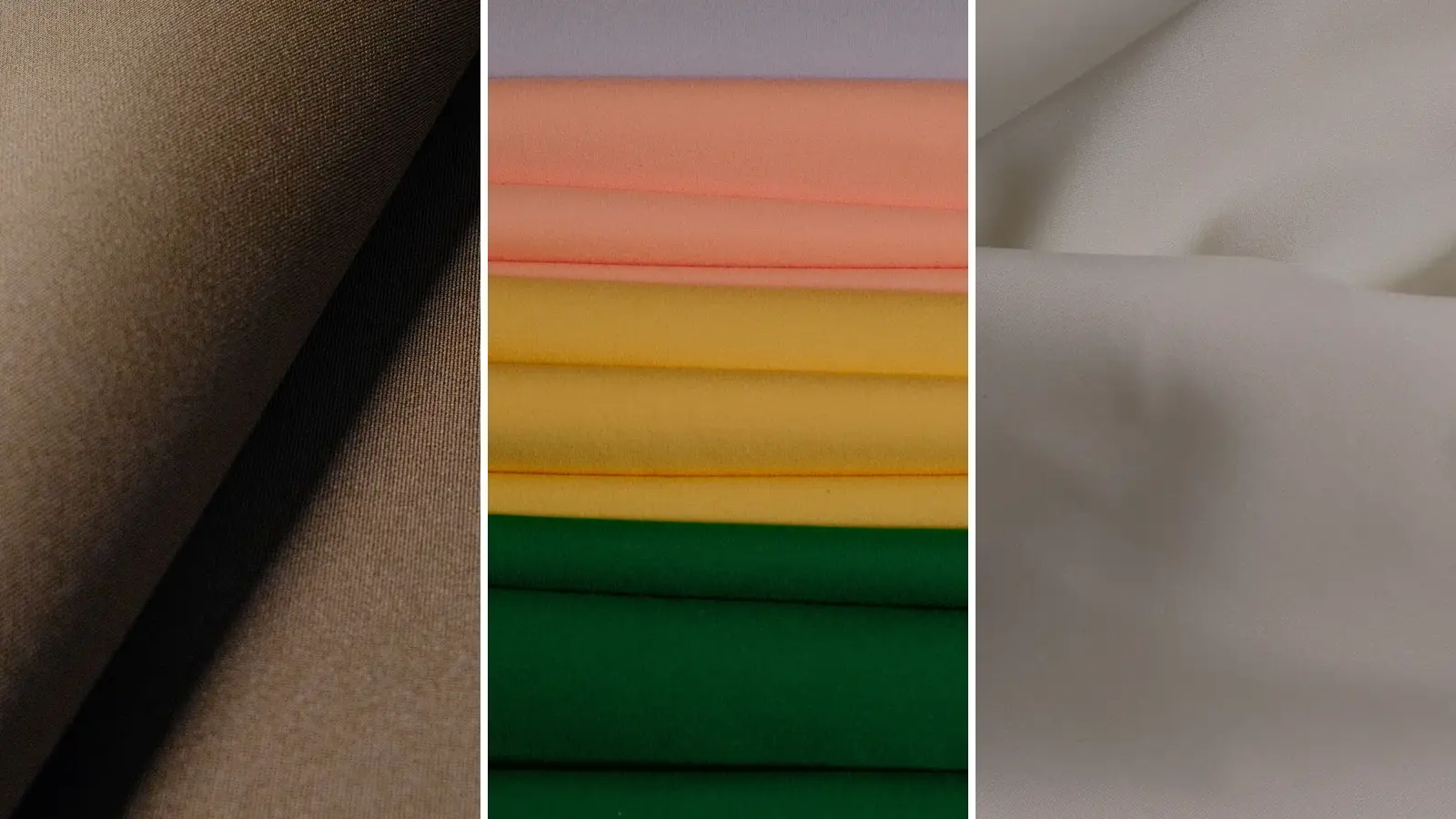
The buyer brief should describe a life, not just a category
“Yoga fabric” or “athleisure fabric” is no longer a complete sourcing brief. Two leggings may look similar online while serving very different users.
One may be intended for high-sweat training and require faster drying, secure recovery and a more technical surface. Another may support Pilates, travel and all-day wear, placing greater emphasis on softness, opacity, a matte face and comfort under outerwear. A third may be fashion-led and need refined drape and color, with only moderate activity performance.
Before development begins, buyers should define:
- the garment’s primary activity and movement range;
- the situations in which it will be worn before and after that activity;
- the desired level of support, softness and coverage;
- the surface and color direction needed for everyday styling;
- the wash frequency and expected wearing life;
- the performance properties that cannot be compromised;
- the target cost, quantity, schedule and documentation requirements.
This approach protects the concept from becoming a vague feature list. It also leaves room for customization: the answer may involve adjusting composition, yarn, knit density, weight, finish or test priorities rather than selecting a supposedly universal fabric.
Where Cofinay fits into the conversation
Cofinay’s role is not to define activewear by one scene or prescribe a fixed material formula. It is to translate a brand’s intended wearing experience into a workable fabric specification.
Through integrated knitting, dyeing, finishing and quality control, the development route can be adjusted around the actual brief—whether the priority is softer handfeel, stronger recovery, stricter colorfastness, a particular surface, recycled content, cost control or another measurable requirement. Composition, GSM, finish, MOQ, sampling route and lead time should be confirmed according to the final customization details.
That is the necessary connection between a market trend and a manufacturable product. The trend supplies the direction; the brief establishes the priorities; sampling and testing determine whether the fabric delivers them.
The future of activewear is not limited to the studio
The studio-to-street movement is sometimes presented as a simple styling story: add a coat to leggings and the outfit is finished. The market shift underneath it is more substantial.
Consumers are redefining what it means to be well dressed. Comfort does not automatically signal a lack of effort. Stretch does not prevent sophistication. An athletic body does not need to be disguised, and a feminine look does not require physical restriction. A hoodie, cap, coat or blazer can alter the mood of an active foundation without removing the ease that made the wearer choose it in the first place.
For brands, the opportunity is not to label more products “athleisure.” It is to understand how people actually move through their day and develop garments that remain useful, attractive and comfortable across those moments.
For material buyers, that means looking beyond a single feature or composition. The fabric must support movement, but it must also support confidence, repeat wear and the freedom to style the garment on the wearer’s own terms.
The next phase of activewear will not be defined by the number of settings a brand lists in its marketing. It will be defined by how naturally the product belongs wherever the customer chooses to take it.
To discuss a custom fabric brief, contact the Cofinay technical team.
Research note and source boundaries
This article uses a limited set of public sources and distinguishes between three kinds of evidence:
- Consumer research: YouGov data for the United States and Great Britain. These findings should not be generalized to every European country or every age group.
- Industry direction: PERFORMANCE DAYS commentary on functional fabrics and extended wearing occasions.
- Fashion-editorial observation: Vogue and British Vogue styling coverage. These sources show how fashion media is presenting the trend; they are not consumer surveys or market-size estimates.
McKinsey’s wellness research is included as broader cultural context and is not presented as direct evidence of apparel purchasing behavior. No market-size, forecast or CAGR figures have been used. All source material is paraphrased; this article does not reproduce extended passages from any publication.
Sources and further reading
- YouGov — America’s Top Fashion Brands of 2024
- YouGov — How American Gen Z & Millennials Approach Fashion Differently
- YouGov — How Men and Women Shop for Clothes in Britain
- McKinsey & Company — The Future of Wellness Trends Survey 2025
- PERFORMANCE DAYS — Fabrics for Performance Tights & Pants
- Vogue — Athleisure Outfits That Balance Style and Sport
- British Vogue — How to Make Leggings Look Cool in 2026
About Cofinay
With over 16 years of expertise, Cofinay is a premier manufacturer of high-end activewear fabrics, certified by global ecological standards. We specialize in engineering premium performance knits for yoga, tennis, equestrian, and golf. Backed by our self-operated vertical weaving and dyeing infrastructure, we provide complete end-to-end services to empower global activewear brands to scale.