
Table of Contents
- 1. Five activewear fabric shifts to watch in 2026
- 2. 1. Activewear is being designed for more than one setting
- 3. 2. Softness is being engineered with performance stability
- 4. 3. Core performance features are becoming the starting point
- 5. 4. Recycled content is moving toward proof and traceability
- 6. 5. Development speed is becoming a fabric capability
- 7. What these trends mean for activewear fabric buyers
- 7.1. 1. What is the garment’s primary use?
- 7.2. 2. What must the wearer feel?
- 7.3. 3. Which properties are measurable requirements?
- 7.4. 4. Which trade-offs are acceptable?
- 7.5. 5. What evidence is needed for material claims?
- 7.6. 6. How will the fabric be validated in garment form?
- 8. From trend direction to a workable fabric specification
- 9. The 2026 outlook
- 10. Further reading
The activewear brief is getting harder.
A fabric may need to feel comfortable in a yoga studio, recover after a strength session, look refined enough for daily wear and remain consistent through repeated washing. At the same time, buyers are under pressure to shorten development cycles, control costs and support environmental claims with better documentation.
This does not mean every fabric must do everything. It means fabric selection has to begin with a clearer understanding of where the garment will be worn, how it will move and which performance characteristics matter most.
Based on current market signals and the questions we hear from activewear buyers, five shifts are shaping fabric development in 2026.
Five activewear fabric shifts to watch in 2026
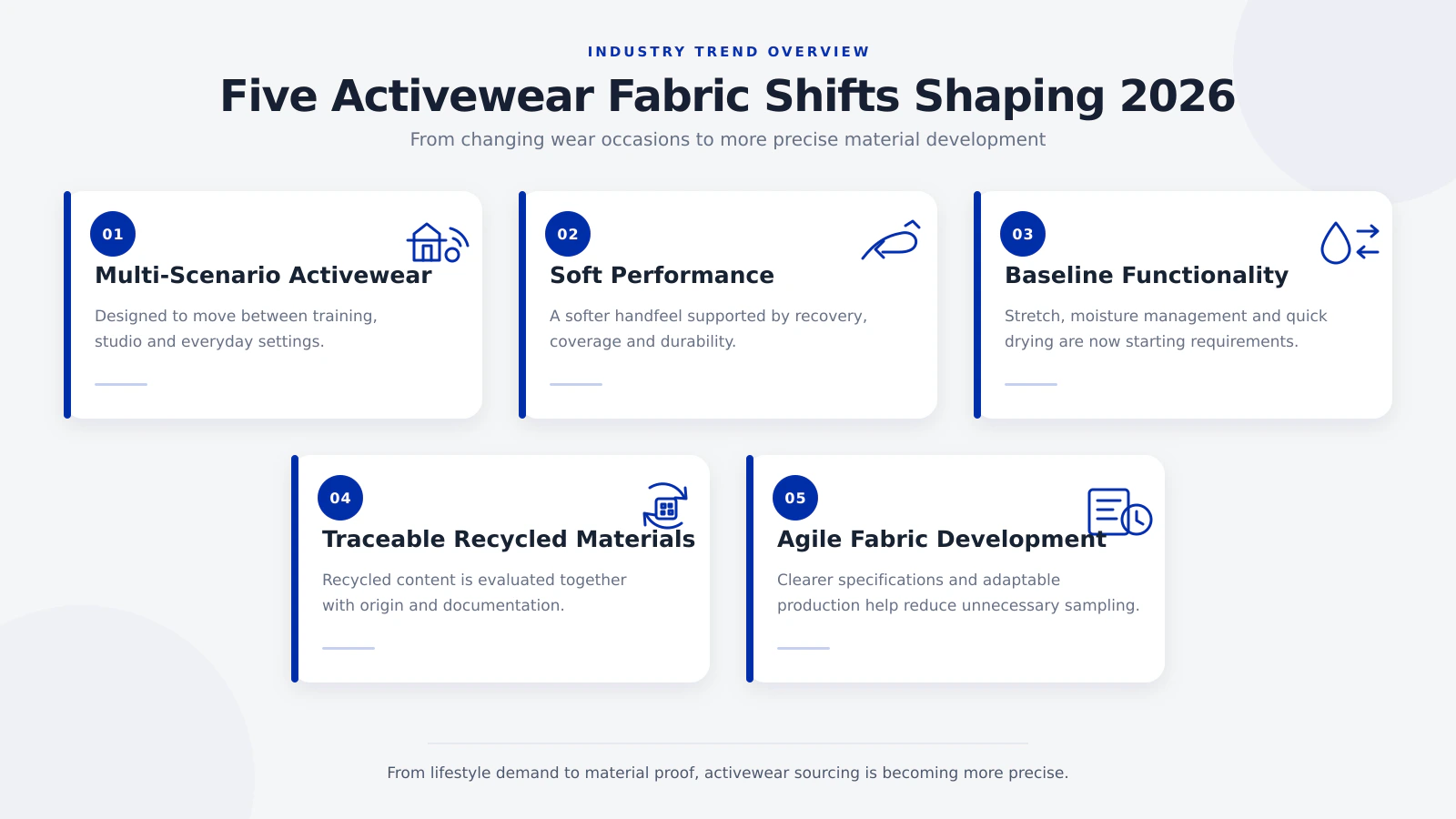
- Activewear is moving from single-sport products toward multi-scenario wardrobes.
- Soft handfeel is being developed alongside recovery, coverage and durability.
- Stretch, moisture management and quick drying are becoming baseline expectations rather than stand-alone selling points.
- Recycled-content claims are being examined together with traceability and material origin.
- Faster, more adaptable fabric development is becoming part of the sourcing brief.
1. Activewear is being designed for more than one setting
The boundary between performance apparel and everyday clothing continues to soften. A customer may wear the same leggings for Pilates, a light gym session and the journey home. A lightweight layer may move between running, travel and casual use. The visual language of sportswear is also appearing in commuter and fashion-led collections.
This crossover is visible in the industry’s material direction. The PERFORMANCE DAYS Bodywear Forum highlights fabrics that combine performance fibers, thermal regulation, breathable support, tactile surfaces and more natural-looking finishes. The point is not simply that activewear looks more fashionable. Garments are being expected to remain comfortable and visually appropriate across a wider range of situations.
For fabric buyers, this changes the order of decision-making. Starting with a generic request such as “a four-way stretch fabric” is no longer enough. A useful brief should identify the garment, its primary activity and the secondary situations in which it will be worn.
For example:
- A studio legging may prioritize softness, controlled stretch, coverage and shape retention.
- A running top may place greater weight on low mass, moisture movement and drying speed.
- A cycling base layer may need close-to-skin comfort, efficient moisture handling and stable fit.
- An outdoor or commuter layer may require abrasion resistance, dimensional stability or light weather protection.
One fabric can serve several nearby uses when its construction and finish are balanced correctly. It should not, however, be treated as universally suitable without garment-level evaluation.
This is why Cofinay’s activewear fabric catalog is organized across applications that include yoga, Pilates, cycling, fitness, outdoor use, commuter wear and urban fashion. The growing overlap between those categories reflects the way activewear is now being developed and worn.
2. Softness is being engineered with performance stability
Soft handfeel remains important, especially for garments worn close to the skin. Yet softness alone says very little about how a fabric will behave after cutting, sewing, stretching and washing.
The more useful question is: what does the fabric retain after softness has been achieved?
A very soft surface can be appealing on a hanger but unsuitable if it develops excessive pilling, loses recovery or changes appearance too quickly. Conversely, a highly stable fabric may meet technical targets while feeling too firm or synthetic for the intended consumer.
In 2026, the stronger developments are likely to sit between those extremes. Buyers are looking for materials that combine a comfortable touch with the performance needed for the finished garment, including:
- stretch recovery that supports repeated movement;
- adequate opacity under extension;
- dimensional stability after laundering;
- controlled surface appearance;
- resistance to pilling and abrasion appropriate to the end use;
- moisture and thermal comfort suited to the activity.
The solution may come from yarn selection, knit construction, fabric weight, elastane proportion, finishing or a combination of these factors. There is no single recipe for “soft performance.” A yoga fabric and a brushed outdoor base-layer fabric may both feel soft, but they achieve that feel for different reasons and should be assessed against different risks.
For buyers, handfeel approval should therefore happen alongside physical testing and garment trials. A small swatch can confirm touch and color direction. It cannot fully show whether the fabric will bag at the knee, turn sheer during movement or remain stable after repeated care cycles.
3. Core performance features are becoming the starting point
Stretch, moisture management and quick drying still matter. What is changing is their role in the conversation.
For many activewear programs, these functions are no longer enough to distinguish a fabric by themselves. They are the starting point from which more specific choices are made: how much stretch, in which direction, with what recovery, for what garment and under which test method?
This distinction matters because broad performance language can hide very different outcomes. A fabric may absorb moisture without spreading it efficiently. Another may dry quickly because it is lightweight, but offer insufficient coverage for leggings. High elastane content may increase stretch, yet the garment can still lose shape if the construction and heat-setting conditions are not properly aligned.
In practical sourcing terms, a stronger specification should convert general claims into measurable requirements. Depending on the garment, that may include:
- fabric composition and tolerance;
- finished weight and usable width;
- stretch and recovery method;
- dimensional change after washing;
- colorfastness requirements;
- pilling or abrasion criteria;
- moisture-management or drying test method;
- opacity or coverage assessment;
- handfeel and approved color standard.
The exact list should be adjusted to the project. A low-impact studio top does not need the same performance package as a high-sweat running garment or a cycling short exposed to repeated friction.
This is also where testing language needs care. “Moisture-wicking,” “quick-dry” and “four-way stretch” should not be treated as interchangeable labels or automatic guarantees. Results depend on fabric construction, finishing, test conditions and the final garment design. Buyers should confirm the relevant method, threshold and approval procedure before bulk production.
4. Recycled content is moving toward proof and traceability
Recycled polyester remains central to many activewear sustainability programs, but the market picture is more complicated than a simple shift away from virgin fiber.
According to Textile Exchange’s Materials Market Report 2025, global fiber production reached approximately 132 million tonnes in 2024. Polyester represented 59% of total output, and 88% of polyester was still fossil-based. Recycled polyester volume increased from 8.9 million tonnes in 2023 to 9.3 million tonnes in 2024, while its share of the polyester market slipped from 12.5% to 12%.
The source of recycled feedstock matters as well. Bottle-based recycled polyester accounted for 6.9% of global fiber production, while textile-to-textile recycled fibers remained below 1%.
For activewear buyers, this means a recycled-content percentage is only one part of the material story. The next questions should address:
- the recycled input and its source;
- the certification or chain-of-custody system used, where applicable;
- whether transaction documentation is required for the order;
- how the claim will be communicated on the finished product;
- whether performance and durability remain suitable for the intended garment;
- what happens to the product at the end of its useful life.
Regulation is also pushing product information toward greater structure. The European Union’s Ecodesign for Sustainable Products Regulation introduces the Digital Product Passport framework, intended to provide digital information about products, components and materials as requirements are developed for specific product groups.
Not every activewear product is subject to the same documentation today, and implementation details will continue to evolve. The direction is nevertheless clear: environmental claims will increasingly need data that can be followed through the supply chain.
This does not make recycled polyester the right answer for every project. Material choice still needs to account for performance, durability, commercial constraints and the buyer’s stated sustainability strategy. It does make vague or unsupported claims progressively less useful.
5. Development speed is becoming a fabric capability
Market uncertainty is changing how buyers think about speed. The goal is not simply to produce fabric as quickly as possible. It is to reduce avoidable rounds of sampling and make decisions earlier with better information.
McKinsey and the World Federation of the Sporting Goods Industry note in their Sporting Goods 2025 report that companies are balancing slower growth and cautious spending with productivity, supply-chain diversification, inventory discipline and digitalization. Those pressures reach fabric development directly.
An agile development process can include:
- choosing a proven base construction before making targeted adjustments;
- aligning the technical brief before knitting or dyeing begins;
- using clear color standards and lab-dip approval procedures;
- defining which tests are required at sample, pilot and bulk stages;
- reviewing fabric and garment behavior together;
- recording approved parameters so repeat orders do not restart from zero.
Customization is part of this trend, but it should be specific. “Custom fabric” may mean adjusting weight, composition, stretch, surface finish, color, handfeel or a performance target. Each adjustment can affect cost, minimum quantity, lead time and test planning.
The most efficient projects usually do not begin with the largest possible list of functions. They begin with a ranked brief: what is essential, what is desirable and what can be traded against price or development time.
That approach is particularly useful when a buyer has a strict cost target or an unusually demanding performance requirement. A factory can then work around the real constraint rather than applying the same material and process to every order.
What these trends mean for activewear fabric buyers
The five shifts point to a more disciplined sourcing process. Before requesting samples, buyers should be able to answer the following questions.
1. What is the garment’s primary use?
Name the main activity first. Secondary uses can follow, but they should not obscure the garment’s core requirement.
2. What must the wearer feel?
Define whether the intended sensation is cool, dry, soft, compressive, supportive, lightweight or protective. Avoid using “comfortable” as the only handfeel direction.
3. Which properties are measurable requirements?
Separate marketing language from approval criteria. Specify the test method, target and stage at which the fabric will be evaluated.
4. Which trade-offs are acceptable?
More coverage may increase weight. Brushing may change drying behavior and pilling risk. Higher stretch does not automatically mean better recovery. A recycled input may affect availability, documentation or cost. Decide which factors can move and which cannot.
5. What evidence is needed for material claims?
Confirm certification scope, chain-of-custody requirements and transaction documentation before placing the order. A supplier certificate alone may not substantiate every product claim.
6. How will the fabric be validated in garment form?
Plan for wear trials, wash testing and movement assessment. Fabric test results are essential, but they do not account for every effect of pattern, seam, lining, print or garment construction.
From trend direction to a workable fabric specification
Trends become useful only when they lead to a better product decision.
Cofinay combines knitting, dyeing, finishing and quality control within its vertically integrated manufacturing process. This allows the technical team to discuss a project from yarn and fabric structure through color, finishing and testing rather than treating each stage as a separate request.
The development route can be adjusted to the order. A buyer focused on high colorfastness may require a different dyeing, finishing and test plan from a buyer whose main constraint is cost. A soft studio fabric may need a different balance of recovery and surface control from a lightweight running fabric. Final composition, weight, finish, testing, minimum quantity and lead time should therefore be confirmed against the actual customization details.
When approaching a new program, it is helpful to share:
- the garment type and target activity;
- a reference fabric or garment, if available;
- target composition, weight and width;
- required stretch, recovery and handfeel;
- color and colorfastness expectations;
- performance test methods or brand standards;
- recycled-content and documentation requirements;
- estimated quantity, sampling needs and target timeline.
The clearer this information is at the beginning, the easier it is to identify a suitable existing construction or define the changes required for a custom development.
The 2026 outlook
Activewear fabric development in 2026 is less about adding more claims and more about making the right functions work together.
Multi-scenario garments need a precise primary-use brief. Softer fabrics still need recovery and durability. Familiar performance terms need measurable definitions. Recycled content needs traceable support. Faster development depends on better decisions, not only shorter production time.
For buyers, the practical advantage comes from connecting consumer expectations with fabric construction, finishing, testing and documentation from the start.
To discuss a new activewear fabric program, contact the Cofinay technical team with your garment reference, target performance and commercial requirements.
Further reading
About Cofinay
With over 16 years of expertise, Cofinay is a premier manufacturer of high-end activewear fabrics, certified by global ecological standards. We specialize in engineering premium performance knits for yoga, tennis, equestrian, and golf. Backed by our self-operated vertical weaving and dyeing infrastructure, we provide complete end-to-end services to empower global activewear brands to scale.