
Table of Contents
- 1. RFQ, tech pack and sample brief: what is the difference?
- 2. Begin with the garment, not the fiber percentage
- 3. What to include in an activewear fabric RFQ
- 4. Build a fabric-specific tech pack
- 4.1. 1. Identify the fabric clearly
- 4.2. 2. Separate required and preferred specifications
- 4.3. 3. Use tolerances where they are meaningful
- 4.4. 4. Describe stretch as a behavior
- 4.5. 5. Define the surface and hand feel with references
- 5. How to send a physical fabric or garment reference
- 6. Choose the right development route
- 7. A practical sample-development sequence
- 7.1. Step 1: Initial fabric screening
- 7.2. Step 2: Physical swatch review
- 7.3. Step 3: Lab dip or color development
- 7.4. Step 4: Prototype yardage
- 7.5. Step 5: Garment sample and wear evaluation
- 7.6. Step 6: Technical testing
- 7.7. Step 7: Approval and bulk handover
- 8. Questions the manufacturer is likely to ask
- 9. Replace vague requests with usable instructions
- 10. Copy-and-paste activewear fabric RFQ template
- 11. Commercial points to confirm before development starts
- 12. How Cofinay reviews an activewear fabric brief
- 13. Frequently asked questions
- 13.1. Do I need a complete garment tech pack before contacting a fabric manufacturer?
- 13.2. Can I request fabric from a photograph?
- 13.3. Can the manufacturer analyze a fabric swatch?
- 13.4. Is a digital color card enough for approval?
- 13.5. When should the final price be confirmed?
- 13.6. What must be approved before bulk production?
- 14. A clear brief saves decisions, not just emails
Many fabric enquiries begin with a sentence such as: “We need a soft, four-way-stretch fabric for leggings, around 220 GSM.”
That is enough to start a conversation, but not enough to identify the right fabric, calculate a dependable quotation or plan sampling. Two fabrics can share the same composition and weight while behaving very differently in opacity, recovery, surface appearance, moisture management and sewing.
A useful brief gives the manufacturer enough context to understand the garment, the performance priorities and the decisions that must be made next. It does not need to be a perfect technical document. It does need to separate firm requirements from preferences and unknowns.
This guide explains how to prepare an activewear fabric RFQ, what belongs in a fabric-specific tech pack and how to move from initial swatches to an approved sample without losing track of the specification.
RFQ, tech pack and sample brief: what is the difference?
These documents support the same project, but they do different jobs.
Document | Main purpose | What it should establish |
|---|---|---|
RFQ | Starts the commercial and sourcing discussion | Product scope, estimated quantity, colors, target timing, destination and quotation requirements |
Fabric specification or fabric tech pack | Defines the technical target | Composition, construction, weight, width, hand feel, stretch, recovery, finish, performance and testing requirements |
Reference pack | Gives physical or visual context | Fabric swatch, garment sample, color standard, finish reference and notes on what should or should not be copied |
Sample approval record | Controls revisions | Sample identity, test results, comments, approved version and any conditions that must carry into bulk production |
A garment tech pack may already contain a fabric line. In many cases, however, that line only states something like “nylon/spandex jersey, 220 GSM.” A fabric manufacturer needs a more focused brief because fiber content is only one part of the material decision.
Begin with the garment, not the fiber percentage
Before specifying nylon, polyester or spandex, explain what the fabric will become.
A fabric for a yoga legging, a running top and a fitted tennis dress may all require stretch and moisture management, but they do not place the same demands on opacity, support, weight, drape or surface durability.
At minimum, state:
- The garment category and intended fit
- The activity or wearing situation
- The target consumer and market level
- Whether the fabric is for the main body, lining, panel, pocket or trim
- The most important performance risks in the finished garment
- Whether the project is at exploration, development, replacement or order-confirmation stage
For example, “fabric for women’s high-rise training leggings” is more useful than “fabric for sportswear.” Better still: “main-body fabric for close-fitting training leggings; medium compression, matte surface and reliable opacity at full stretch are priorities.”
The second version tells the manufacturer what to evaluate when selecting samples.
What to include in an activewear fabric RFQ
An RFQ should be short enough to review quickly and complete enough to prevent avoidable follow-up. The following fields cover most activewear fabric enquiries.
RFQ field | Information to provide | Why it matters |
|---|---|---|
Buyer and project | Company, brand, contact person and project name | Keeps quotations and sample revisions traceable |
Garment and end use | Garment type, activity, fit and fabric position | Guides structure, weight and performance recommendations |
Development stage | New concept, existing quality replacement, color development or repeat order | Determines whether the next step is selection, analysis or confirmation |
Target composition | Required blend, preferred blend or “open to recommendation” | Prevents a preference from being treated as a fixed requirement |
Construction | Jersey, interlock, warp knit or other known structure | Narrows the technical route |
Weight and width | Target GSM and usable width, with acceptable tolerance if known | Affects garment coverage, marker efficiency and costing |
Hand feel and appearance | Matte or lustrous, compact or fluid, smooth or brushed, cool or warm touch | Translates subjective expectations into comparable attributes |
Stretch and recovery | Direction, support level and recovery expectations | Helps distinguish easy stretch from stable, controlled stretch |
Performance | Moisture management, quick drying, UV protection, warmth, abrasion resistance or other priorities | Identifies the tests and finishes that may be relevant |
Color | Standard reference, number of colors and approval method | Affects lab-dip planning and color MOQ |
Testing and compliance | Required test methods, pass criteria, restricted-substance requirements and documentation | Prevents compliance questions from appearing after development |
Quantity | Estimated units, fabric quantity or quantity per color | Supports MOQ, dye-lot and price assessment |
Timing | Sample deadline, garment trial date and target bulk delivery | Allows the mill to identify the actual critical path |
Delivery details | Destination and requested trade or shipping terms | Clarifies what the quotation should include |
Requested response | Price basis, MOQ, sample options, lead time, available colors and recommended alternatives | Makes supplier quotations easier to compare |
If a value is unknown, write “open to recommendation” instead of guessing. A false requirement can send development in the wrong direction.
Build a fabric-specific tech pack
The fabric section of a tech pack should describe the material as a measurable target, not only as an aesthetic idea. It should also show which parameters are mandatory and which may be adjusted to improve cost, availability or performance.
1. Identify the fabric clearly
Give each fabric position a stable name or code, such as F01 Main Legging Fabric or F02 Pocket Mesh. Use the same code in the RFQ, garment tech pack, sample comments and approval record.
If you are replacing an existing quality, include the current supplier article number for internal reference, but do not rely on that code to communicate the construction.
2. Separate required and preferred specifications
A practical brief might state:
- Required: non-sheer at the intended stretch level, matte face, suitable recovery for fitted leggings
- Preferred: nylon-rich composition, 210–230 GSM, cool and smooth hand feel
- Open to adjustment: exact spandex percentage, usable width and finishing route
This hierarchy allows the manufacturer to suggest a better available construction without ignoring the performance that matters most.
3. Use tolerances where they are meaningful
Targets without tolerances can create unnecessary rejection; wide tolerances can remove control. Agree tolerances for values such as weight and usable width based on the chosen article and manufacturing route.
Do not copy a tolerance from another fabric simply because it appears in an old tech pack. A lightweight warp knit and a heavy brushed circular knit do not necessarily require the same control range.
4. Describe stretch as a behavior
“Four-way stretch” is not a complete specification. State whether the garment needs light mobility, close-body support or compression. If stretch and recovery are critical, agree on the direction, test method, extension or load, number of cycles and pass criteria.
Opacity should also be assessed at the intended extension and in the intended color. A fabric that appears opaque while relaxed may behave differently in a pale color or when stretched over a close-fitting garment block.
5. Define the surface and hand feel with references
Words such as “buttery,” “silky” and “cotton touch” are useful for direction, but people interpret them differently. Pair them with a physical sample and more precise notes:
- Smooth face with low visual shine
- Fine peach finish on the skin side only
- Compact body with soft drape
- Dry touch rather than slippery touch
- No visible surface hair after rubbing
When the reference is a finished garment, mark the exact panel being evaluated.
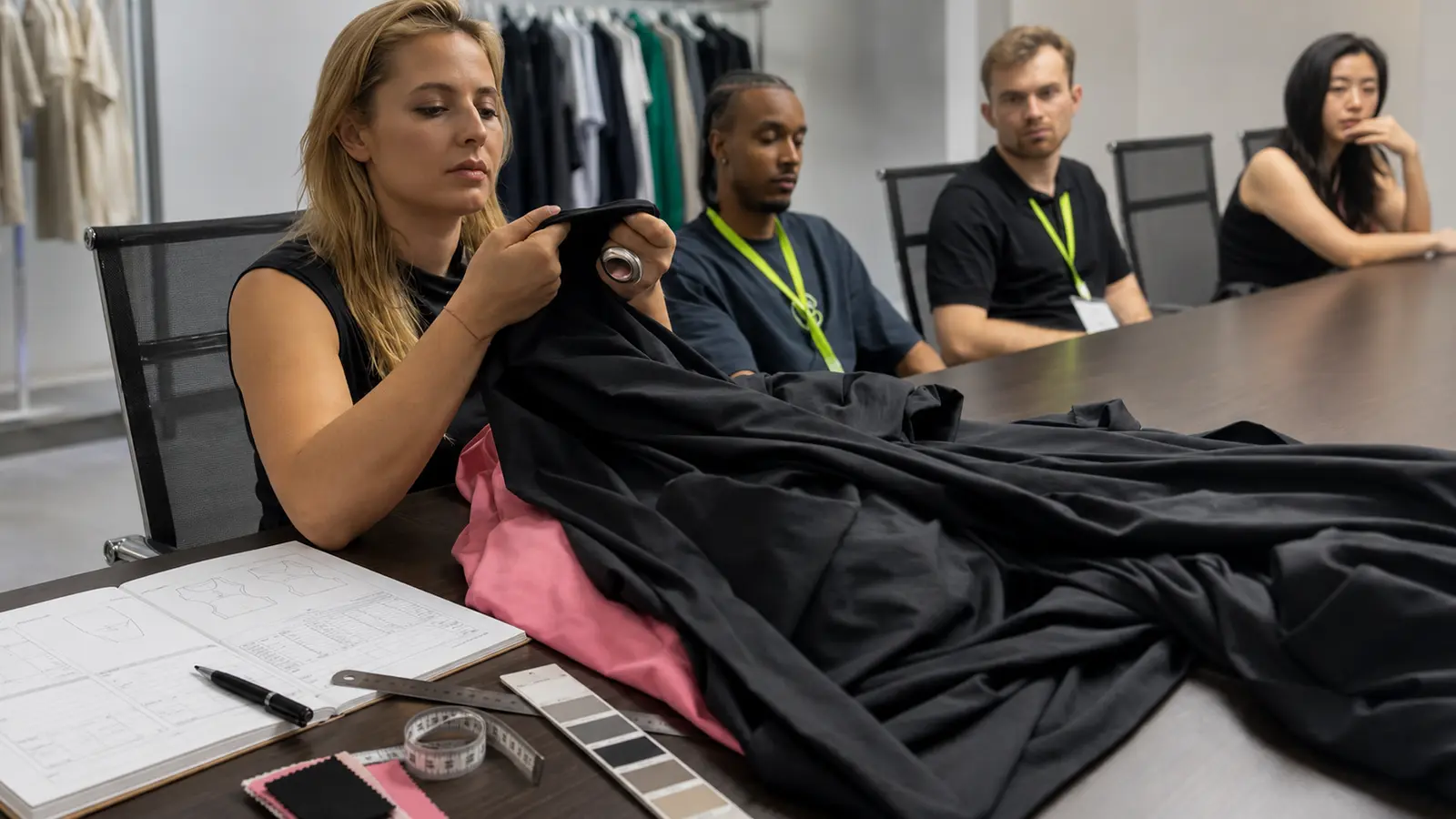
Fabric hand feel, construction and specification details are reviewed together before development moves forward.
How to send a physical fabric or garment reference
A physical reference can shorten the search, but only when it is labelled and explained.
For a fabric cutting, include:
- Project and fabric-position code
- Face and reverse sides
- Warp, wale or length direction if known
- The quality you want to reproduce or improve
- What you like about the sample
- What must change
- Whether destructive analysis is permitted
For a garment, identify the relevant panel and explain whether the target is the hand feel, support, appearance, performance or complete material construction.
Avoid sending a reference with only the instruction “same as this.” The sample may contain several attributes that conflict with the new project. You may want its softness but not its weight, or its opacity but not its high compression.
Color references should be equally clear. State whether the standard is a physical fabric cutting, a recognized color system reference or an approved lab dip. Digital screen colors can support early discussion but should not be the sole approval reference for production color.
Choose the right development route
After reviewing the brief and references, the manufacturer will normally recommend one of three routes.
Route | Best used when | Typical next step | Main consideration |
|---|---|---|---|
Existing article | A current fabric already meets the main requirements | Review available swatches or sample yardage | Fastest way to assess a proven base quality |
Modified existing article | The base quality is close but color, finish, weight or hand needs adjustment | Confirm feasible changes and make a development sample | Changes can affect more than one property |
Custom development | The project requires a different yarn blend, structure or performance balance | Confirm development scope, technical targets and trial plan | More variables require clearer checkpoints |
An existing fabric should not be rejected simply because its specification is slightly different from the first draft of the tech pack. If it solves the garment’s main risks and performs well in a sewing trial, it may be a stronger commercial option than a custom construction.
Conversely, customization should not begin until the buyer and manufacturer agree on what the development is intended to improve. Changing composition, yarn, gauge, weight, width, color and finish at the same time makes it difficult to understand why a sample succeeds or fails.
A practical sample-development sequence
Sample development works best as a series of decisions rather than a request for one “perfect” sample.
Step 1: Initial fabric screening
The manufacturer reviews the brief and proposes a small, relevant group of articles. Compare them against the garment use, not only against each other.
Record why each option is accepted or rejected. “Too light for the desired coverage” is actionable; “does not feel premium” is not.
Step 2: Physical swatch review
Check face and reverse, thickness, drape, surface, hand feel and color. Stretch the swatch in both directions and allow it to recover, but treat this only as an initial handling check—not as a substitute for testing.
Step 3: Lab dip or color development
Provide the agreed color reference and viewing conditions. Review shade, undertone and metamerism where relevant, then identify the approved lab dip clearly.
Cofinay’s current service information lists standard lab dips at approximately 3–5 business days. Actual timing should be reconfirmed for the selected fabric, color, finish and submission requirements.
Step 4: Prototype yardage
Order enough material for the planned garment trial and any required testing. Confirm whether the yardage uses the intended yarn, structure, color and finish or whether any element remains provisional.
Current Cofinay service information lists custom prototype yardage and sample swatches at around seven days. This is a planning reference rather than a universal lead-time promise; the final schedule depends on the development route and actual customization details.
Step 5: Garment sample and wear evaluation
Cut and sew the fabric in the intended pattern. Evaluate coverage, mobility, support, seam behavior, comfort and appearance on the garment—not only on the table.
If the fabric is intended for leggings, for example, assess opacity at the actual garment extension. For a running top, check moisture comfort, cling and drying behavior under realistic use conditions. Record garment size, color and wearer feedback so the result can be interpreted properly.
Step 6: Technical testing
Use the test plan agreed for the product and market. Relevant checks may include dimensional stability, colorfastness, pilling, abrasion, stretch and recovery, bursting strength or functional performance. The required methods and pass criteria should come from the buyer’s quality standard or an agreed project specification.
Step 7: Approval and bulk handover
Approval should identify the exact sample, not simply say “approved.” Record:
- Fabric article or development code
- Composition, construction, weight and usable width
- Approved color reference or lab-dip code
- Approved finish and hand-feel reference
- Test report or result status
- Garment-trial version
- Accepted tolerances
- Any condition still to be checked in bulk
- Approval date and responsible person
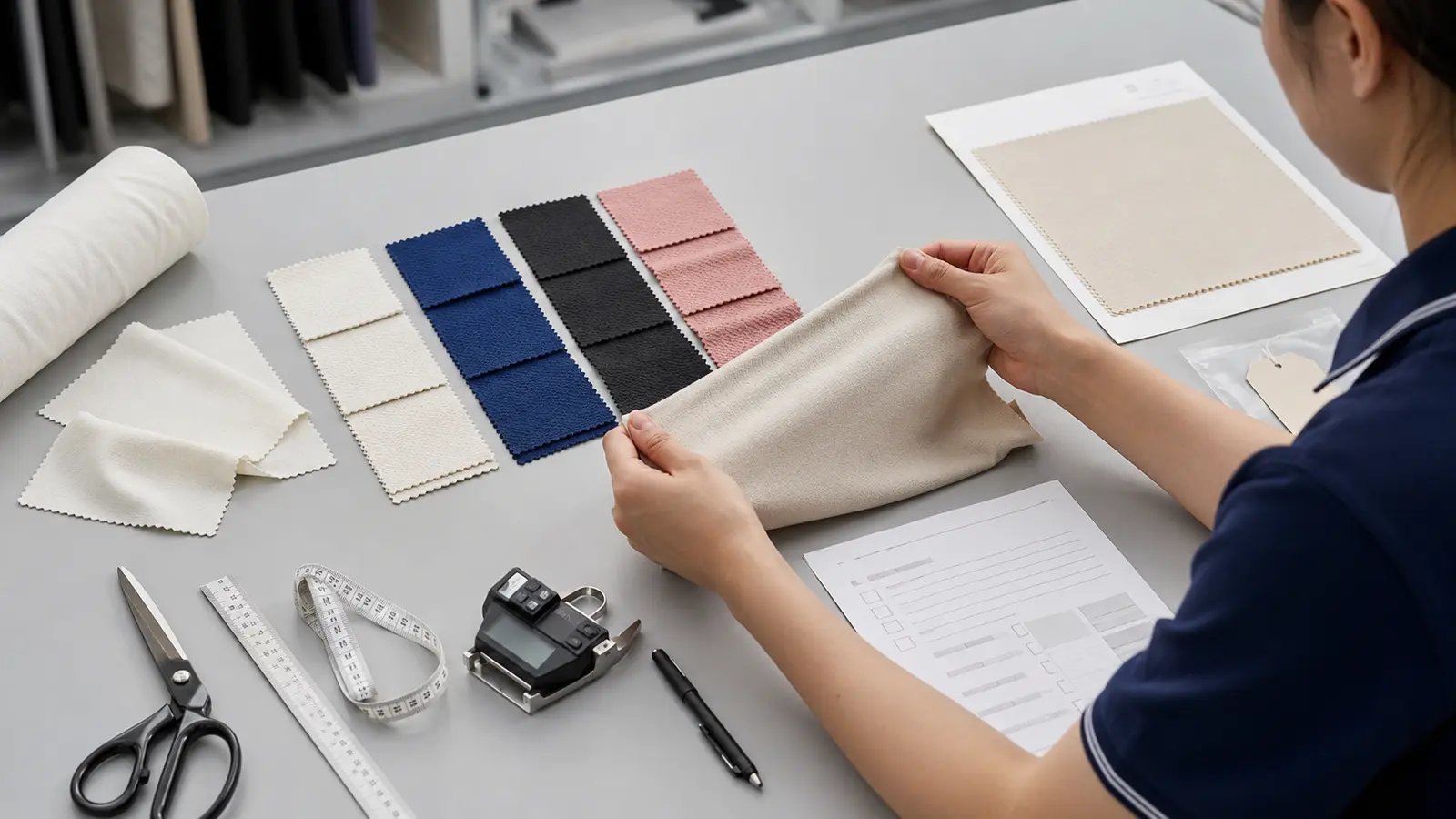
Fabric color, hand feel and construction are reviewed against the specification before a reference sample is confirmed.
Questions the manufacturer is likely to ask
A detailed brief does not eliminate questions. It makes the questions more useful.
Be ready to answer:
- Which three requirements are non-negotiable?
- Which parameter can change if it improves cost or lead time?
- Is the stated composition required or preferred?
- What part of the reference sample should be matched?
- How much support or compression should the garment provide?
- At what extension and in which color must opacity be assessed?
- Which tests and pass criteria apply to the target market?
- How many colors and what quantity per color are planned?
- Is the sample deadline different from the bulk-delivery deadline?
- Who will approve fabric, color, testing and commercial terms?
If the project team cannot answer all ten immediately, identify the owner and decision date for each open point.
Replace vague requests with usable instructions
Vague request | Better instruction |
|---|---|
“We need the best quality.” | “Our main risks are loss of recovery and surface pilling after repeated wear.” |
“Make it feel premium.” | “We want a smooth, compact face, low shine and a soft reverse without a heavy brushed surface.” |
“It must be squat-proof.” | “The finished dark-color legging must maintain acceptable coverage at the intended pattern extension; we will confirm this in the garment trial.” |
“Match this fabric.” | “Match the reference hand feel and opacity, but reduce weight and retain a matte face.” |
“We need recycled fabric with certification.” | “Please confirm the recycled fiber content, applicable certification scope and order-specific documentation available before quotation.” |
“The order is urgent.” | “Swatches are needed by [date], prototype yardage by [date] and bulk fabric at [destination] by [date].” |
Copy-and-paste activewear fabric RFQ template
BUYER AND PROJECTCompany / Brand:Contact Person:Project Name:Garment Category:Fabric Position:Intended Activity / Use:Target Market:Development Stage:
FABRIC TARGETRequired Composition:Preferred Composition or Alternatives Allowed:Construction:Target GSM and Tolerance:Usable Width and Tolerance:Face / Reverse Appearance:Hand Feel:Stretch and Recovery Requirement:Opacity / Coverage Requirement:Required Functions:Required Tests and Pass Criteria:Compliance or Documentation Requirements:
COLOR AND REFERENCESNumber of Colors:Color Standard:Physical Fabric or Garment Reference Included:What to Match:What to Change:
QUANTITY AND TIMINGEstimated Fabric Quantity:Estimated Quantity per Color:Swatch Requirement:Prototype Yardage Requirement:Sample Deadline:Target Bulk Delivery Date:Destination:
PLEASE CONFIRMRecommended Article(s):Price Basis:MOQ / Color MOQ:Sample Cost:Lab-Dip and Prototype Timing:Bulk Lead Time:Available Test Reports / Order Documents:Payment and Trade Terms:Any Specification Risks or Recommended Alternatives:
Commercial points to confirm before development starts
Technical suitability and commercial feasibility should be reviewed together. Before authorizing a custom sample, confirm:
- MOQ for the selected fabric article
- MOQ per custom color
- Whether suitable greige or finished stock is available
- Swatch, lab-dip and prototype-yardage charges
- What sample freight is included or excluded
- Quotation unit and price basis
- Sampling and bulk lead times
- Payment and trade terms
- Testing responsibilities and charges
- Certification or transaction-document scope where applicable
- Packaging, roll-length and shipping requirements
- How long the quotation and approved color standard remain valid
Cofinay’s product range includes articles with different MOQs, stock positions and customization routes. These points should therefore be confirmed against the selected article and the actual order rather than assumed from a general service statement.
How Cofinay reviews an activewear fabric brief
Cofinay by Xiongqi Textile Technology Co., Ltd. can begin with an existing fabric article, a physical swatch, a garment reference or a new technical target.
The first review compares the garment use and priorities with available nylon, polyester, spandex and recycled-fiber constructions. If an existing article is close, the team can discuss color and finish options. If the project requires a different balance of stretch, weight, width, surface or performance, the development scope can be adjusted around the buyer’s confirmed priorities.
Because knitting, dyeing, finishing and quality control are connected stages, a requested change should be reviewed for its effect on the complete fabric rather than treated as an isolated number. A softer finish, for example, may also influence surface appearance or performance; a weight change may affect coverage and recovery.
For accurate planning, final MOQ, pricing, test scope, certification documents and lead time are confirmed according to the chosen fabric, colors, order volume and customization details.
Frequently asked questions
Do I need a complete garment tech pack before contacting a fabric manufacturer?
No. You can begin with the garment type, intended use, reference sample and top priorities. Clearly mark unknown values and update the brief as decisions are made. A partial but honest brief is more useful than a complete-looking document filled with assumptions.
Can I request fabric from a photograph?
A photograph can communicate color, drape and general surface direction, but it cannot confirm weight, construction, stretch, recovery or hand feel. Use it for initial direction and follow with a physical reference or measurable target.
Can the manufacturer analyze a fabric swatch?
Yes. Cofinay supports physical-swatch analysis and development. State what you want to preserve, what you want to change and whether the sample can be cut for analysis.
Is a digital color card enough for approval?
It is useful for browsing and shortlisting. Production color should be approved through the agreed physical color standard or lab-dip process because screens, lighting and device settings alter color appearance.
When should the final price be confirmed?
Request an initial quotation early, then reconfirm after the article, color, finish, quantity, testing, packaging and trade terms are defined. Custom-development choices can change the commercial basis.
What must be approved before bulk production?
At minimum, approve the fabric article, specification, color, finish, relevant test status, garment-trial result and commercial terms. Make sure the approved sample or record can be identified later without relying on memory.
A clear brief saves decisions, not just emails
The purpose of an RFQ and tech pack is not to make the buyer sound technical. It is to help both sides make the same product decision.
Start with the garment and its risks. Separate requirements from preferences. Label every reference. Use sampling to answer one set of questions at a time, and record the approved result before bulk production begins.
To start a new project, browse the Cofinay activewear fabric collection, review our integrated manufacturing process or send your RFQ and reference details to the Cofinay team.
Prepared by the Cofinay Technical Team.
About Cofinay
With over 16 years of expertise, Cofinay is a premier manufacturer of high-end activewear fabrics, certified by global ecological standards. We specialize in engineering premium performance knits for yoga, tennis, equestrian, and golf. Backed by our self-operated vertical weaving and dyeing infrastructure, we provide complete end-to-end services to empower global activewear brands to scale.