
Table of Contents
- 1. Custom Development Begins with Decisions, Not Machinery
- 2. 1. The Buyer Brief Is Converted into a Fabric Target
- 3. 2. The Team Chooses the Most Efficient Development Route
- 4. 3. Yarn, Blend and Knit Structure Are Engineered Together
- 5. 4. Physical Samples Replace Assumptions
- 6. 5. Trial Knitting Establishes the Greige-Fabric Baseline
- 7. 6. Color and Performance Are Built through a Controlled 12-Step Dyeing and Finishing Route
- 8. 7. Testing Must Reflect the Garment's Real Failure Risks
- 9. 8. Approval Creates the Control Standard for Bulk Production
- 10. 9. Bulk Production Repeats the Approved Route with Multiple Quality Gates
- 11. 10. What Is Customized from Project to Project?
- 12. Conclusion: A Custom Fabric Is an Approved Chain of Decisions
Custom Development Begins with Decisions, Not Machinery
A custom activewear fabric does not begin at the knitting machine. It begins with a garment, a wearer and a set of priorities that must be translated into a material.
A buyer may ask for a fabric that feels soft, provides support, stays opaque during movement and meets a target cost. Those requests are useful, but they are not yet a production specification. Softness can come from the yarn, knit structure or finishing route. Support depends on more than the percentage of spandex. Opacity changes with color, density and extension. Cost may be affected by composition, usable width, dyeing, finishing, testing and order volume.
The development process is therefore a sequence of controlled decisions. Each stage should narrow uncertainty until the approved fabric can be reproduced in bulk.
1. The Buyer Brief Is Converted into a Fabric Target
The first task is not to choose a composition. It is to understand how the finished garment must behave.
For a close-fitting legging, the discussion may focus on coverage at extension, stretch recovery, support and surface durability. A running top may place more weight on moisture movement, drying, low mass and next-to-skin comfort. A tennis dress may require a balance of mobility, drape, coverage and appearance.
The technical team reviews the buyer's information and separates it into four groups:
Input from the buyer | Technical question it creates |
|---|---|
Garment type and fit | What structure, weight and support level are appropriate? |
Activity and wearing conditions | Which performance risks should the fabric and garment trial address? |
Hand feel and appearance | Should the surface be matte, lustrous, smooth, dry, brushed, compact or fluid? |
Commercial target | Which requirements are fixed, and where can composition, finish or construction be adjusted? |
This is also the point to identify compliance documents, test methods, color standards, expected quantities and delivery conditions. If a requirement is still unknown, it should be recorded as open rather than replaced with a guess.
2. The Team Chooses the Most Efficient Development Route
Not every project needs a fabric to be rebuilt from zero. After the target is clear, one of three routes is normally more practical.
Development route | Best suited to | Typical work involved |
|---|---|---|
Existing article | A proven fabric already meets most requirements | Select an article, confirm color, finish, testing and order conditions |
Modified base fabric | A suitable structure exists but one or two attributes need adjustment | Revise yarn ratio, weight, density, hand feel, color or functional finish |
New custom construction | The required combination cannot be achieved reliably with an existing base | Engineer the yarn system, knit structure, gauge, density and finishing route |
Using an existing or modified base can shorten development and reduce unnecessary sampling. A new construction is justified when the garment needs a genuinely different balance of support, recovery, coverage, surface or weight.
This distinction matters because “custom” should describe a technical need, not simply a longer development process.
3. Yarn, Blend and Knit Structure Are Engineered Together
Composition is important, but it does not predict fabric performance by itself. Two nylon–spandex fabrics with the same percentages can differ substantially because of filament type, yarn count, loop construction, density, gauge and finishing.
At Cofinay, the available route may include polyester, nylon, spandex, recycled polyester or other project-specific yarns. The choice depends on the intended garment and the buyer's priorities:
- Polyester can support moisture-management, color and cost objectives in many activewear constructions.
- Nylon is often considered where smooth hand feel, abrasion performance and a refined surface are important.
- Spandex contributes extension and recovery, but its percentage must be evaluated with the full construction rather than treated as a compression score.
- Recycled polyester or recycled nylon may be selected when traceable recycled content and the relevant documentation are part of the project brief.
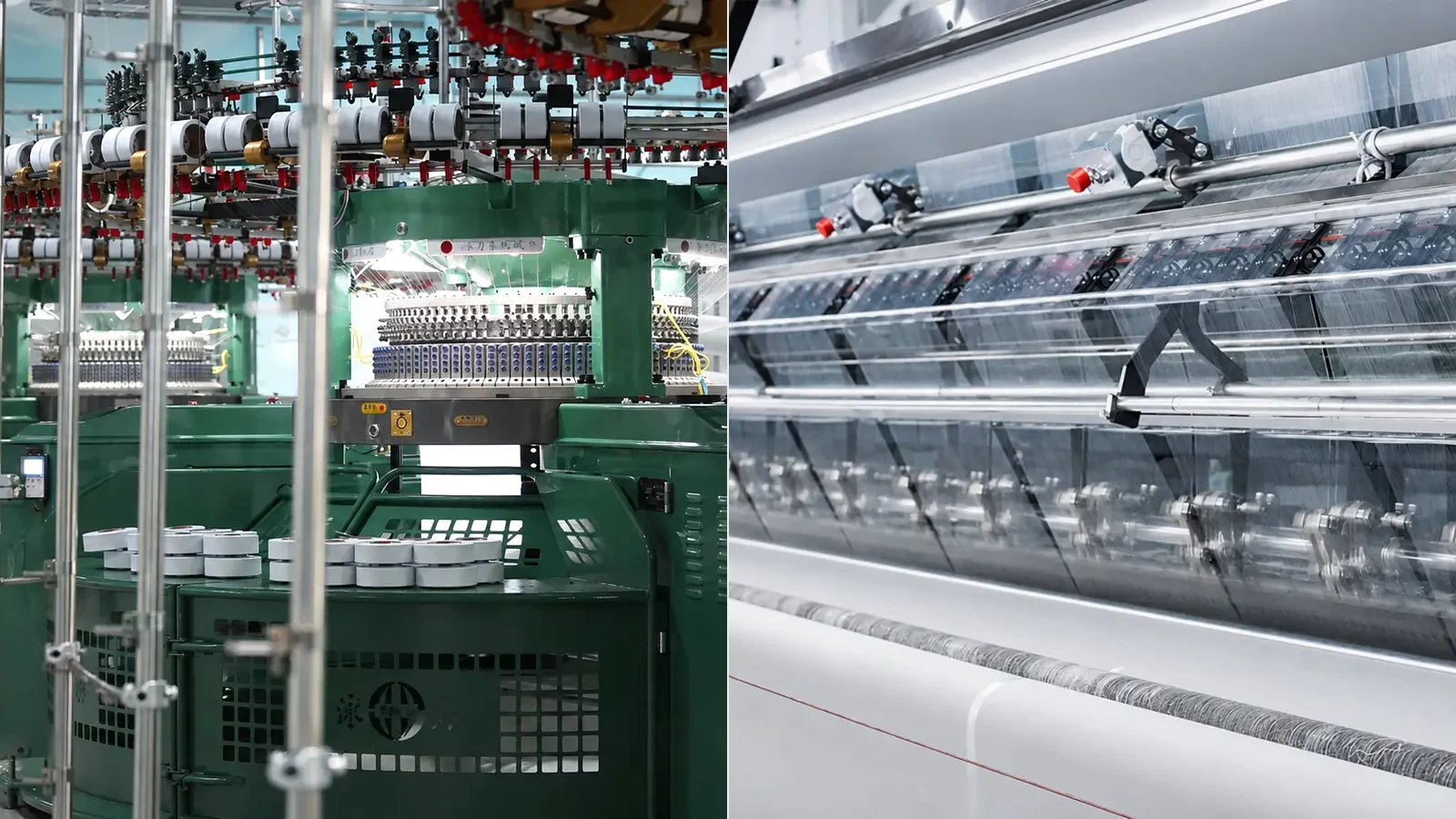
The team then determines whether a circular-knit or warp-knit route is more appropriate. High-gauge circular knitting can create compact, smooth fabrics for leggings, bras, tops and other close-fitting garments. Warp-knit structures may be selected when dimensional control, recovery or a particular technical surface is required.
Machine gauge, yarn tension and loop formation are adjusted as one system. Cofinay's knitting operations use precision equipment, including Groz-Beckert needles, but the machine specification is not the final objective. The objective is a repeatable greige fabric that can survive dyeing and finishing while retaining the required structure.
4. Physical Samples Replace Assumptions
Once a promising route has been selected, the project moves from description to evidence.
Depending on the starting point, the first physical submission may include stock swatches, a modified sample, lab dips or prototype yardage. A physical reference is especially important when the brief uses words such as “buttery,” “cool,” “dry” or “compressive.” These terms are useful for direction, but they do not have one universal technical meaning.
Each sample should carry a stable identifier and revision. The record should connect the sample to its known composition, construction, weight, usable width, color or finish route. Comments such as “Sample B is better” are hard to use later unless Sample B can be traced to an actual specification.
Cofinay publishes short turnaround targets for common lab dips and prototype samples. These are planning references, not universal promises. Actual timing depends on the selected construction, raw-material status, number of colors, finishing route, testing and shipment requirements. The project schedule should be confirmed against the final customization details.
5. Trial Knitting Establishes the Greige-Fabric Baseline
During trial knitting, technicians set up the specified yarn paths and monitor the variables that shape the unfinished fabric. These include yarn tension, loop consistency, knitting density, roll weight and visible structural defects.
Incoming yarn control also matters. Depending on the project, checks may review yarn count or denier, strength, moisture condition, lot consistency and surface condition. A problem introduced at the yarn stage can reappear as barre, uneven dye uptake, width variation or recovery inconsistency later.
The resulting greige fabric is not judged only by how it looks before dyeing. It must provide a stable foundation for the planned wet processing, heat setting and finish.
6. Color and Performance Are Built through a Controlled 12-Step Dyeing and Finishing Route
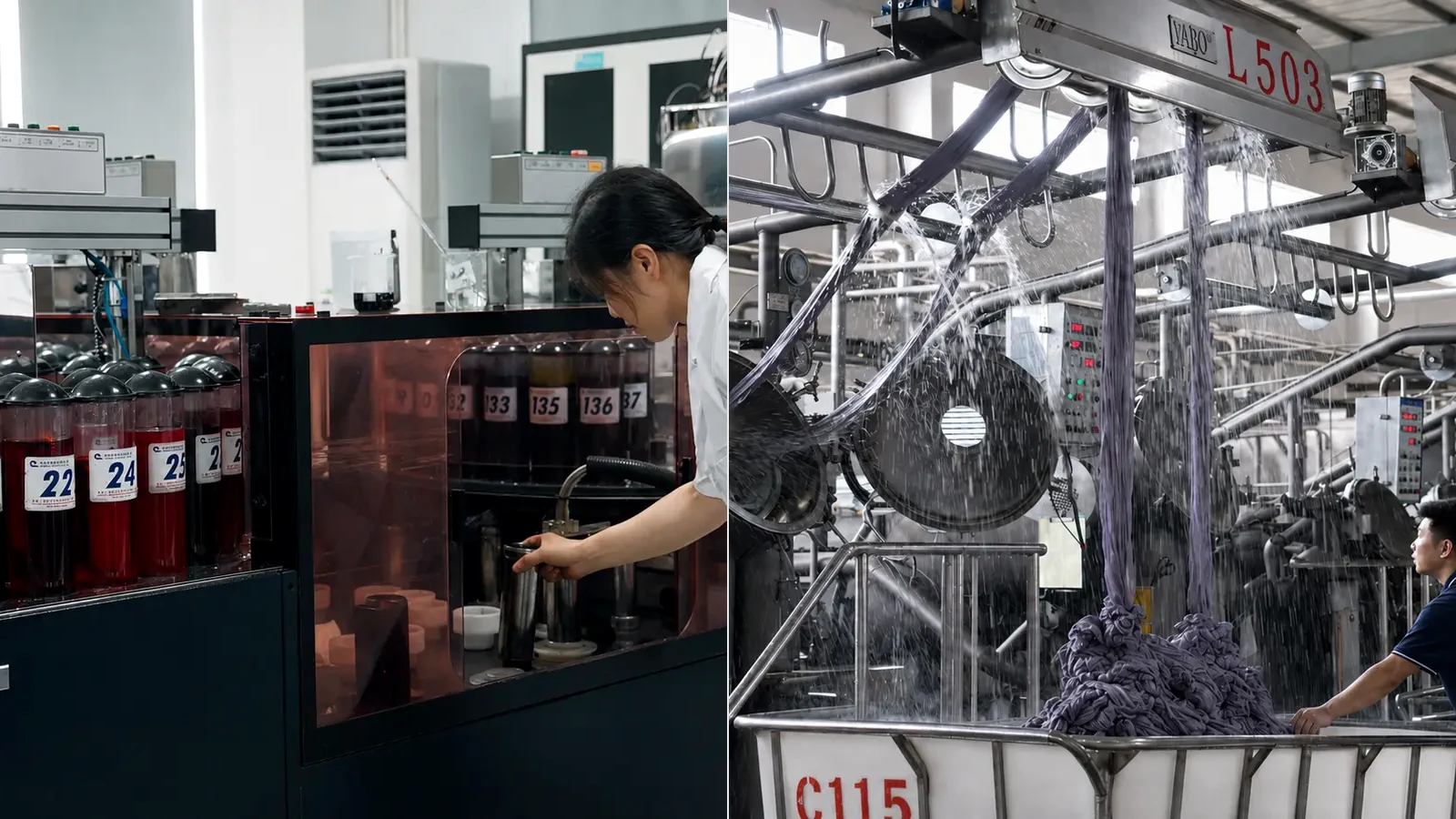
Cofinay's published dyeing and finishing workflow contains 12 stages. The exact settings and chemistry vary by article, color and required finish, but the control sequence remains important.
Stage | Process | Development purpose |
|---|---|---|
01 | Pre-scouring | Removes knitting oils and residues so the fabric can absorb dye evenly |
02 | Pre-setting | Stabilizes initial width, density and internal stress |
03 | Air tumbling | Develops softness, loft and elastic comfort through mechanical action |
04 | Color matching | Converts the approved color target into a controlled dye formula |
05 | Jet dyeing | Applies color with the process conditions selected for the fiber system |
06 | Shade auditing | Compares the dyed lot with the approved standard under controlled lighting |
07 | Dewatering | Removes excess moisture before open-width processing |
08 | Fabric slitting | Opens and flattens rope-form fabric for uniform finishing |
09 | Wet sueding | Creates a fine raised surface when the specified hand feel requires it |
10 | Final setting | Locks final width and weight and may apply specified functional finishes |
11 | Lab testing | Checks agreed physical and performance requirements before release |
12 | Warehousing | Packages and identifies inspected rolls for traceable dispatch |
Not every custom fabric should receive the same finish. A buyer seeking maximum softness may accept a different surface-durability balance from a buyer prioritizing abrasion resistance. A project requiring stringent colorfastness may need a different dye and wash-off route from one built around strict cost control. These decisions are made against the actual end use, not added as generic features.
7. Testing Must Reflect the Garment's Real Failure Risks
A long test report is not automatically a useful test plan. The tests should answer the risks identified in the first brief.
Garment or claim | Questions to verify before bulk approval |
|---|---|
Leggings and fitted bottoms | Is coverage acceptable at the intended extension? Does the fabric recover after repeated movement? |
Running or training tops | Does the material manage moisture and dry as required without becoming uncomfortable? |
Sports bras and support panels | Does the fabric combine stretch with controlled recovery and adequate dimensional stability? |
Brushed or soft-touch fabric | Does the selected surface remain acceptable after abrasion, pilling and laundering? |
Matching sets | Is shade consistency acceptable across articles, lots and viewing conditions? |
UV, antibacterial or other functional claim | Has the exact claim been evaluated using the agreed method and sample condition? |
Common laboratory checks may include weight, usable width, dimensional stability, pilling, abrasion, bursting strength, stretch and recovery, colorfastness and moisture-related performance. The buyer and manufacturer should agree on the methods, sample condition and pass criteria rather than relying on the test name alone.
A garment trial is equally important. It reveals issues that a flat fabric specimen may not show: opacity on the body, seam behavior, waistband recovery, edge rolling, panel compatibility and appearance after wear and washing.
8. Approval Creates the Control Standard for Bulk Production
Bulk production should not begin from a chain of emails or an unmarked swatch. It should begin from an approval set.
That set may include:
- The approved physical fabric sample
- Final composition, construction, weight and usable width
- Approved color standard or lab dip
- Confirmed surface and hand-feel reference
- Agreed stretch, recovery and dimensional criteria
- Relevant test methods and pass requirements
- Garment-trial feedback and resolved comments
- Packaging, identification, quantity and delivery conditions
If a value has changed during development, the final record should replace the older revision. The goal is not paperwork for its own sake. It is to give sales, technical, production, dyeing and quality teams the same control target.
9. Bulk Production Repeats the Approved Route with Multiple Quality Gates
Once the control standard is locked, the approved yarn, knitting, dyeing and finishing route is scheduled for bulk production. The scale is larger, but the reference remains the approved development.
Cofinay's vertical setup connects knitting, dyeing, finishing and quality control within one manufacturing chain. Quality checks are therefore placed at more than one point:
- Inbound checks review relevant raw-yarn parameters and lot consistency.
- In-line checks monitor knitting tension, density, roll weight and structural condition.
- Dyeing and finishing controls compare shade, width, weight, hand feel and dimensional behavior with the approved target.
- Laboratory tests review the agreed release requirements.
- Finished rolls are inspected on illuminated frames and graded using the Four-Point System before packaging.
No process can remove every source of variation, but a connected control system makes variation easier to identify before it becomes a garment-production problem.
10. What Is Customized from Project to Project?
Custom development does not mean maximizing every parameter. It means selecting the right balance for one product and one business case.
A project may prioritize:
- Exceptional colorfastness for a demanding use or market
- A specific level of support and recovery
- Lower mass with acceptable coverage
- A particular matte, smooth, brushed or dry surface
- Traceable recycled content and supporting documentation
- Cost control within clearly defined performance limits
- Faster development using an available greige construction
These priorities can lead to different raw materials, yarn ratios, densities, dye recipes, setting conditions, finishes, test plans, MOQs and schedules. All technical and commercial details should therefore be confirmed against the actual order rather than treated as fixed for every Cofinay fabric.
Conclusion: A Custom Fabric Is an Approved Chain of Decisions
The finished roll is only the visible result. Behind it is a sequence that begins with the buyer's garment and ends with a traceable production standard.
When the brief, sample identity, color approval, testing and bulk controls are connected, custom development becomes easier to manage. The buyer can see why a material was selected, the technical team can explain the trade-offs, and production has a clear target to reproduce.
For help preparing the first enquiry, read How to Brief an Activewear Fabric Manufacturer. To discuss an existing quality, a modified base fabric or a new construction, contact Cofinay and include the garment type, intended use, target quantity, timing and any physical references available.
About Cofinay
With over 16 years of expertise, Cofinay is a premier manufacturer of high-end activewear fabrics, certified by global ecological standards. We specialize in engineering premium performance knits for yoga, tennis, equestrian, and golf. Backed by our self-operated vertical weaving and dyeing infrastructure, we provide complete end-to-end services to empower global activewear brands to scale.