
Table of Contents
- 1. A Fabric Recommendation Is Only the Start
- 2. 1. The Conversation Starts with the Garment, Not a Catalog Code
- 3. 2. Subjective Design Language Is Translated into Technical Variables
- 4. 3. A Shortlist Is Built around Trade-Offs, Not Sample Quantity
- 5. 4. Conflicting Requirements Are Discussed before Sampling
- 5.1. Softness versus surface durability
- 5.2. Compression versus comfort
- 5.3. Low weight versus coverage
- 5.4. Performance versus cost
- 5.5. Recycled content versus documentation scope
- 6. 5. Material Decisions Are Connected to Pattern and Sewing Behavior
- 7. 6. Sample Feedback Is Converted into Actionable Revisions
- 8. 7. Color Approval Is Managed as Part of Performance
- 9. 8. The Test Plan Follows the Product's Actual Risk
- 10. 9. Traceability Keeps the Project Aligned from Swatch to Bulk
- 11. 10. Vertical Manufacturing Makes Cross-Functional Feedback More Direct
- 12. 11. What the Buyer Provides—and What the Technical Team Returns
- 13. 12. When a Custom Development Is Worthwhile
- 14. Conclusion: The Best Fabric Decision Is a Shared Technical Decision
A Fabric Recommendation Is Only the Start
When a brand asks for activewear fabric, the visible task is to send swatches. The more important task is to determine which swatches are relevant—and what must happen before one of them is safe to order in bulk.
A fabric can feel excellent in the hand and still be wrong for the garment. It may lose coverage at the required extension, create too much seam bulk, recover poorly at a waistband or develop a different appearance after dyeing and finishing. A composition label and GSM cannot answer those questions on their own.
The Cofinay technical team works between the buyer's product language and the factory's production controls. The role is not to replace the brand's designer, pattern maker or quality team. It is to connect their decisions to yarn, construction, color, finish, testing and manufacturability.
1. The Conversation Starts with the Garment, Not a Catalog Code
The same fabric does not serve every activewear product in the same way. Before suggesting an article, the team needs to understand the garment and the conditions in which it will be worn.
Useful starting information includes:
- Garment category and fabric position
- Intended activity and climate
- Close, regular or relaxed fit
- Required support or compression direction
- Coverage expectations at extension
- Surface and hand-feel reference
- Functional priorities and required claims
- Target price range and estimated quantity
- Color count, compliance needs and development timing
The team also asks which requirement is most important when two objectives conflict. A buyer may want very low weight, strong compression and complete opacity in a pale color. Those priorities cannot always be maximized at the same time. Identifying the ranking early makes the recommendation more honest and the sample round more useful.
2. Subjective Design Language Is Translated into Technical Variables
Activewear development depends on sensory language. Designers naturally use words such as “buttery,” “clean,” “sculpting” and “premium.” The technical team does not discard those words; it connects them to attributes that can be compared.
Buyer language | What the team may review |
|---|---|
Buttery soft | Filament fineness, knit structure, surface finish, friction and drape |
Sculpting or compressive | Extension under load, recovery, density, modulus and garment fit |
Squat-proof | Color, density, thickness and coverage at the intended extension |
Lightweight | Finished GSM, thickness, openness and the minimum acceptable coverage |
Matte | Fiber luster, surface geometry, color and finish |
Cool touch | Fiber and surface selection, moisture behavior and actual wearing conditions |
Premium hand feel | Surface evenness, body, drape, finishing and consistency—not price alone |
Physical references make this translation more accurate. A garment or fabric swatch can show what the buyer means by soft, dry, compact or fluid. The team can then identify which elements should be reproduced and which should be changed.
3. A Shortlist Is Built around Trade-Offs, Not Sample Quantity
Sending many unrelated samples shifts the technical work back to the buyer. A better approach is to build a small, reasoned shortlist.
For each option, the team should explain:
- Why the construction may suit the garment
- Which requirement it handles well
- Which trade-off the buyer should evaluate
- Whether it is available, modifiable or requires new development
- What must be tested in fabric or garment form
For example, one fabric may provide stronger recovery and a more compact body, while another offers softer drape and easier stretch. The correct choice depends on the fit and product position; there is no universal winner.
When no existing article meets the brief, Cofinay can review changes to yarn ratio, construction, density, weight, color or finishing. A completely new knit route is considered when modification would not address the underlying requirement.
4. Conflicting Requirements Are Discussed before Sampling
Many development delays come from hidden conflicts rather than factory execution.
Softness versus surface durability
A stronger sueding or brushing treatment may create the desired touch but can also change surface appearance, pilling behavior and maintenance. The finish should be judged after the relevant abrasion and laundering—not only when the sample is new.
Compression versus comfort
Adding spandex does not automatically create better support. Yarn system, structure, density, extension curve and recovery all influence the result. The correct level must also be tested in the actual garment pattern.
Low weight versus coverage
Reducing weight can improve lightness and drying, but may reduce opacity, body or stability. Pale colors and high extension deserve separate review.
Performance versus cost
Premium yarns, complex structures, additional finishing and extensive testing can all affect cost. If cost control is strict, the team needs to know which performance attributes cannot move and which can be optimized.
Recycled content versus documentation scope
When a project uses recycled polyester or recycled nylon, the buyer should specify the required recycled percentage, certification scope and transaction documentation. A supplier certificate is not a substitute for checking whether the final order and claim fall within the required chain of custody.
These conversations do not weaken the product idea. They turn it into a brief that can be manufactured and evaluated.
5. Material Decisions Are Connected to Pattern and Sewing Behavior
A fabric is approved for a garment, not for a swatch book. The technical team therefore needs feedback from cutting and sewing trials.
Key observations may include:
- Usable width and marker efficiency
- Edge curling or distortion during cutting
- Seam stretch and seam recovery
- Needle cutting, skipped stitches or puckering
- Bulk at hems, waistbands and layered panels
- Compatibility with lining, mesh, elastic or bonded components
- Opacity and support on the intended garment block
- Appearance after wear and laundering
These issues are shared between material and garment engineering. Some can be improved by changing sewing parameters; others indicate that the fabric specification should be revised.

6. Sample Feedback Is Converted into Actionable Revisions
“Too thin,” “not soft enough” or “needs more compression” are valid first reactions. To guide the next sample, they need context.
A useful comment identifies:
- The exact sample and revision
- The garment area or test condition
- The observed problem
- The intended change
- The reference used for comparison
- Whether the comment is mandatory or preferred
Instead of “Sample 2 is too sheer,” a more actionable note would be: “Sample 2 loses coverage at the seat when the legging is worn at the current pattern extension. Maintain the matte face and soft hand, but improve coverage without substantially increasing finished weight.”
The team can then decide whether to change density, yarn, structure, weight, color or garment extension. Clear feedback reduces random iteration.
7. Color Approval Is Managed as Part of Performance
Color is not an isolated decorative choice. Dyeing can affect hand feel, dimensional behavior and stretch, while the same target shade can appear different on different fibers or structures.
The technical team helps define:
- The master color standard, such as an approved physical swatch or Pantone reference
- The light sources used for review
- Whether multiple fabric articles must match as one set
- The allowed shade relationship between main fabric, lining and trim
- Which lab dip becomes the signed approval standard
- Whether colorfastness requirements need a project-specific route
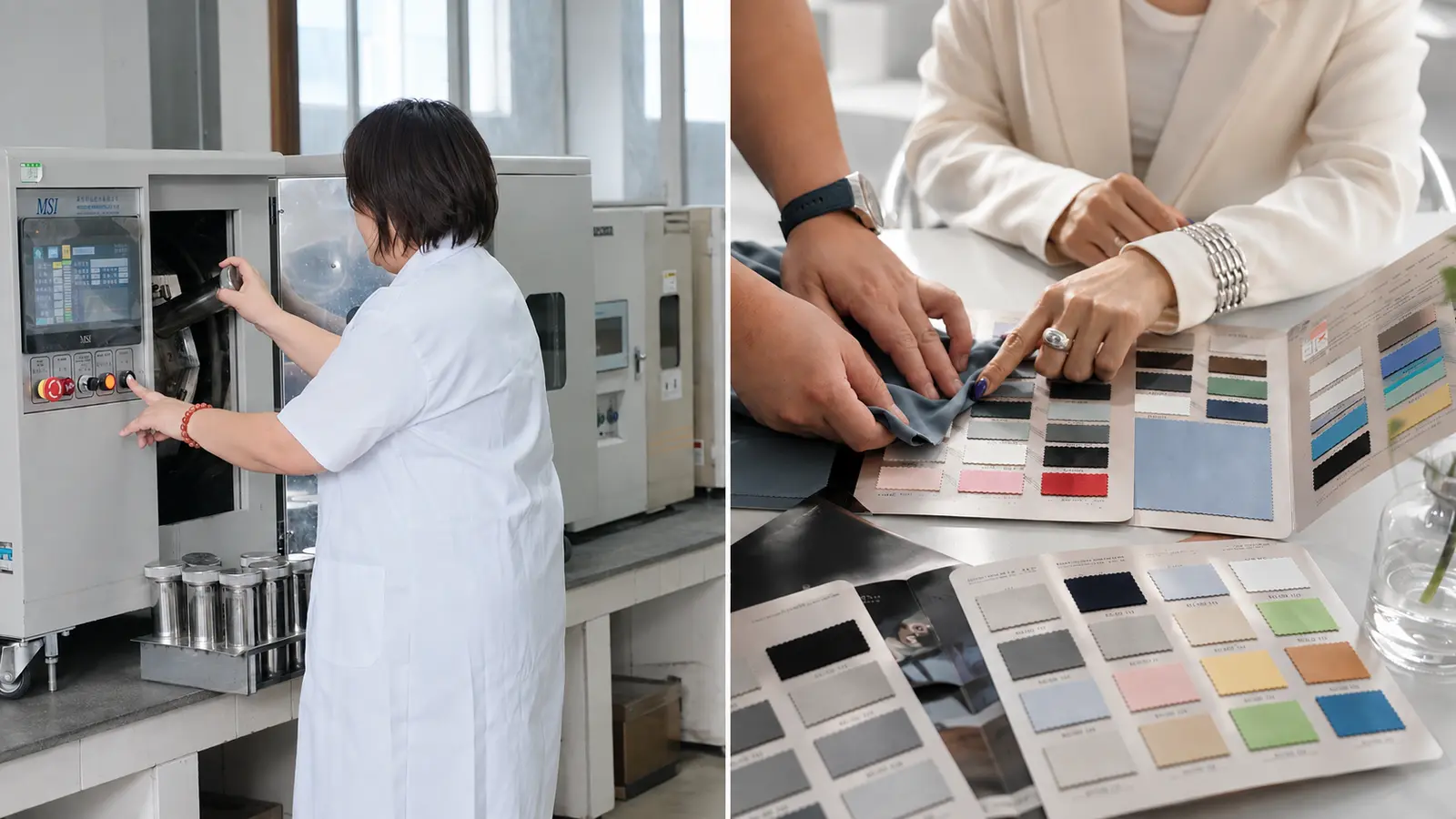
Cofinay uses digital color analysis and controlled light sources to support lab-dip and bulk shade review. However, instrumental data and visual approval serve different purposes. The final decision should follow the agreed method and be recorded against the correct sample.
8. The Test Plan Follows the Product's Actual Risk
Testing is most useful when it answers a decision. The team works with the buyer to connect garment risk, test method and pass criteria.
Product risk | Relevant evaluation may include |
|---|---|
Loss of shape | Dimensional stability, stretch and recovery after repeated extension or laundering |
Surface damage | Pilling, abrasion and snagging under the agreed conditions |
Color transfer or fading | Washing, rubbing, perspiration or other relevant colorfastness tests |
Failure in fitted garments | Bursting strength, seam behavior, coverage and recovery |
Moisture-related claim | Absorption, wicking, drying or other defined method |
UV or other functional claim | A method and sample condition suitable for the exact claim |
Passing a test on one sample does not automatically validate every color, finish or production lot. The scope of the test must match the claim being made.
9. Traceability Keeps the Project Aligned from Swatch to Bulk
Activewear developments often involve several swatches, lab dips, garment trials and revised comments. Without stable identification, the buyer and factory can be discussing different versions while using the same informal name.
Cofinay's technical workflow links samples and approvals to article or project codes. The working record may include:
- Fabric and revision code
- Composition and construction
- Finished weight and usable width
- Color or lab-dip identity
- Finish and hand-feel reference
- Test report and tested sample
- Garment-trial comments
- Approval status and outstanding conditions
The approved record then becomes the reference for knitting, dyeing, finishing, laboratory checks and final roll inspection.
10. Vertical Manufacturing Makes Cross-Functional Feedback More Direct
Cofinay by Xiongqi Textile Technology Co., Ltd. operates a vertically connected activewear-fabric chain covering knitting, dyeing, finishing and quality control. For the buyer, the practical advantage is not simply that these processes exist. It is that a problem can be discussed with the function that controls it.
A surface issue can involve knitting and finishing. A shade problem may require input from color development, dyeing and quality control. Recovery may involve yarn, structure, heat setting and garment extension. Cross-functional review helps avoid the common situation in which separate suppliers explain the same failure in different ways.
The commercial coordinator remains important. This person connects quantity, MOQ, timing, quotation, shipping and documentation with the technical route. Good development depends on both disciplines; technical feasibility without commercial clarity is not production-ready.
11. What the Buyer Provides—and What the Technical Team Returns
The collaboration becomes faster when responsibilities are visible.
Buyer provides | Cofinay technical team returns |
|---|---|
Garment, activity, fit and fabric position | A fabric route aligned with the actual end use |
Required and preferred attributes | A shortlist with trade-offs explained |
Physical reference or clear visual direction | Comparable samples and proposed adjustments |
Quantity, colors, timing and cost target | Feasibility, MOQ, sampling route and project-specific schedule |
Test and compliance requirements | Proposed test plan and documentation scope for confirmation |
Consolidated sample comments | A revised technical action rather than an unrelated replacement sample |
Signed color and fabric approvals | A production control standard for the relevant order |
The factory cannot infer every brand decision, and the buyer should not need to design the knitting and dyeing route alone. The best results come from a clear handoff in both directions.
12. When a Custom Development Is Worthwhile
A custom route is most useful when the brand has a clear gap to solve: an unavailable performance balance, a distinctive hand feel, a revised cost structure, a traceable material requirement or a fit problem that existing fabrics do not address.
It may not be the best first step when:
- The garment concept is still changing substantially
- The target quantity cannot support the proposed development route
- The buyer has not identified the essential performance priorities
- A proven existing article already meets the need
- The testing or compliance requirement is not yet defined
In those cases, starting with a controlled shortlist or modified base can create better information before committing to a new construction.
Conclusion: The Best Fabric Decision Is a Shared Technical Decision
Technical collaboration goes beyond recommending nylon, polyester or spandex. It means understanding the garment, exposing trade-offs, controlling sample revisions and connecting approval to the manufacturing route.
For a brand, this creates a clearer reason for selecting one fabric over another. For the factory, it creates a specification that can be produced, tested and inspected. For both teams, it reduces the gap between an attractive swatch and a dependable bulk material.
Read How a Custom Activewear Fabric Is Developed at Cofinay for the full brief-to-bulk workflow. If you are preparing a new project, contact Cofinay with the garment category, intended use, priorities, estimated quantity and any available reference samples.
About Cofinay
With over 16 years of expertise, Cofinay is a premier manufacturer of high-end activewear fabrics, certified by global ecological standards. We specialize in engineering premium performance knits for yoga, tennis, equestrian, and golf. Backed by our self-operated vertical weaving and dyeing infrastructure, we provide complete end-to-end services to empower global activewear brands to scale.