
Table of Contents
- 1. What “Four-Way Stretch” Actually Tells You
- 2. Four Properties That Should Not Be Used as Synonyms
- 2.1. Extension
- 2.2. Recovery
- 2.3. Growth
- 2.4. Support
- 3. Why Spandex Percentage Is Not a Performance Score
- 4. How Fabric Construction Changes the Stretch Profile
- 4.1. Yarn and filament structure
- 4.2. Knit structure and direction
- 4.3. Density, weight and width
- 4.4. Heat setting and finishing
- 5. Match the Stretch Profile to the Garment
- 6. Compare Samples on the Same Basis
- 7. Evaluate the Finished Garment, Not Only the Fabric
- 8. Common Misunderstandings
- 9. What to Put in the Development Brief
- 10. Develop a Stretch Profile, Not Just a Label
“Four-way stretch” is one of the most common descriptions in activewear sourcing. It is useful, but it does not tell the whole story.
Two fabrics may both stretch in the length and width directions, yet behave very differently in a garment. One may feel easy and fluid, another firm and supportive. One may return cleanly after repeated movement, while another gradually bags at the knees or loses tension at the waistband.
The difference lies in the fabric’s complete stretch profile: how far it extends, how much force it takes to extend, how well it recovers, and how much residual growth remains after use.
What “Four-Way Stretch” Actually Tells You
A knitted fabric is commonly described as four-way stretch when it can extend in both its width and length directions. By comparison, a two-way stretch fabric has meaningful stretch mainly in one direction, usually across the width.
That description answers only one question: in which directions can the fabric move? It does not explain:
- how much the fabric extends under a given force;
- whether the resistance feels light, balanced or firm;
- how quickly and completely the fabric returns;
- what happens after repeated wear or laundering;
- how the fabric behaves once it is cut, seamed and worn on the body.
For fabric comparison, “four-way stretch” should be treated as a starting point rather than a performance grade.
Four Properties That Should Not Be Used as Synonyms
Extension
Extension describes how much a fabric lengthens when force is applied. It should always be considered by direction because knitted fabrics are rarely identical in length and width.
A high-extension fabric can accommodate deep movement and close-fitting patterns with less restriction. That does not automatically mean it has strong recovery or high support.
Recovery
Recovery is the fabric’s ability to return toward its original dimensions after the force is removed. Good recovery helps leggings retain their shape, waistbands remain stable and close-fitting garments continue to sit smoothly against the body.
Recovery also has a time component. A fabric may appear to return immediately but still show measurable change after repeated extension. Another may recover more gradually. Samples should therefore be compared under the same conditioning and recovery time.
Growth
Growth is the residual extension left after the fabric has been stretched and allowed to recover. In practical terms, it is the change that can become visible as bagging, looseness or local distortion.
Growth is especially relevant around knees, seats, elbows and waistbands—areas exposed to repeated movement or prolonged strain. Low growth is often desirable, but the acceptable level depends on the garment, fit and intended activity.
Support
Support is the holding sensation produced when the fabric resists extension on the body. It is sometimes discussed as compression, although true compression performance must be evaluated in the finished garment, where pattern reduction, panel direction, seams and body dimensions all matter.
A supportive fabric is not simply one that feels difficult to pull by hand. Useful support should be controlled and consistent without creating excessive restriction, sheerness or discomfort.
Property | What it describes | What it does not prove |
|---|---|---|
Extension | How far the fabric stretches under stated conditions | Recovery or durability |
Recovery | How well it returns after extension | The amount of support on the body |
Growth | Residual dimensional change after recovery | Overall garment fit by itself |
Support | Resistance and holding sensation in use | Medical or graduated compression |
Why Spandex Percentage Is Not a Performance Score
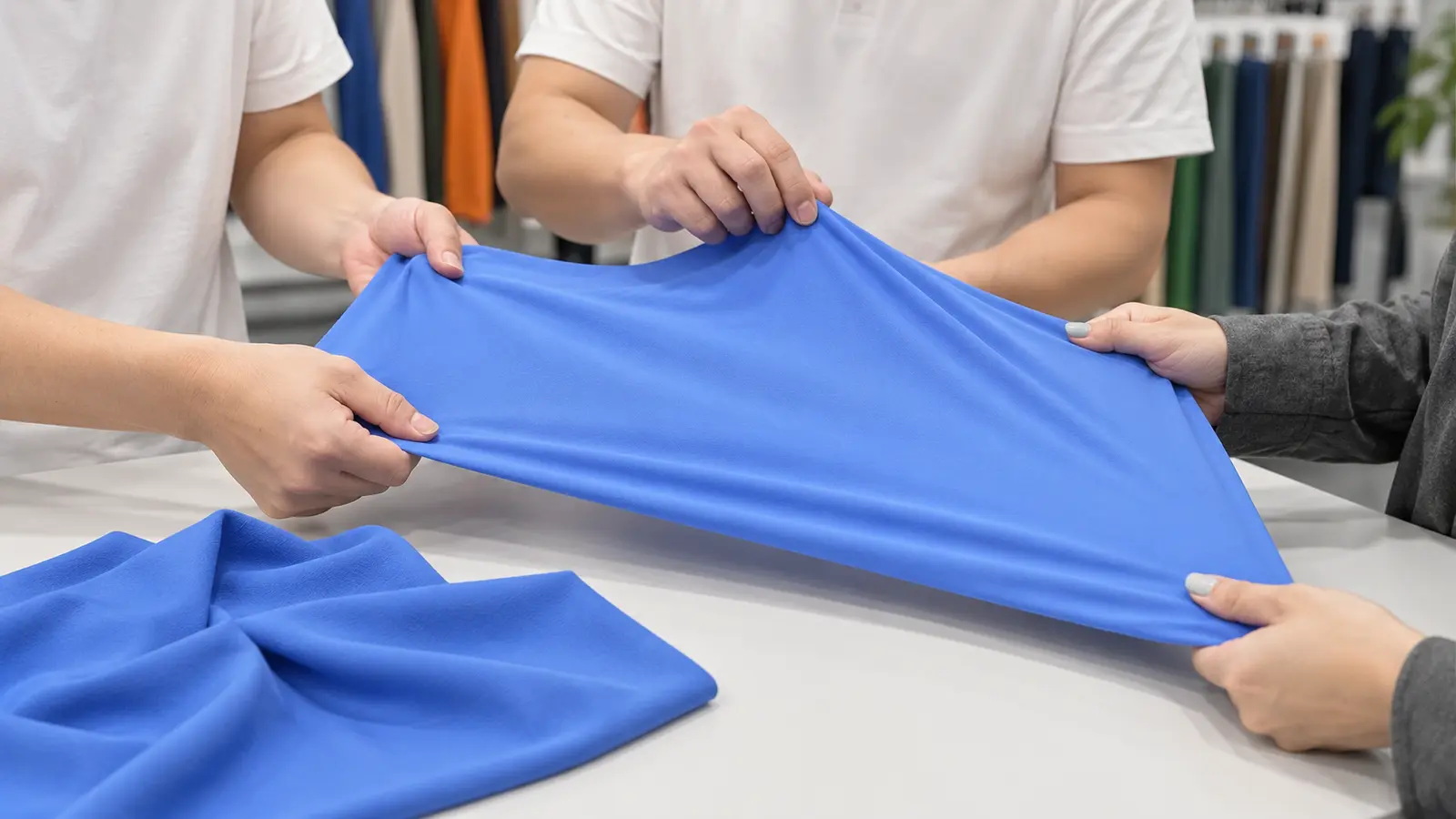
Spandex content influences stretch, but the percentage on a composition label cannot predict the complete result.
Performance also depends on the type and quality of spandex, how it is introduced into the knit, the tension used during knitting, and the relationship between the elastic yarn and the base yarn. Nylon/spandex and polyester/spandex fabrics with similar stated compositions can have noticeably different extension, recovery and surface character.
More spandex is not automatically better. Depending on the construction, it may increase holding power, but it can also affect weight, drape, dyeing behaviour, cost and comfort. The target should be a balanced stretch profile for the garment—not the highest percentage available.
How Fabric Construction Changes the Stretch Profile
Yarn and filament structure
Fine multifilament yarns can create a smooth, flexible surface, while different yarn sizes and textures change bulk, friction and hand feel. The interaction between the base yarn and spandex influences how evenly force is distributed through the fabric.
Knit structure and direction
Loop geometry allows knitted fabrics to deform and recover. Structure determines how easily loops open under force and how effectively they pull back afterward. It also explains why lengthwise and widthwise results can differ even when both directions stretch.
Density, weight and width
GSM is useful, but it should not be read alone. A heavier fabric can feel firm because of density, yarn size or finish rather than superior elastic recovery. Finished width matters as well: changes in width and knitting tension can alter the balance between stretch, coverage and support.
Heat setting and finishing
Heat setting helps stabilise synthetic stretch fabrics after knitting and dyeing. Poorly controlled conditions can disturb width, hand feel, recovery or dimensional stability. Brushing, sanding and softening can improve comfort, but they must be balanced against surface durability and elastic performance.
This is why a first hand-feel impression is not enough. The fabric should be reviewed after the relevant finishing, colouration and laundering stages.
Match the Stretch Profile to the Garment
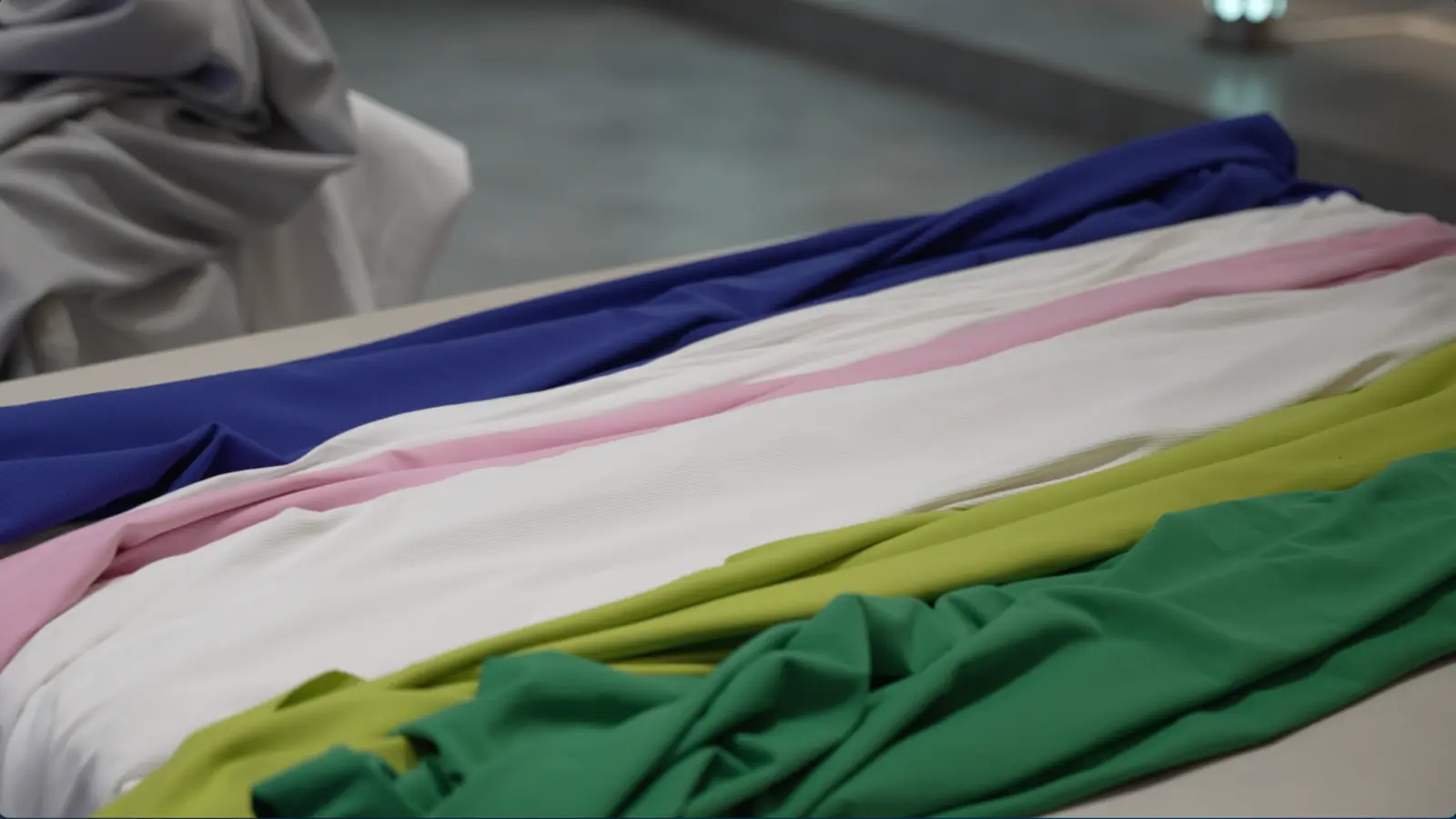
There is no single ideal balance for every activewear product.
Garment or activity | Useful priorities | Common risks to check |
|---|---|---|
Yoga and Pilates leggings | Multi-directional mobility, smooth recovery, comfort through deep flexion | Knee bagging, waistband relaxation, show-through |
Training or cycling leggings | Firmer resistance, stable recovery, coverage under repeated movement | Restriction, seam stress, heat and moisture discomfort |
Sports bras and supportive tops | Controlled extension, stable underband and strap areas | Excess pressure, edge rolling, difficult dressing |
Tennis and golf apparel | Mobility with lighter weight and clean drape | Hem distortion, seat growth, loss of shape after washing |
Lifestyle and studio layers | Softness, relaxed movement and visual recovery | Over-softening, surface wear, a limp appearance |
The same fabric may work well for one silhouette and poorly for another. A soft, high-extension fabric may be excellent for studio leggings but too relaxed for a structured bra. A firm fabric may provide a secure training fit but feel unnecessarily restrictive in a loose tennis layer.
Compare Samples on the Same Basis
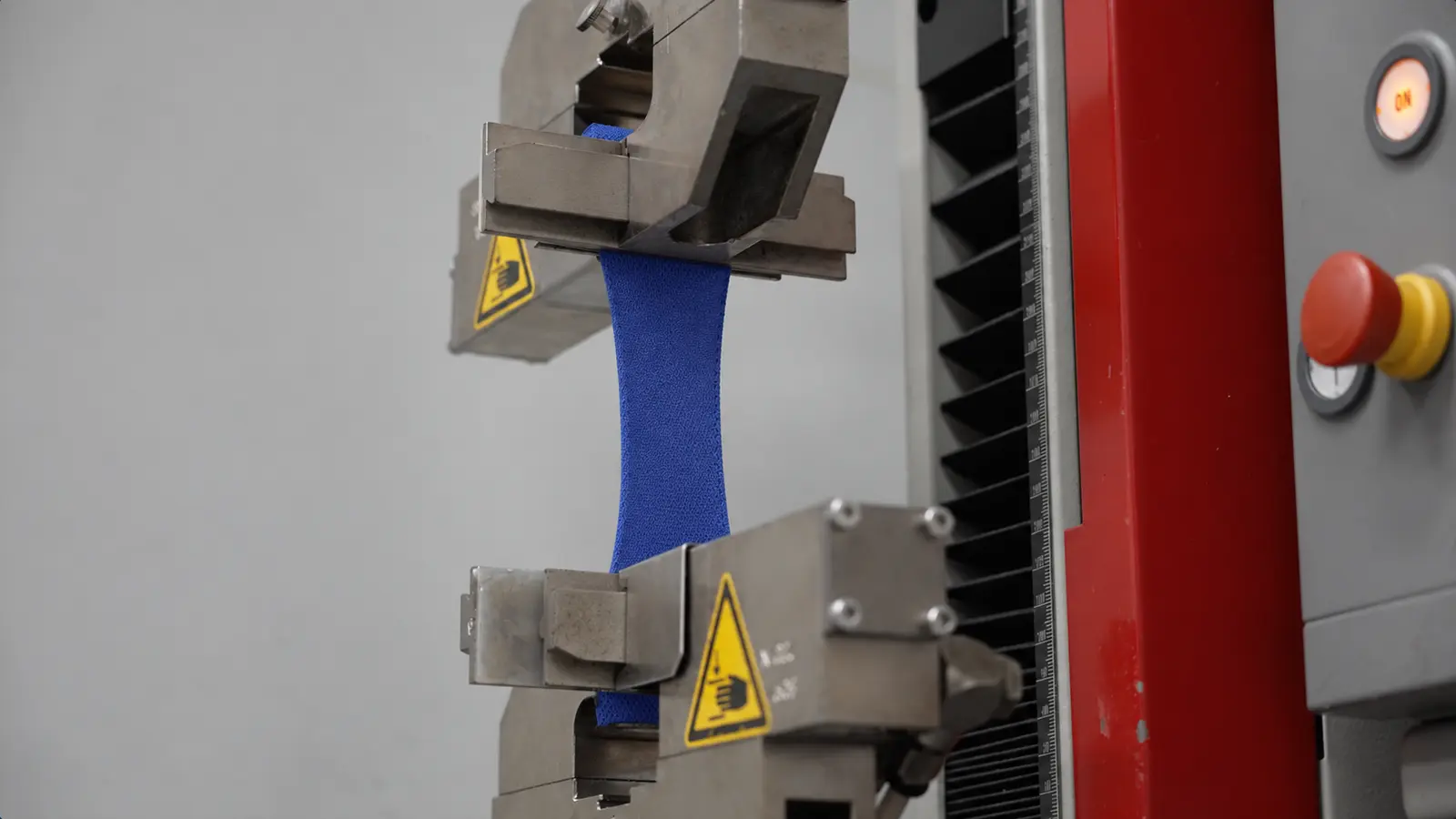
Hand pulling is useful for quick screening, but it cannot replace controlled comparison. Before reviewing supplier results, confirm that the test direction, specimen dimensions, applied load or extension, number of cycles, recovery period and conditioning are aligned.
ISO 20932-1 provides strip methods for determining fabric elasticity, while ASTM D2594/D2594M covers stretch and growth of knitted fabrics with low power. These methods are useful references, but the method and acceptance criteria still need to match the product and be agreed between buyer and supplier.
For development work, compare:
- the original approved swatch;
- production-representative fabric in the intended colour and finish;
- fabric after repeated extension;
- fabric after the agreed laundering or care cycle;
- a garment prototype worn through relevant movements.
Dark shades, pale shades and different finishes may not behave identically. Approval should therefore cover the actual colour and finish range when the risk justifies it.
Evaluate the Finished Garment, Not Only the Fabric
Fabric data cannot fully predict garment performance. Pattern reduction determines how much the material is stretched before the wearer moves. Cutting direction changes which fabric property acts around the body. Seams, elastic tapes, waistbands, gussets and bonded areas can restrict or redistribute stretch.
A practical wear review should include the movements the product is designed for: squatting, lunging, bending, seated flexion, repeated arm movement or cycling posture. Check whether the garment returns smoothly, whether pressure remains comfortable, and whether local areas begin to ripple or loosen.
Common Misunderstandings
Four-way stretch means good recovery. It does not. Directional stretch and recovery are separate properties.
More spandex means more compression. Not necessarily. Construction, density, finishing and garment pattern are equally important.
A higher GSM fabric is always more supportive. Weight may contribute to opacity or substance, but it is not a direct measurement of holding power.
A buttery-soft fabric must have weak recovery. Soft surface character and elastic recovery can coexist when yarn, structure and finishing are properly balanced.
One approved result covers every colour. Dyeing and finishing conditions can affect the final fabric. High-risk colourways should be confirmed rather than assumed.
What to Put in the Development Brief
Instead of requesting only “four-way stretch,” give the supplier a clearer performance target:
- garment type and intended activity;
- close, supportive or relaxed fit;
- priority stretch direction and range of movement;
- preferred holding sensation;
- recovery and growth expectations after repeated movement;
- required coverage, weight and hand feel;
- colour and surface finish;
- care method and evaluation stage;
- agreed test method and reporting conditions.
This brief gives the mill a better basis for choosing yarn, knit construction and finishing. It also makes sample comparison more meaningful because each option is being judged against the same end use.
Develop a Stretch Profile, Not Just a Label
Four-way stretch remains a useful product description, but it should never stand alone. Extension explains mobility. Recovery and growth indicate shape retention. Resistance contributes to support. Yarn, construction, finishing and garment engineering determine how those properties appear in real wear.
For buyers and designers, the most reliable approach is to define the intended garment first, compare fabrics under consistent conditions, and confirm the result in a finished prototype. That turns a broad marketing term into a measurable development decision.
To discuss a stretch profile for yoga, Pilates, training, cycling, tennis or golf apparel, explore the Cofinay fabric collection or contact our technical team with your garment brief.
Technical note: Test methods and acceptance levels should be confirmed for the specific fabric and end use. Always check the current edition of the selected standard before testing.
Written by the Amber, Cofinay.
About Cofinay
With over 16 years of expertise, Cofinay is a premier manufacturer of high-end activewear fabrics, certified by global ecological standards. We specialize in engineering premium performance knits for yoga, tennis, equestrian, and golf. Backed by our self-operated vertical weaving and dyeing infrastructure, we provide complete end-to-end services to empower global activewear brands to scale.