
Table of Contents
- 1. Why a shrinkage result needs context
- 2. Shrinkage is one type of dimensional change
- 3. Why finished knits can change during laundering
- 4. Choose a method and define the complete procedure
- 4.1. Fabric testing and garment testing serve different purposes
- 4.2. Specify more than the standard number
- 5. Read the percentages correctly
- 6. Set limits around the garment, not a universal percentage
- 7. Check shape as well as length and width
- 8. Connect the report to bulk approval
- 9. Sources
Why a shrinkage result needs context
A legging can fit well at the sample stage and feel shorter after washing. A waistband may change differently from the main body, or a seam may turn even when the overall dimensions remain close to the original.
For buyers, the useful question is how the finished material behaves under the care conditions intended for the garment. “Low shrinkage” is too vague to answer it.
A dimensional stability report should identify the material, the laundering procedure and the changes measured in each direction. Without those details, two apparently similar percentages may describe very different tests.
Shrinkage is one type of dimensional change
Dimensional change includes a reduction or an increase in the distance between measurement marks after the specified treatment. Report length and width separately. A fabric can shorten in one direction and become wider in the other.
For knitted activewear, identify the lengthwise and widthwise directions clearly when preparing samples. Do not treat the edges of an arbitrarily cut square as proof of fabric direction.
Wash-related dimensional change is also different from stretch recovery. Recovery testing asks how a material returns after extension under specified conditions. Laundering tests ask how its dimensions change after washing and drying. Good performance in one does not establish the other.
Why finished knits can change during laundering
Knitting, wet processing and finishing can leave a fabric in a different state from the one it reaches after laundering. Yarn and loop arrangement, processing tension, finishing conditions and the fiber blend can all contribute to its response.
Elastane content alone cannot predict the result. Two fabrics with the same composition may differ in construction and finishing, and therefore behave differently in use.
Evaluate the finished material that will be supplied. An earlier greige or development sample does not necessarily represent the final production finish. If a finish is changed, review whether the dimensional stability assessment still applies.
Drying belongs in the assessment too. A flat-dried sample and a tumble-dried sample have not undergone the same treatment. Record the procedure rather than reducing the report to the wash temperature.
Choose a method and define the complete procedure
Fabric testing and garment testing serve different purposes
AATCC TM135 addresses length and width changes of fabrics after home laundering.[1] AATCC TM150 addresses dimensional changes of garments.[4]
ISO 5077 provides a method for determining dimensional change after specified washing and drying procedures.[2] ISO 6330 specifies domestic washing and drying procedures for textile testing, including reference detergents and ballast. It notes that changing procedure parameters can affect results.[3]
Use the current agreed edition and the full method. A short article cannot replace the instructions for sample preparation, conditioning, marking, measurement and reporting.
Specify more than the standard number
Before testing, agree the details that make the result comparable:
Test detail | What the buyer should define |
|---|---|
Material | Article, color, finish and relevant production lot |
Method | Standard, edition and selected procedure |
Washing | Machine type, program and temperature |
Test load | Detergent and ballast as required by the procedure |
Drying | Selected drying procedure and applicable settings |
Repetition | Number of complete wash-and-dry cycles |
Measurement | Preparation, conditioning and measurement requirements |
Acceptance | Separate limits for length and width, with sign convention stated |
Choose conditions relevant to the proposed care instructions. If the buyer also wants a more demanding development assessment, identify it separately so it is not confused with the care-label test.
Read the percentages correctly
A common way to express dimensional change is:
Dimensional change (%) = (distance after treatment − original distance) ÷ original distance × 100.
Under this convention, a negative value indicates shrinkage and a positive value indicates growth. Some reports express shrinkage as a positive magnitude instead. Confirm the convention before comparing results.
For illustration, a marked distance changing from 500 mm to 490 mm gives −2.0%; a change from 500 mm to 505 mm gives +1.0%. These are calculation examples, not Cofinay test results or recommended acceptance limits.
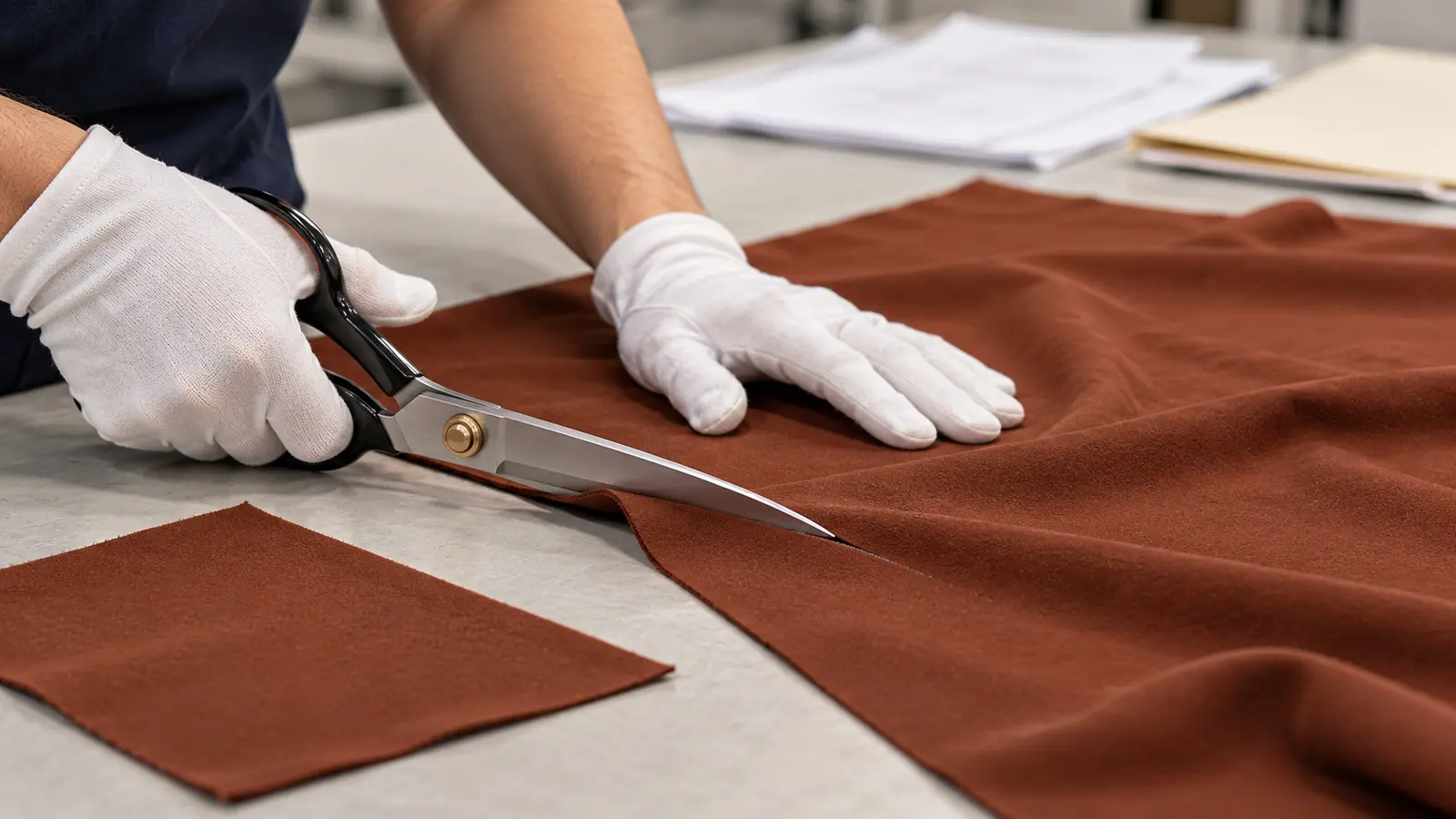
Use the distances between the prescribed marks, rather than the overall cut edge. Follow the method’s requirements for individual measurements, averaging and reporting. Measuring a stretchy specimen while pulling it taut can undermine the comparison.
Ask for both directions and the cycle count. A single unsigned number such as “2%” does not explain whether the fabric shrank, grew or changed differently along its length and width.
Set limits around the garment, not a universal percentage
There is no single purchasing limit suitable for every activewear product. A fitted legging, a relaxed top and a layered garment may have different sensitivities to dimensional change.
Agree acceptance criteria during development and confirm them in the specification. Consider critical garment measurements, intended fit, construction and the response of materials used together.
Where the main fabric, lining and elastic respond differently, assess the assembled garment. A fabric report alone cannot show how seams, panels and trims behave as a finished product.
Do not use a shrinkage allowance in the pattern as a substitute for understanding the material. The pattern team needs a reliable, repeatable basis for any adjustment; inconsistent change between lots can still disrupt fit.
Check shape as well as length and width
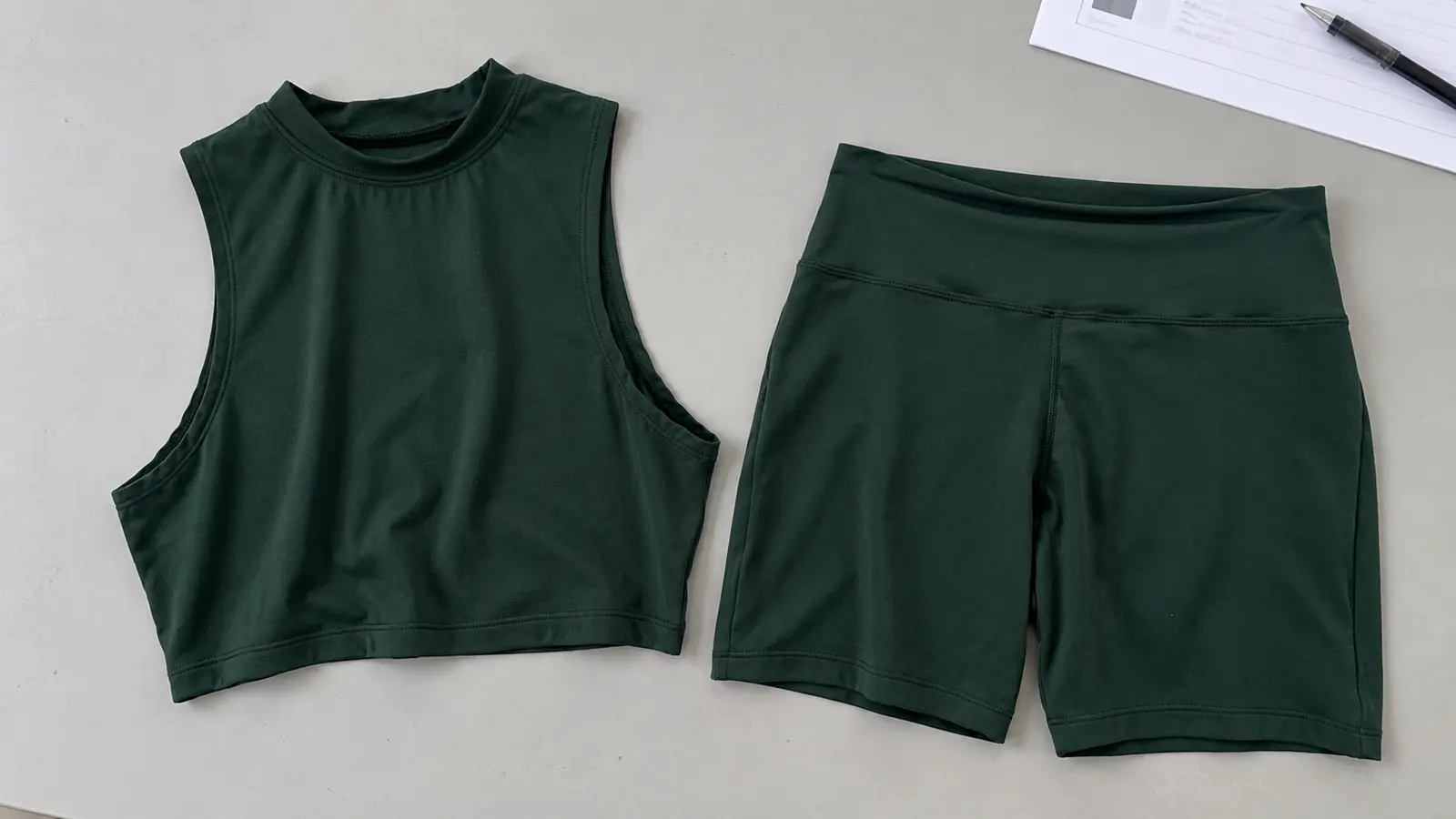
A sample can remain within dimensional limits yet show an appearance problem. Twisting, skew, seam distortion or surface changes may require separate assessment.
AATCC lists distinct methods for skew change in fabrics and seam twist in garments after laundering.[4] If these issues matter for the product, include them in the test plan rather than assuming a dimensional change result covers them.
For fitted activewear, also keep washed appearance and the agreed recovery checks in view. A shorter specimen should not automatically be described as providing more support, and a wider one should not automatically be called more comfortable.
Connect the report to bulk approval
Check whether the tested sample represents the article and finish being ordered. Keep its identity linked to the relevant report and production records.
If a result falls outside the agreed limits, ask what changed and what action is proposed. After reworking, repeat the relevant assessment rather than relying on the original report. Also review whether the adjustment affects other required properties.
Retain identified references according to the project agreement. They make a later discussion about fit or washing behavior more useful than comparing unidentified scraps or photographs.
When contacting Cofinay, provide the garment application, proposed care instructions and dimensional stability requirements with the fabric enquiry. Ask the technical team to confirm the applicable test plan and production evidence for the selected article.
Discuss activewear fabric testing requirements with Cofinay.
Sources
- [1] AATCC TM135: Dimensional Changes of Fabrics after Home Laundering.
- [2] ISO 5077: Determination of dimensional change in washing and drying.
- [3] ISO 6330: Domestic washing and drying procedures for textile testing.
- [4] AATCC laundering test methods: fabric dimensions, garment dimensions, skew and seam twist.
Written by Amber, Cofinay Technical Team.
About Cofinay
With over 16 years of expertise, Cofinay is a premier manufacturer of high-end activewear fabrics, certified by global ecological standards. We specialize in engineering premium performance knits for yoga, tennis, equestrian, and golf. Backed by our self-operated vertical weaving and dyeing infrastructure, we provide complete end-to-end services to empower global activewear brands to scale.