
Table of Contents
- 1. What distinguishes the three structures?
- 1.1. Single jersey
- 1.2. Rib knit
- 1.3. Interlock
- 2. Stretch is only part of the decision
- 3. Judge drape and coverage in the proposed garment
- 4. Check what happens during cutting, sewing and washing
- 4.1. Cutting and sewing
- 4.2. After laundering
- 5. Specify more than “rib” or “double knit”
A fabric substitution can look straightforward on paper: the same fibre blend, a similar weight and the right colour. Then the cutting room reports curled edges, or the first garment hangs differently from the approved sample.
The missing detail may be the knitted structure. Rib knit, single jersey and interlock describe how loops are arranged. They give buyers useful clues, but the finished fabric still needs to be assessed against the garment brief.
What distinguishes the three structures?
Single jersey
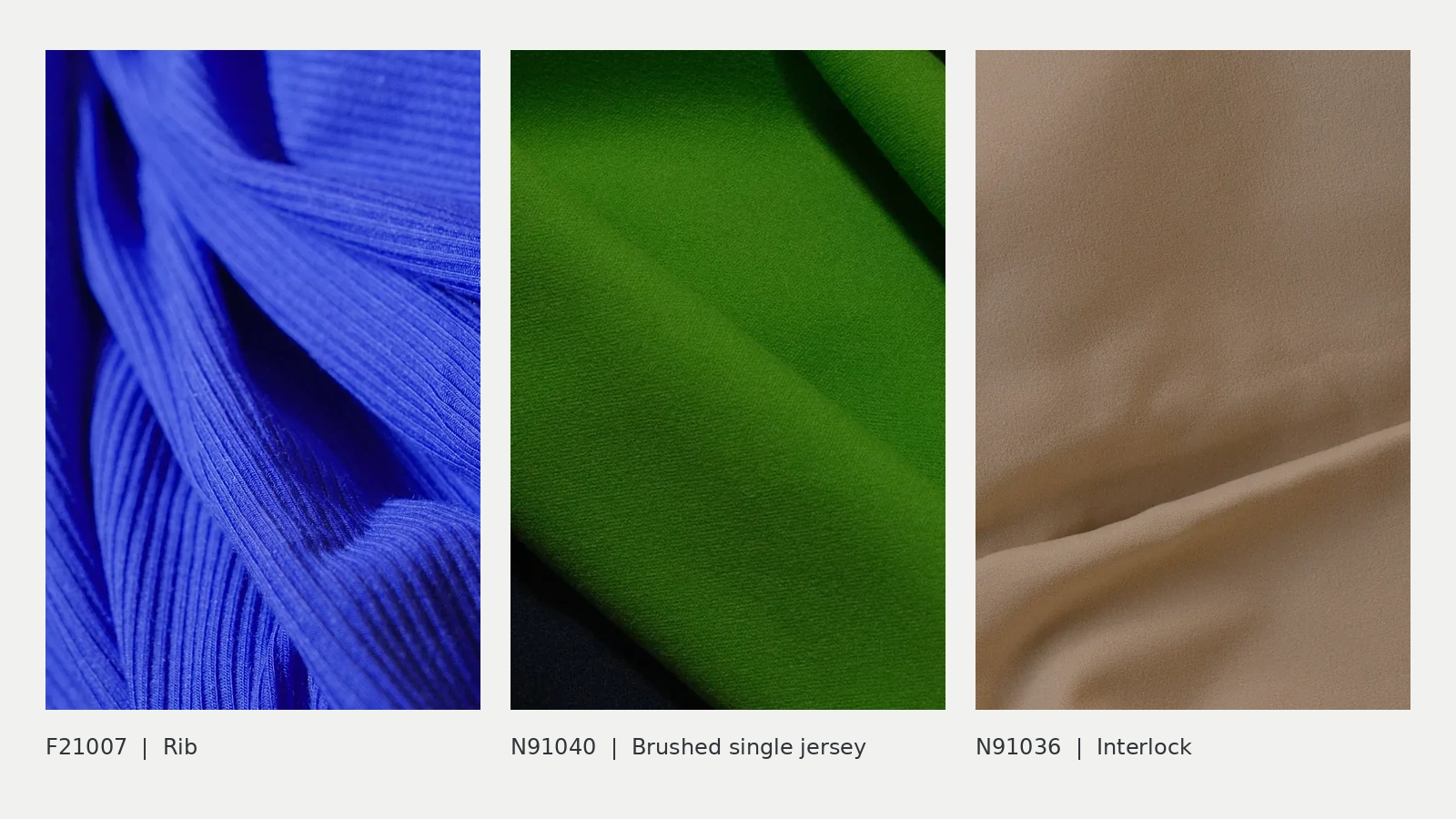
Basic single jersey uses one set of needles. Its technical face shows vertical V-shaped loop columns, while its back has a different, more horizontal loop appearance. Free cut edges tend to curl. This makes face identification and edge handling worth checking early in development.
Rib knit
Basic rib alternates face and reverse loop columns across the width. In 1×1 rib these alternate individually; 2×2 rib groups them in pairs. The structure opens sideways like an accordion. A balanced basic rib generally resists edge curl, although commercial variants need checking.
Interlock
Basic interlock connects two 1×1 rib structures within one knitted construction. It is knitted together, rather than laminated from two finished fabrics. Both surfaces look similar, and its interlocked arrangement limits the sideways opening found in basic rib. Cut edges generally lie flatter than single jersey.
Starting observation | Single jersey | Basic rib | Basic interlock |
|---|---|---|---|
Face and back | Distinct | Often similar | Similar |
Free-edge curl | Common | Generally low | Generally low |
Structural character | Single-knit | Sideways opening | More restrained |
These descriptions refer to the basic structures. Plating, stitch variations and finishing can change what a commercial fabric looks and feels like. Ask the supplier to confirm the construction rather than identifying it from a photograph alone.
Stretch is only part of the decision
Separate three questions when comparing samples: how far does the fabric extend, how much force does that require, and how well does it return?
A hand pull answers none of them precisely. For a useful comparison, request results using the same specimen dimensions, direction, loading conditions and recovery period. Record residual growth as well as extension.
For a fitted top, check whether the neckline stays in place after dressing and movement. For lounge trousers, inspect the knees and seat after wear. For a supportive garment, assess the complete design, including lining, seams and fit. A rib label or a high spandex percentage does not establish support.
Judge drape and coverage in the proposed garment
Hold a larger sample vertically, lay it flat and fold it over an edge. Then make the intended silhouette. These checks are more useful than assigning every jersey to “fluid” garments or every interlock to “structured” ones.
If one candidate hangs differently, compare the yarn, finished weight, thickness and finish alongside the construction. Do not attribute the whole difference to the knit name when several variables have changed.
Use the intended colour and fit for coverage checks. Examine the garment while standing, sitting and moving, including areas under tension. Approve the actual sample rather than assuming that interlock is always opaque or rib is always suitable for fitted bottoms.
Check what happens during cutting, sewing and washing
A good fabric trial should include the people who will cut and sew it. Ask them to note edge handling, panel alignment and seam appearance, not just whether the fabric feels pleasant.
Cutting and sewing
Let samples relax under an agreed procedure before measuring and cutting. Mark the intended garment face and length direction. For ribbed styles, agree how visible lines should align across panels and seams.
Trial the proposed needle, stitch, thread and machine settings. Inspect for needle damage, wavy seams, uncomfortable bulk and seams that restrict garment movement. Keep these observations with the sample approval.
After laundering
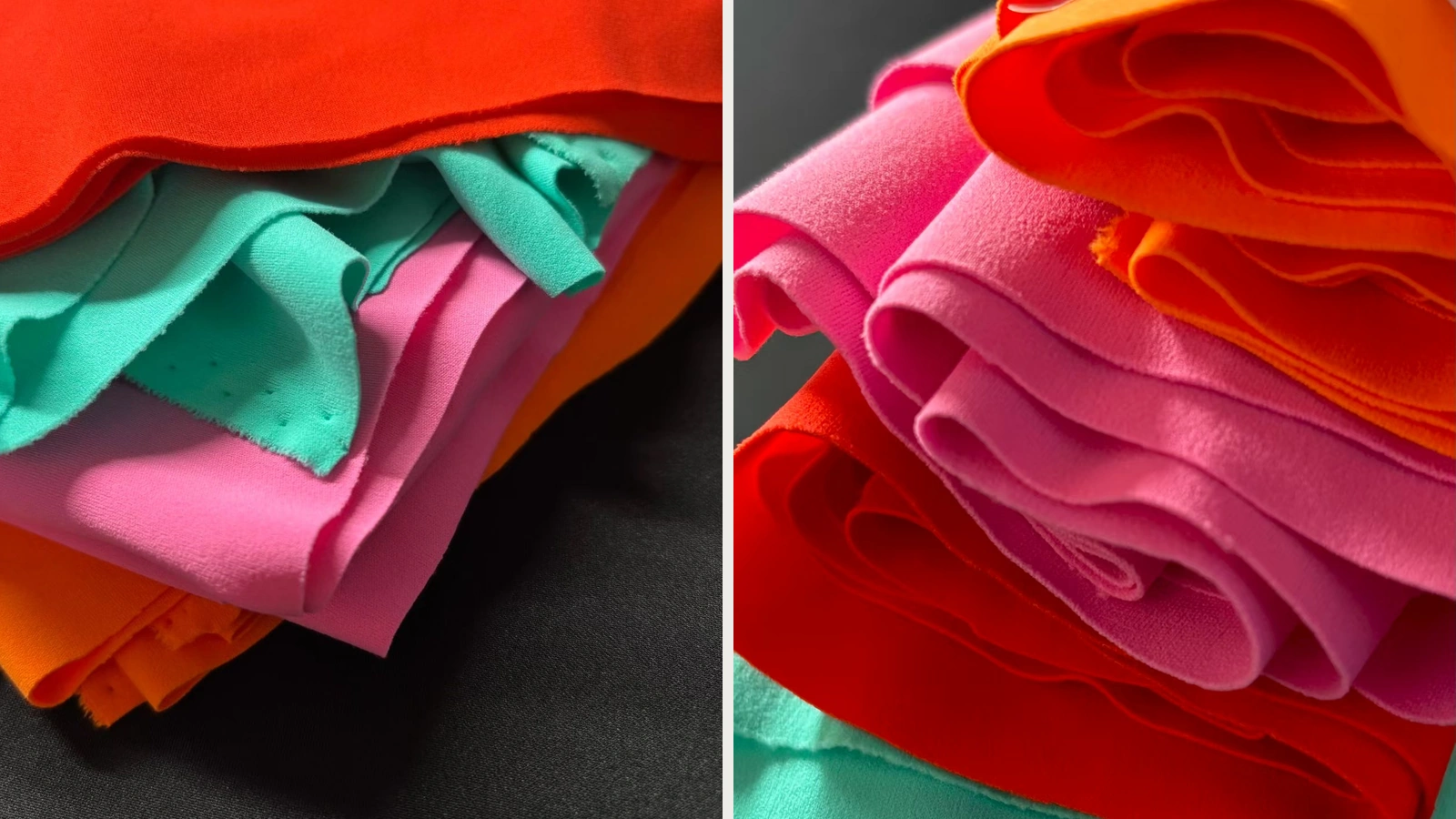
Wash and dry the sewn sample using the proposed care route. Record length and width changes separately, then inspect twisting, rib alignment, surface appearance and fit.
Dimensional behaviour also depends on yarn, stitch length and processing. A stable-looking double knit still needs washing trials; a fabric that stretches easily is not automatically unstable after laundering.
Specify more than “rib” or “double knit”
For an enquiry or substitution request, include:
- Construction: the confirmed structure and any relevant variation, rather than a trade name alone.
- Material and finish: fibre blend, yarn details where agreed, and surface treatment.
- Finished dimensions: GSM, usable width and their agreed tolerances.
- Movement requirements: extension, force and recovery criteria in both directions where relevant.
- Garment checks: care conditions, dimensional tolerances, seam trials and coverage requirements.
- Approval reference: an identified physical swatch and, where possible, a sewn sample.
If a replacement changes the structure, reopen the relevant approvals even when the composition and GSM remain close. The practical goal is a fabric that works with the pattern, production process and wearer—not simply a matching specification line.
Send your garment brief and reference sample through the Cofinay fabric catalogue to discuss suitable constructions and sampling.
Written by Amber, Cofinay Technical Team.
About Cofinay
With over 16 years of expertise, Cofinay is a premier manufacturer of high-end activewear fabrics, certified by global ecological standards. We specialize in engineering premium performance knits for yoga, tennis, equestrian, and golf. Backed by our self-operated vertical weaving and dyeing infrastructure, we provide complete end-to-end services to empower global activewear brands to scale.