
Table of Contents
- 1. Stage 1: Yarn selection establishes the performance foundation
- 1.1. Incoming yarn quality control
- 2. Stage 2: Knitting transforms yarn into fabric structure
- 2.1. High-gauge circular knitting
- 2.2. Precision needles and yarn-tension control
- 3. Stage 3: Color development and dyeing control visual consistency
- 3.1. Preparation before dyeing
- 3.2. From target color to bulk dyeing
- 4. Stage 4: Finishing develops hand feel, stability, and function
- 4.1. Cofinay’s 12-step dyeing and finishing process
- 4.2. Not every fabric follows exactly the same conditions
- 5. Stage 5: Multi-stage quality control determines whether fabric can be released
- 5.1. Gate 1: Incoming raw materials
- 5.2. Gate 2: In-process control
- 5.3. Gate 3: Finished-roll inspection
- 5.4. Laboratory testing
- 6. Certification and traceability
- 7. Custom manufacturing means balancing performance, compliance, and cost
- 8. Seven questions buyers should ask an activewear fabric manufacturer
- 9. Cofinay’s vertically integrated manufacturing capability
- 10. Frequently asked questions
- 11. Develop your next activewear fabric with Cofinay
Two activewear fabrics can have the same fiber composition and similar weight, yet perform very differently in stretch recovery, opacity, hand feel, colorfastness, and dimensional stability.
The reason is simple: performance is not added in a single step.
It is developed through a controlled manufacturing process that begins with yarn selection and continues through knitting, dyeing, finishing, laboratory testing, inspection, and final release.
For sportswear brands and garment manufacturers, understanding this process makes it easier to evaluate suppliers, define realistic specifications, prevent quality disputes, and select the right fabric for each application.
Founded in Dongguan in 2010, Cofinay is a vertically integrated activewear fabric manufacturer with in-house knitting, dyeing, finishing, and quality-control capabilities. This guide explains how performance activewear fabric is made and what buyers should examine at each production stage.
Quick answer: Performance activewear fabric is generally developed through five connected stages: yarn selection and incoming quality control, fabric knitting, color development and dyeing, performance finishing, and multi-stage quality testing.
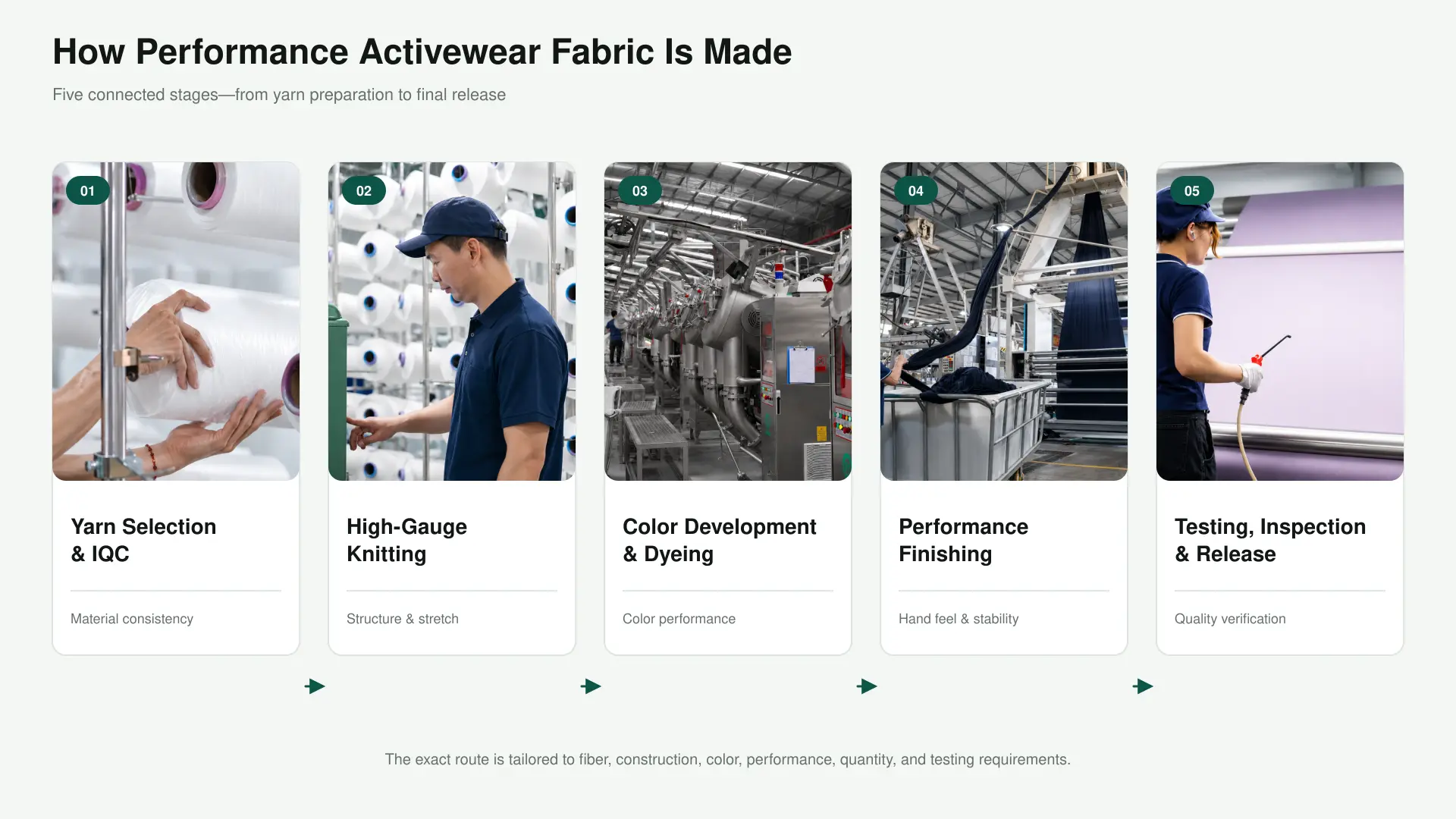
The precise route may vary according to fiber type, fabric construction, target color, hand feel, functional requirements, testing standards, order quantity, and budget.
Stage 1: Yarn selection establishes the performance foundation
Every fabric begins with yarn, but not every yarn is suitable for demanding activewear applications.
The fiber type, yarn specification, lot consistency, strength, elasticity, and compatibility with the intended knitting structure all influence the final result.
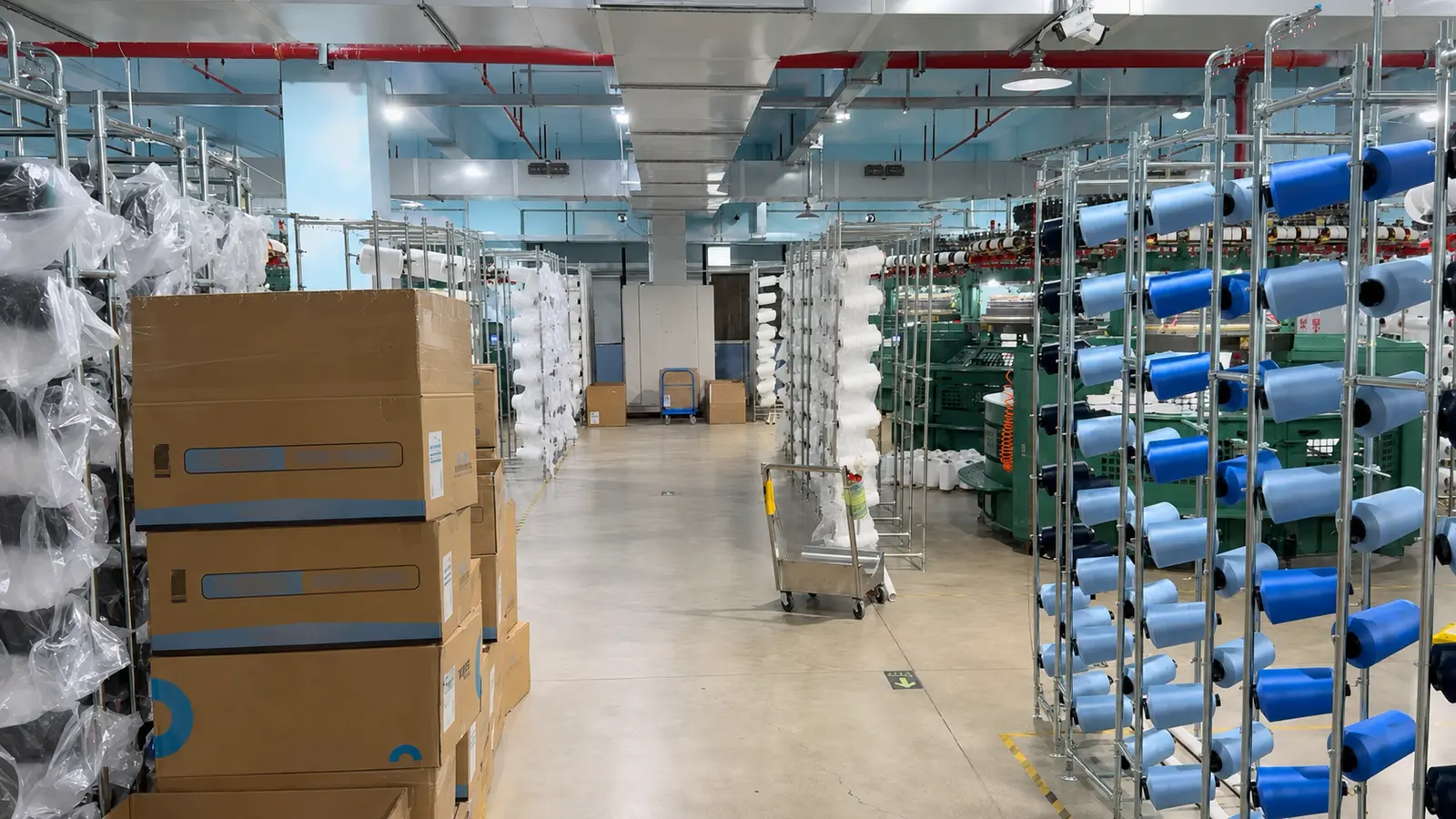
Common activewear fibers include:
- Nylon: Frequently selected for its soft hand feel, abrasion resistance, and suitability for close-to-skin applications.
- Polyester: Commonly used for quick-drying performance, moisture-management constructions, and stable color development.
- Spandex or elastane: Added to provide stretch, recovery, fit retention, and freedom of movement.
- LYCRA® fiber: A premium branded elastane option used in selected developments that require lasting stretch, comfort, fit, and shape retention.
- GRS-certified recycled polyester or recycled nylon: Selected when a project requires verified recycled content and material traceability.
- Specialty and eco-conscious fibers: Considered when customers need a particular touch, sustainability profile, appearance, or performance characteristic.
Incoming yarn quality control
Fiber composition alone does not provide enough information to predict fabric performance. Before production, the yarn must be evaluated against the intended technical specification.
Depending on the development, Cofinay’s incoming quality-control process may review:
- Yarn count or denier;
- Tensile strength;
- Moisture regain;
- Lot and batch consistency;
- Surface condition;
- Tension stability during feeding;
- Supplier documentation;
- Recycled-content and traceability records where applicable.
A variation at the yarn stage can later appear as inconsistent fabric weight, uneven texture, knitting lines, unstable stretch, or shade differences between production lots.
For this reason, yarn selection should be treated as an engineering decision rather than a simple purchasing decision.
Stage 2: Knitting transforms yarn into fabric structure
Knitting determines how yarns interact, stretch, recover, breathe, drape, and resist deformation.
Cofinay manufactures both circular-knitted and warp-knitted performance fabrics. Neither method is automatically better. The correct construction depends on the end use and the performance targets of the finished garment.
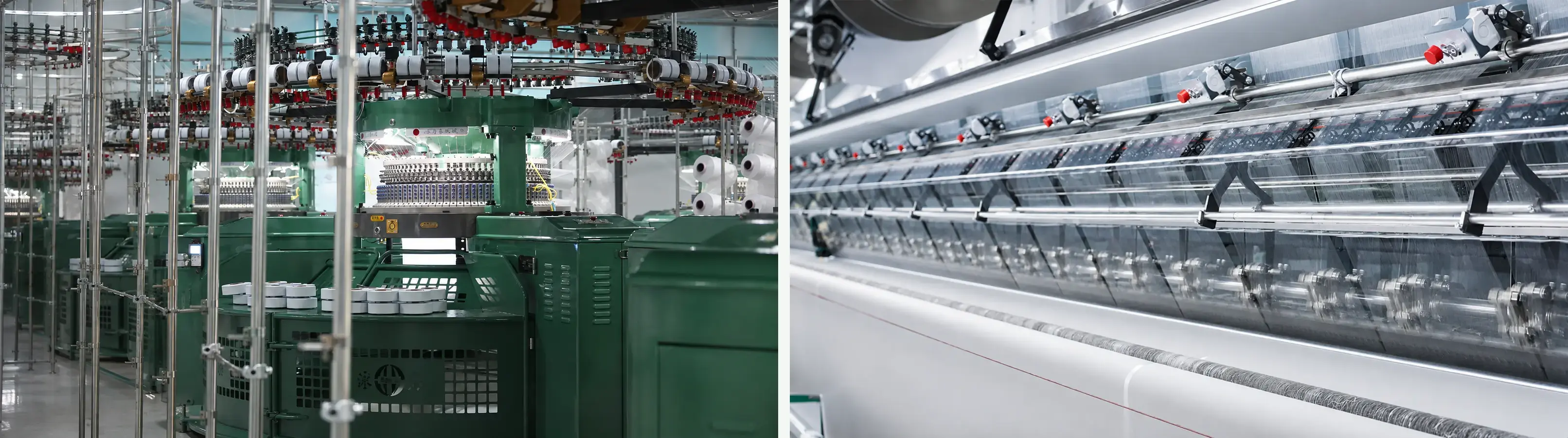
Construction | General characteristics | Typical considerations |
Circular knitting | Soft, flexible, versatile, and suitable for many close-fitting applications | Hand feel, four-way stretch, recovery, opacity, breathability, and surface smoothness |
Warp knitting | Structurally stable, durable, and suitable for engineered performance constructions | Dimensional stability, abrasion resistance, support, durability, and controlled stretch |
Circular-knitted fabrics are widely used in yoga wear, leggings, training apparel, underwear, and athleisure. Warp-knitted structures may be selected for applications requiring enhanced stability, support, abrasion resistance, or technical construction.
However, the knitting method alone does not determine performance. Yarn composition, gauge, loop structure, density, GSM, elastane percentage, and finishing conditions must all be considered together.
High-gauge circular knitting
Cofinay’s circular-knitting facility supports high-gauge developments from 18G to 50G.
Higher-gauge knitting can help create:
- A finer and smoother surface;
- Compact fabric structures;
- Improved coverage and opacity;
- A lightweight yet dense construction;
- A refined second-skin hand feel;
- More controlled appearance and stretch distribution.
Higher gauge does not automatically mean higher quality. The gauge must be selected according to the target fabric weight, hand feel, support level, opacity, durability, and application.
Precision needles and yarn-tension control
Cofinay’s circular-knitting machines use Groz-Beckert needles and controlled yarn-feeding systems.
Stable needle operation and yarn tension help reduce structural variation during knitting. Technicians also monitor fabric density, roll weight, yarn feeding, and visible defects while the machines are running.
The objective is not simply to produce greige fabric quickly. It is to create a stable foundation for consistent dyeing and finishing.
Stage 3: Color development and dyeing control visual consistency
Color is one of the most sensitive parts of activewear fabric development.
A target shade can behave differently on nylon, polyester, recycled fibers, or blended constructions. The same color may also require different dye recipes depending on fabric weight, yarn lot, surface finish, and end-use performance requirements.
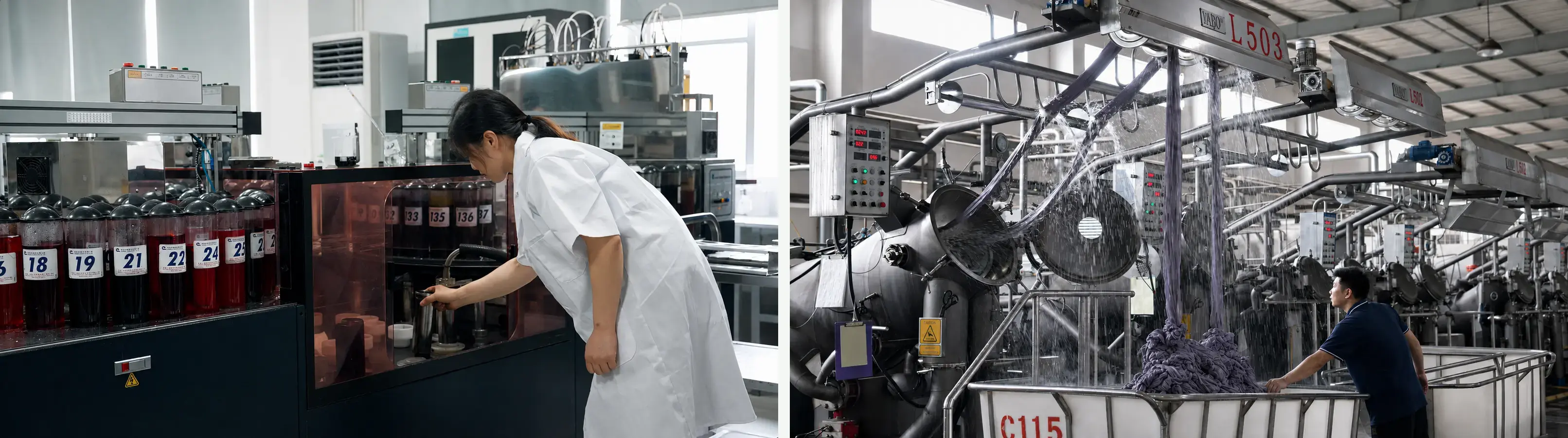
Preparation before dyeing
Before the main dyeing process, greige fabric must be prepared so that it can absorb color evenly.
Typical preparation processes include:
- Removing knitting oils and machine residues;
- Releasing internal fabric tension;
- Stabilizing preliminary width and density;
- Reducing the risk of creasing, staining, or uneven dye absorption;
- Preparing the fabric for the selected dyeing system.
Insufficient preparation can lead to shade variation, uneven color penetration, surface marks, or instability during later finishing.
From target color to bulk dyeing
Color development normally begins when the customer provides a Pantone reference, a physical swatch, or an approved color standard.
The process may include:
- Analyzing the target color;
- Developing several laboratory color options;
- Submitting lab dips for customer approval;
- Confirming the approved standard;
- Preparing the bulk dye recipe;
- Dyeing the production batch;
- Reviewing the finished shade under controlled lighting.
Cofinay uses digital color-matching systems and modern jet-dyeing equipment to support repeatable color development.
When customers have particularly demanding colorfastness requirements, the dyeing route, dyestuff selection, processing conditions, and testing plan can be adjusted accordingly. These requirements should be discussed before sampling because a higher performance target may affect the production process, development time, and cost.
Stage 4: Finishing develops hand feel, stability, and function
After dyeing, fabric still requires additional processing to achieve its final width, weight, hand feel, appearance, shrinkage performance, and functional characteristics.
The Cofinay manufacturing system currently follows a representative 12-step dyeing and finishing journey.
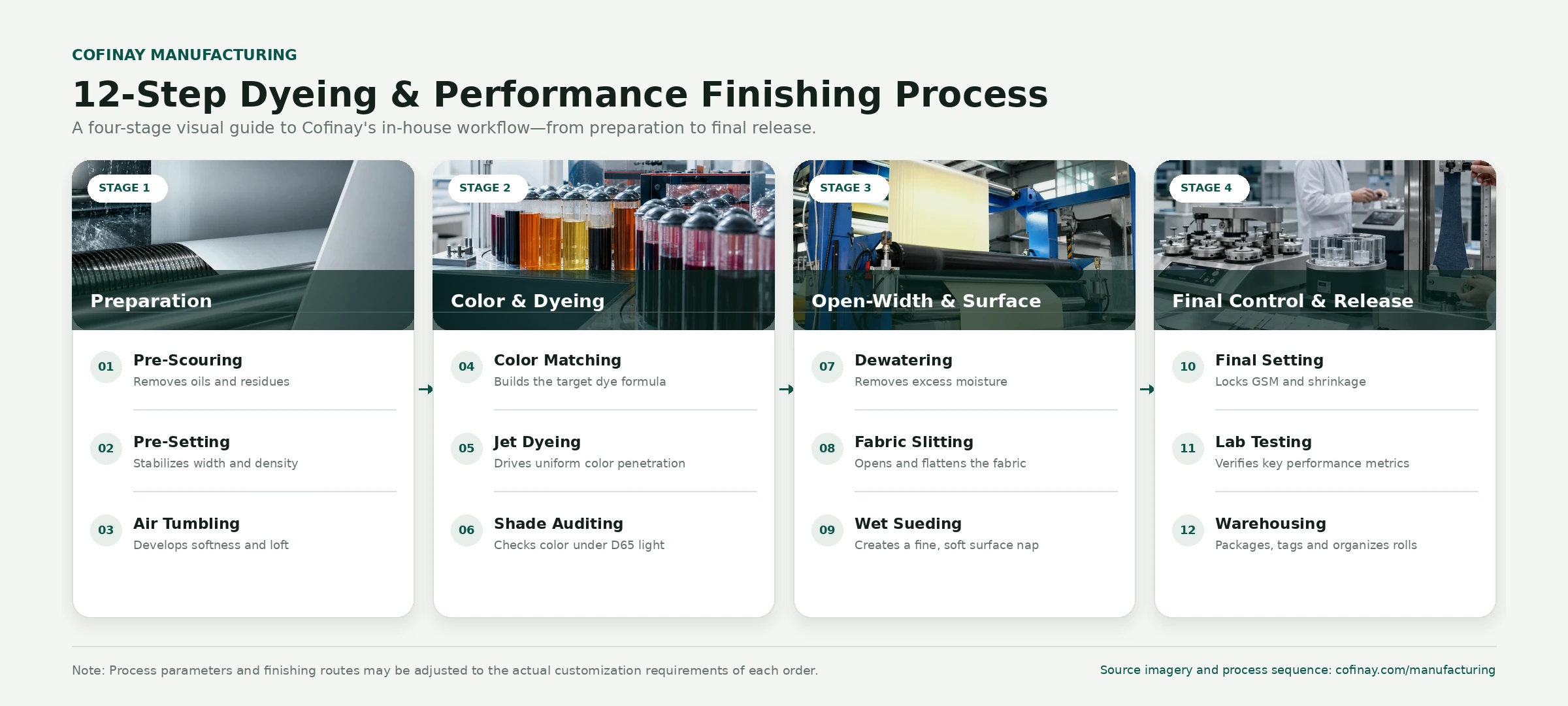
Cofinay’s 12-step dyeing and finishing process
1. Pre-scouring
Knitting oils and machine residues are removed to support uniform dye absorption and reduce the risk of spots or stains.
2. Pre-setting
The greige fabric is stabilized before wet processing. This helps release internal stress and control its initial width and density.
3. Air tumbling
High-speed air movement relaxes and mechanically softens the fabric, helping develop loft, elasticity, and comfort.
4. Color matching
The technical team analyzes the target color and prepares the appropriate dye formulation.
5. Jet dyeing
The fabric is dyed in modern jet-dyeing machines to achieve controlled color penetration and the required shade.
6. Shade auditing
The dyed batch is compared with the approved color standard under controlled lighting before it moves to the next stage.
7. Dewatering
Excess moisture is removed to prepare the wet fabric for open-width processing.
8. Fabric slitting and open-width processing
Tubular or rope-form fabric is opened and flattened so that it can move evenly through the subsequent finishing equipment.
9. Wet sueding
For fabrics requiring a peach-skin or buttery-soft surface, wet-sueding technology raises a fine and controlled fiber nap.
Wet sueding is not required for every product. It is selected according to the target hand feel, appearance, durability, and end application.
10. Final setting
The fabric is heat-set to control its finished width, GSM, dimensional stability, and surface condition.
Where required, performance finishes may also be applied during the appropriate finishing stage. These can include moisture management, UV protection, anti-odor treatment, or other customer-specified functions.
11. Laboratory testing
The finished fabric is tested against the agreed technical requirements before release.
12. Warehousing
Approved rolls are packed, labeled, recorded, and organized for traceable storage and shipment.
Not every fabric follows exactly the same conditions
The twelve steps provide an overview of Cofinay’s integrated manufacturing route, but the exact parameters are customized.
A buttery-soft yoga fabric, a high-support training fabric, a moisture-wicking running fabric, and a recycled sportswear fabric should not be processed in exactly the same way.
Production may be adjusted according to:
- Fiber composition;
- Knitted structure;
- Fabric weight and width;
- Stretch and recovery targets;
- Target hand feel;
- Color and colorfastness requirements;
- Moisture-management or other functional needs;
- Sustainability and certification requirements;
- Testing standards;
- Order quantity;
- Target cost.
Functional requirements must also be balanced carefully. For example, an aggressive surface treatment may improve softness but affect durability, weight, or stretch behavior. A qualified manufacturer should therefore evaluate the whole specification rather than optimize one property in isolation.
Stage 5: Multi-stage quality control determines whether fabric can be released
Quality control should not begin only after production is complete.
Cofinay uses several inspection gates to identify risks at different points in the manufacturing process.
Gate 1: Incoming raw materials
Yarn specifications, strength, lot information, and relevant documentation are reviewed before knitting.
Gate 2: In-process control
During knitting, dyeing, and finishing, technicians monitor parameters such as:
- Yarn tension;
- Fabric density;
- Roll weight;
- Surface condition;
- Color development;
- Width and GSM;
- Processing stability.
Finding a variation during production is more efficient than discovering it after the full order has been completed.
Gate 3: Finished-roll inspection
Finished rolls are inspected on illuminated fabric-inspection machines and evaluated using the international Four-Point System.
The inspection may review:
- Holes, lines, stains, or surface defects;
- Shade variation;
- Usable width;
- GSM;
- Roll length and weight;
- Fabric flatness;
- Packaging and identification.
Laboratory testing
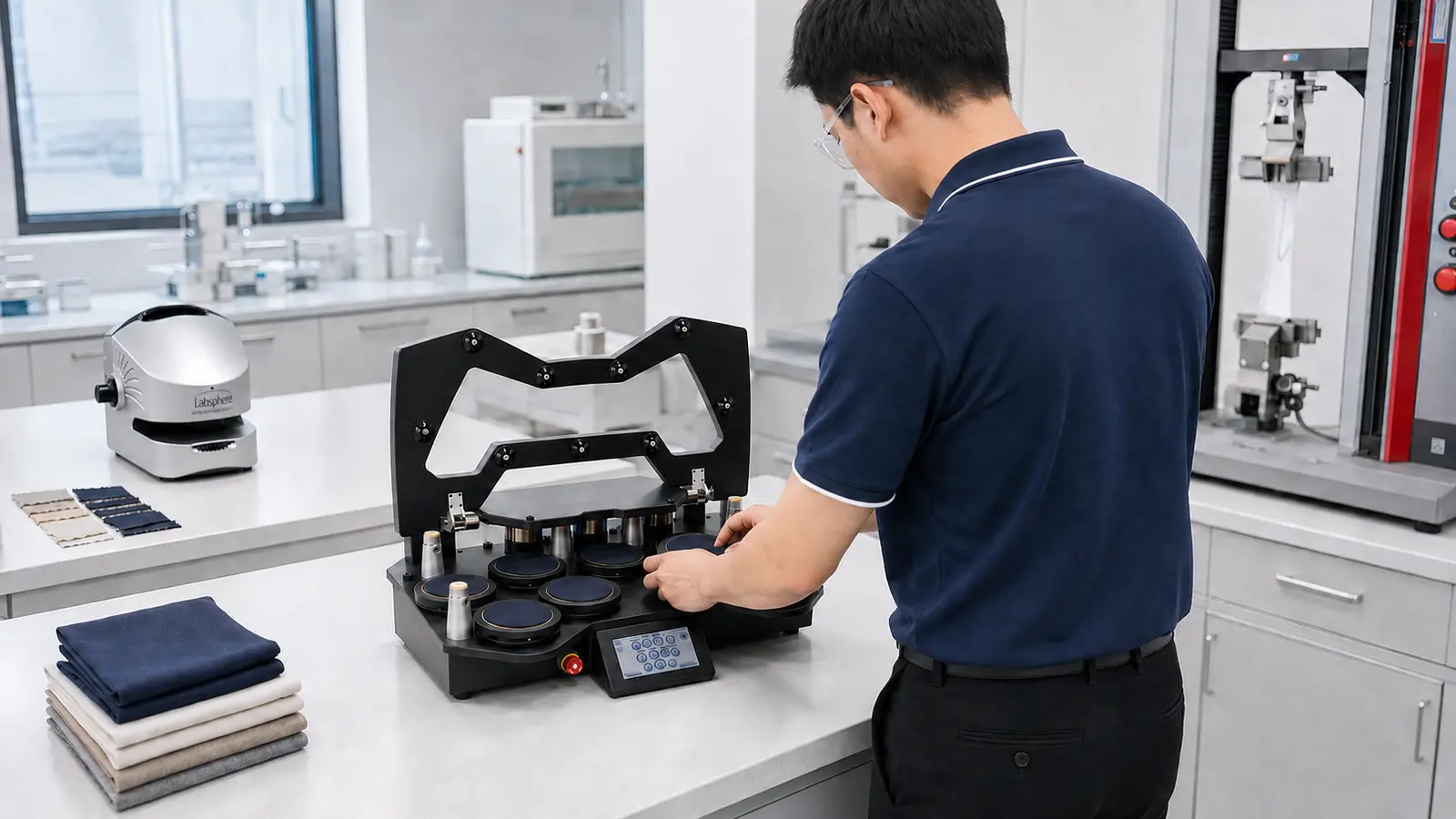
Cofinay’s in-house quality-control system can evaluate the performance characteristics required for activewear fabric, including:
- Dimensional stability and shrinkage;
- Colorfastness to washing;
- Colorfastness to perspiration;
- Colorfastness to rubbing;
- Pilling resistance;
- Bursting strength;
- Stretch and recovery;
- Fabric composition;
- GSM and width.
The applicable test methods and pass requirements depend on the product and the customer’s specification. Testing may follow relevant AATCC, ASTM, ISO, or customer-specific methods.
Cofinay also maintains relevant CNAS accreditation documentation and soft-copy certification files for qualified customer review.
Certification and traceability
Cofinay’s manufacturing and quality systems are supported by certifications and third-party documentation that include, where applicable:
- OEKO-TEX® STANDARD 100;
- Global Recycled Standard (GRS);
- ISO 9001;
- ISO 14001;
- ISO 45001;
- SGS audit documentation.
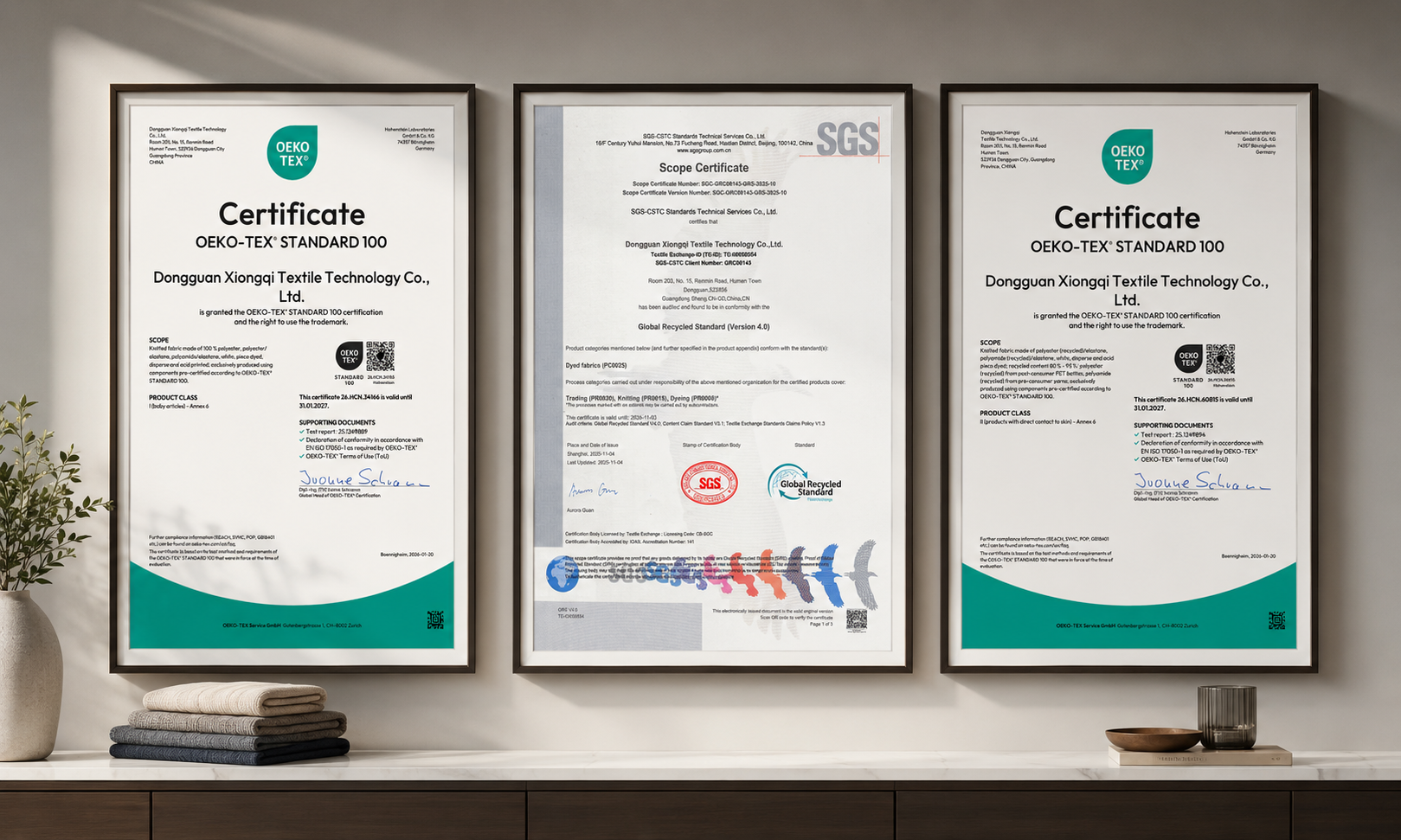
Soft copies can be provided to customers for review.
For qualifying recycled-material orders, Cofinay can also support the application for relevant GRS Transaction Certificates after shipment. Certification availability and scope should always be confirmed against the selected material and order.
Custom manufacturing means balancing performance, compliance, and cost
A professional source mill should not force every customer into the same material or production route.
Different customers may prioritize different outcomes.
One brand may require exceptionally high colorfastness for intensive training or repeated washing. Another may prioritize a buttery-soft hand feel for premium yoga wear. A growing brand may need careful cost control while maintaining the agreed quality and safety requirements.
Cofinay can adjust the development approach through:
- Alternative yarn and fiber combinations;
- Different knitted structures and gauges;
- Optimized elastane percentages;
- Appropriate dye and finishing routes;
- Different hand-feel treatments;
- Customer-specific testing requirements;
- Certified recycled material options;
- Trial quantities and scalable bulk production planning.
Cost optimization does not have to mean lowering the basic quality standard. It may involve selecting a more efficient construction, avoiding unnecessary finishing processes, using an alternative yarn combination, or matching the test plan more closely to the actual end use.
The most effective development begins with a clear technical brief.
Seven questions buyers should ask an activewear fabric manufacturer
Before confirming a supplier, buyers should ask:
- Which production stages are completed in-house?
- How are yarn lots and dye batches recorded and traced?
- How is the approved color standard transferred to bulk production?
- Which tests are included as standard, and which must be requested separately?
- What tolerances apply to GSM, width, shrinkage, stretch, and color?
- How are functional finishes tested for durability?
- Can the supplier provide valid certificates and order-related traceability documents?
The answers reveal more than a simple factory-capacity statement. They show whether the supplier has a repeatable quality-control system and understands the requirements of international sportswear development.
Cofinay’s vertically integrated manufacturing capability
Since 2010, Cofinay has developed an integrated manufacturing system focused on performance activewear fabrics.
Its current capabilities include:
- Approximately 10,000 square meters of manufacturing facilities;
- High-gauge circular knitting and warp-knitting capabilities;
- In-house dyeing and finishing;
- Laboratory testing and multi-stage inspection;
- Certified recycled-material developments;
- Custom fabric engineering for sportswear applications;
- Scalable production capacity for growing and established brands.
This integrated structure allows Cofinay’s knitting, dyeing, finishing, quality-control, and customer-service teams to coordinate directly.
Depending on greige availability, composition, quantity, color, finishing, testing, and approval requirements, qualifying bulk orders may typically be completed within approximately 7–15 working days.
Actual production and delivery schedules are confirmed according to the final customized specification.
Learn more about our manufacturing capabilities and company history.
Frequently asked questions
How long does activewear fabric production take?
The production time depends on whether greige fabric is available, as well as the composition, structure, color, quantity, finishing process, testing requirements, and approval schedule.
Cofinay’s standard lab-dip development typically takes approximately 3–5 working days. Qualifying bulk orders may typically require approximately 7–15 working days, but the final schedule is confirmed after reviewing the full specification.
Is circular-knitted or warp-knitted fabric better for activewear?
Neither construction is universally better.
Circular knitting is often selected for soft, flexible, and close-fitting fabrics. Warp knitting may be preferred for constructions requiring greater stability, durability, or controlled support.
The correct choice depends on the required hand feel, stretch, recovery, opacity, weight, support, abrasion resistance, and garment application.
How is batch-to-batch color consistency controlled?
Color consistency is supported through an approved color standard, digital color analysis, controlled dye formulations, standardized lighting, production records, and final shade review.
Buyers should confirm the target color, evaluation method, and acceptable tolerance before bulk production.
What tests should be required for activewear fabric?
Common tests include shrinkage, pilling resistance, washing fastness, perspiration fastness, rubbing fastness, bursting strength, stretch, and recovery.
Additional testing may be required for UV protection, moisture management, chlorine resistance, abrasion resistance, anti-odor performance, or other product-specific claims.
What information should I provide for custom fabric development?
A useful development brief should include:
- Intended garment or activity;
- Preferred fiber composition;
- Target GSM and width;
- Required stretch and support level;
- Target hand feel;
- Color or Pantone reference;
- Functional requirements;
- Certification requirements;
- Estimated order quantity;
- Target price range;
- Required testing standards.
The more complete the brief, the more accurately the technical team can recommend a suitable fabric construction.
Develop your next activewear fabric with Cofinay
Whether you are selecting an existing fabric or developing a customized construction, Cofinay’s technical team can support you from initial requirement analysis to bulk production.
Request fabric swatches
Explore Cofinay’s nylon, polyester, elastane, soft-touch, high-support, moisture-wicking, and certified recycled activewear fabrics.
Discuss a custom fabric development
Share your target composition, hand feel, GSM, color, performance requirements, quantity, and cost objectives with our technical team.
Contact the Cofinay Technical Team
Author: Cofinay Technical Team
Trademark notice: LYCRA® is a trademark of The LYCRA Company. OEKO-TEX® is a registered trademark of OEKO-TEX Service GmbH. Other trademarks belong to their respective owners.
About Cofinay
With over 16 years of expertise, Cofinay is a premier manufacturer of high-end activewear fabrics, certified by global ecological standards. We specialize in engineering premium performance knits for yoga, tennis, equestrian, and golf. Backed by our self-operated vertical weaving and dyeing infrastructure, we provide complete end-to-end services to empower global activewear brands to scale.